|
Costco Is Rationing Motor Oil. Here Is What That Means
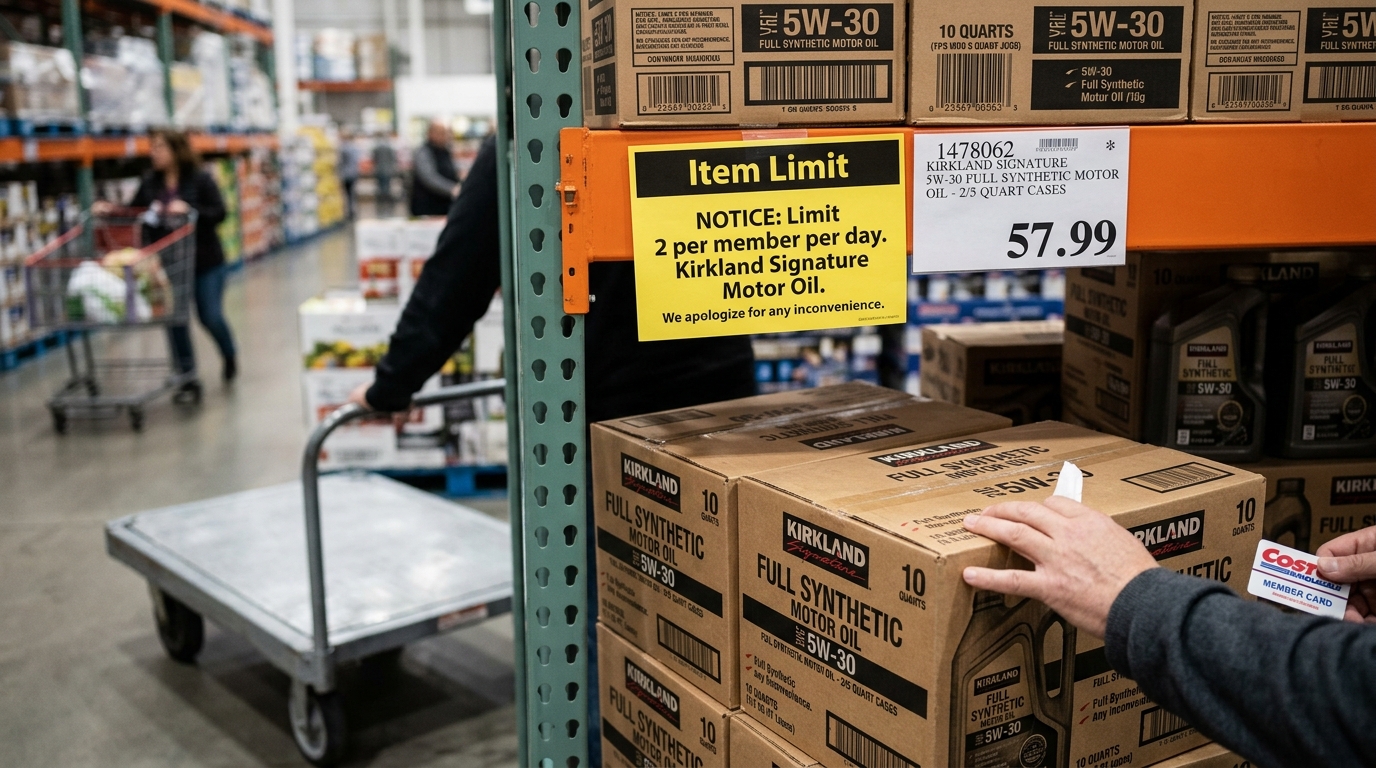
Hey there, bargain hunter. Costco just put a two-box-a-week cap on its Kirkland Signature full-synthetic motor oil, and the price tag has gone from roughly $30 to $57.99 in a matter of months. That is not a rounding error. That is a near-doubling of the cost of one of the most reliable cheap-bulk items the warehouse club has ever stocked. ScoreboardKirkland 10-quart case: $57.99 now, vs. roughly $30 last year. Purchase limit: two units per member per week. Mobil 1 at Costco: six quarts at about $44, capped at five per member. Oil change service prices: rising, but this draft’s 6.2% year-over-year figure and “15 major providers” detail could not be verified from Ducker Carlisle’s published materials. Rationing is also in effect, and Newsweek has begun asking whether Walmart is next. The Real ReasonThis is not just a Costco pricing decision. It is a Group III base oil crisis that has been building since the Strait of Hormuz effectively closed in late February 2026 after the opening days of the U.S.-Israel war with Iran. Group III is a key input for many full-synthetic motor oils, and the U.S. market is structurally dependent on imports from the Persian Gulf. A March 2026 attack damaged Shell’s Pearl GTL facility in Qatar, and an initial assessment by QatarEnergy and Shell pointed to about a year for full repair of one of its trains. South Korean refiners, a secondary source, have also been prioritizing fuels over base oils as distillate economics improved. And some refiners have been leaning into fuels when margins are better, which can tighten lubricant availability at the margin. The Independent Lubricant Manufacturers Association has described conditions as a “global base oil supply crisis” and warned the market may not fully normalize until at least mid-2027. Industry pricing for Group III has moved into historically extreme territory, with some benchmarks running around $10 per gallon. Several industry writeups citing ILMA have also put the disrupted share of U.S. Group III supply in the neighborhood of the low-to-mid 40% range. What the Business Actually Looks LikeCostco's model is built on one counterintuitive fact: the merchandise is almost a loss leader. Through the first 24 weeks of fiscal 2026, net sales of $134.22 billion left $5.07 billion in operating income after SG&A. Membership fees over that same period totaled $2.684 billion and are largely high margin, lifting the total earnings power of the model. The fee machine, not the merchandise margin, is the business. That structure is both the protection and the pressure point here. Kirkland motor oil is precisely the kind of item that makes members feel the membership is worth renewing. U.S. and Canada renewal rates came in at 92.2% in Q3 2026, up 10 basis points sequentially. If the value signal on everyday consumables erodes, renewal rates are what moves. Data Section
- Costco Q3 2026 net sales: $69.15 billion, up 11.6% year-over-year
- Membership fee revenue Q3: $1.373 billion, up 10.7%
- Gross margin: 11.04%; about +1 basis point excluding gasoline impacts
- Operating cash flow, first 36 weeks: $11.133 billion
- Valvoline (VVV) Q3 2026 adjusted EBITDA: $162 million, up 25%; management discussed Q4 EBITDA margin compression of 300-400 basis points tied to product costs
- Finished lubricant costs at Valvoline: management said they could be about 60% above March levels
- ExxonMobil and Chevron both pushed through lubricant price increases of up to 30% and up to 15%, respectively, announced in spring 2026
Is It Cheap?Costco trades at roughly low-40s forward earnings. That premium has always been justified by membership compounding and margin predictability. The lubricant shock does not break the model, but it does test the thesis at an expensive entry point. Valvoline at roughly 29x forward EBITDA is the more direct play on the shortage, though Q4 margin compression of 300-400 basis points is real, and the roughly $1.6 billion long-term debt load adds rate sensitivity. Chevron and ExxonMobil are the vertically integrated names with upstream base oil exposure. Both passed through significant price increases to distributors. Neither is a pure play, but both benefit from the spread between crude and finished lubricant widening. Bull / Base / BearBull: Costco's renewal rate holds above 92%, the shortage resolves by mid-2027 as ILMA-linked industry outlooks suggest, and the price increase on Kirkland oil becomes a permanent margin improvement rather than a temporary pass-through. Valvoline's pricing actions hold, and Q4 compression is the trough. Base: Costco absorbs modest renewal rate pressure as the value signal on commodity items weakens. Lubricant costs stay elevated through 2026 but don't worsen. Service center chains like Valvoline keep raising ticket prices; consumer pushback is limited because oil changes are non-discretionary. Bear: The shortage deepens into 2027, rationing spreads to Walmart and AutoZone, and consumer delay of oil changes accelerates engine damage claims. Renewal rates slip at Costco. Valvoline's Q4 margin compression extends into fiscal 2027, and debt service absorbs cash flow needed for store expansion. Action PlanOn COST: this is not a buy-the-dip moment in the low-40s forward P/E range. It is a hold-and-watch moment. The membership engine is intact and renewal rates confirm it, but the valuation leaves no room for a renewal rate miss. If COST pulls back 10%-15% on a broader market rotation, the entry becomes more defensible. Scale into weakness in two tranches. On VVV: more interesting as a direct shortage beneficiary. Pricing actions are covering cost increases, system-wide same-store sales guidance was raised to 7.5%-8% for the full year, and EBITDA still grew 25% in Q3 despite the headwinds. The Q4 compression warning is the overhang. A position sized for a volatile Q4 result, with room to add if the stock sells off on the report, is the disciplined approach. On XOM and CVX: treat as indirect hedges within existing energy allocations, not new positions built around this story. Cheap Investor Checklist
- Costco U.S./Canada renewal rate: watch for any report below 92%
- Kirkland motor oil SKU availability: check Costco.com weekly for limit changes or stockouts
- Group III base oil spot and benchmark pricing: watch whether it stays around $10/gallon territory
- Valvoline Q4 2026 EBITDA margin: management discussed 300-400 bps sequential compression; anything worse is a flag
- ILMA supply outlook updates: watch for updated guidance on normalization timing
- Walmart/Sam's Club rationing news: if WMT follows COST, the shortage has gone mainstream retail
- Pearl GTL repair timeline: updates on Train 2 repair progress shift supply expectations
Bottom LineIf the Strait of Hormuz situation stabilizes and Pearl GTL’s damaged train is repaired on the roughly one-year timeline described in March 2026 updates, this is a temporary input shock that Costco's membership model weathers and Valvoline passes through in pricing. If the conflict drags, the lubricant shortage becomes a prolonged consumer tax on vehicle ownership, renewal rate pressure at COST becomes quantifiable, and Valvoline's debt-financed expansion looks poorly timed. The rationing at Costco is the consumer-visible signal that the shortage has moved from wholesale to retail. That does not happen unless suppliers are telling buyers the pipeline is genuinely thin. |




Tidak ada komentar:
Posting Komentar