Goldman Sachs Q3 Earnings Showed Growth: Wall Street Wanted More
Posted On Oct 14, 2026 by Grayson Cavern
Goldman Sachs (NYSE: GS) just posted a 39% jump in earnings per share, yet its stock is trading near $892 after falling from July’s peak around $1,150. The selloff looks strange beside the headline numbers, but a closer look at the third-quarter results reveals why investors may be reluctant to chase the stock. Revenue and earnings are growing year over year, although the trading surge that powered much of that growth has cooled from last quarter.
Table of Contents
Goldman reported $18.68 billion in net revenue, up 23% year over year, and diluted EPS of $17.01, up 39%. The firm’s core franchises are producing, just as we argued in Monday’s preview. The catch is that revenue fell 8% sequentially, and earnings declined 20%. The business is stronger than it was a year ago, but the pace of improvement has become harder to sustain.
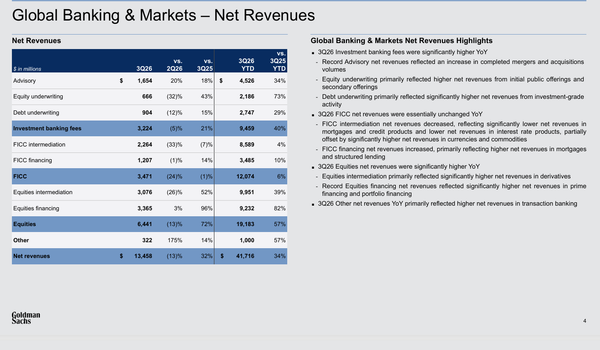
The standout number was equities revenue, which climbed 72% year over year to $6.44 billion on stronger financing and derivatives activity. Investment banking fees also delivered, rising 21% to $3.22 billion, with advisory revenue up 18% and equity underwriting up 43%. These are meaningful gains across two franchises that investors want to see firing together.
But the sequential comparison complicates the bullish read. Equities revenue fell 13% from Q2’s $7.42 billion, while Global Banking & Markets revenue declined 13% to $13.46 billion. FICC brought in $3.47 billion, down 1% year over year and 24% sequentially as intermediation weakened across mortgages, credit and interest-rate products.
That is the tension we are dealing with. Goldman has regained considerable earnings power versus last year, but a meaningful share of the latest growth came from businesses whose revenue can swing with market conditions and client activity. A 72% year-over-year increase in equities looks powerful on the scorecard; the pullback from Q2 shows why investors cannot simply extrapolate it forward.
Investment banking offers another clue, in that fees are rising, but the firm’s investment banking backlog declined from the end of Q2 and remained slightly below its year-end 2025 level. Completed transactions are generating revenue today. The backlog is the forward indicator, and it does not yet point to an accelerating pipeline.
Asset and Wealth Management Is Picking Up the Slack
While trading cooled, Asset & Wealth Management moved in the opposite direction. Revenue increased 14% year over year and 10% sequentially to $5.05 billion. Management and other fees reached $3.59 billion, while incentive fees climbed to $587 million from $112 million in Q2.
That sequential gain gives Goldman a second engine as Global Banking & Markets normalizes. Recurring management fees can provide a more durable revenue base than trading, and the firm is benefiting from a business mix that extends beyond its markets franchise.
Still, I would not annualize the incentive-fee jump. Fund distributions contributed to the increase, so that line can fluctuate from quarter to quarter. The stronger evidence is the broader growth in Asset & Wealth Management revenue and management fees, which supports the argument that Goldman is building earnings capacity outside its most volatile businesses.
This is where the continuity from Monday’s preview becomes clearer: the core-franchise strategy is producing growth, but the latest report also shows why diversification matters. Asset & Wealth Management grew sequentially while Global Banking & Markets contracted. That offset helped Goldman deliver a strong year-over-year result despite the cooling in trading.
Costs Are Rising, but Efficiency Has Improved
Goldman’s operating expenses increased 20% year over year to $11.31 billion, driven by transaction-based expenses, compensation and charitable contributions. That is a hefty increase, although revenue grew 23%, allowing the firm to absorb the higher cost base while expanding earnings.
The year-to-date efficiency ratio adds useful context. Goldman reported 59.4% for the first nine months of 2026, down from 62.1% over the same period in 2025. The firm has generated more revenue relative to its expenses over the year to date, even with the elevated spending in the latest quarter.
Goldman also reported an annualized return on common equity of 18.7%, while book value per share rose 1.4% during Q3 to $372.64. Those figures show a profitable franchise still building shareholder value. Yet the sequential decline in revenue and EPS means the next leg of the bullish case depends on Goldman sustaining those returns as trading conditions shift.
GS Needs to Reclaim Its Technical Ground
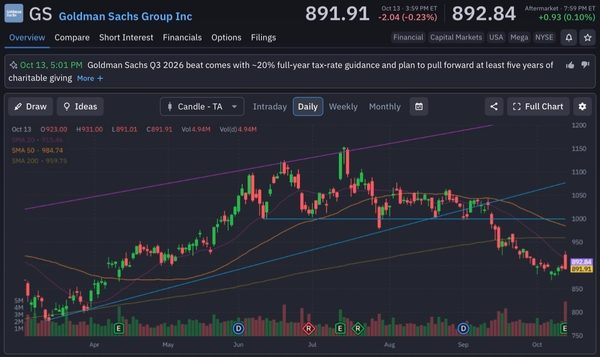
The chart has taken a beating. GS closed October 13 at $891.91, below its 20-day moving average at $915.46, its 50-day at $984.74 and its 200-day at $959.75. The stock has fallen from around $1,150 in July, and the $1,000 area that once provided support now sits overhead as resistance.
A reclaim of $915 would be the first sign that buyers are regaining control. The stock would then need to work through the $960 area and the $985–$1,000 zone to repair the broader technical damage. If sellers push GS below the recent $880–$890 area, the risk of another leg lower increases.
I remain constructive on Goldman’s underlying business. Investment banking fees are growing, equities remain substantially higher than last year, Asset & Wealth Management is expanding, and year-to-date efficiency has improved. But the sequential decline in earnings, weaker FICC revenue, and softer backlog make it harder to argue that the stock should immediately recover.
Today’s editorial pick for you
Etsy Q3 Earnings Preview: Can Its Recovery Keep Going?
Posted On Oct 13, 2026 by Ian Cooper
Etsy (NYSE: ETSY) heads into its upcoming earnings report with an encouraging story: shoppers are spending more on its marketplace, and sales growth has improved. Now investors want to know whether that progress can continue through the holiday shopping season.
Table of Contents
That makes this report about more than beating an earnings estimate. Etsy needs to show that its efforts to attract shoppers, encourage repeat purchases, and make products easier to find are building a stronger business.
There are reasons for optimism. But with the recovery still developing, Wall Street will have plenty to examine beneath the headline numbers.
Analysts estimate about 81 cents per share on revenue of $680.5 million. Management has already provided some useful targets. Management previously forecast third-quarter gross merchandise sales of $2.53 billion to $2.58 billion, representing growth of approximately 4% to 6% from a year earlier. It also projected an adjusted EBITDA margin of 28% to 30%, a profitability measure that excludes interest, taxes, depreciation, amortization, and certain other expenses.
Revenue reached $668.3 million, up 6.2% on a continuing-operations basis. Looking specifically at the Etsy marketplace and excluding Reverb from the previous year’s comparison, revenue increased 9.3%. Etsy marketplace gross merchandise sales rose 7.5% to approximately $2.58 billion. Gross merchandise sales, or GMS, measures the value of merchandise sold through the platform. That differs from Etsy’s revenue, which comes from fees and services associated with running the marketplace.
Source: Etsy
The third-quarter report should help establish whether the company’s recent improvement is becoming a dependable trend. Results near the upper end of management’s sales outlook would strengthen that argument.
Are More Shoppers Coming Back?
The buyer numbers may offer the clearest test. The company reported about 87 million active buyers at the end of the second quarter, down 0.4% from a year earlier. Meanwhile, spending per active buyer over the preceding 12 months increased 2.8% to $124.
That is encouraging, but it leaves room for improvement. Higher spending helps, while a growing customer base would give the recovery broader support.
Investors should also look at what is driving those larger purchases. Management said higher average order values were the biggest contributor to second-quarter merchandise-sales growth, with higher listing prices the main factor. Purchase frequency remained slightly below year-earlier levels, although the decline was easing.
For the next report, stronger repeat purchasing would be particularly welcome. A shopper who returns regularly creates more opportunities for sellers and gives Etsy additional chances to generate fees.
Profits and Buybacks Also Matter
Etsy is also reshaping the business around its main marketplace. The company completed its Depop sale to eBay in July and announced a new $2 billion share-repurchase authorization in August. It also outlined a workforce reduction of roughly 12% as part of its reorganization. Investors will want to understand how those changes affect expenses, investment priorities, and future earnings.
Buybacks can help earnings per share by reducing the number of shares outstanding. However, that makes it useful to examine total profit alongside per-share results. A stronger earnings figure carries more weight when the underlying business is improving too.
The same applies to margins. Better profitability is encouraging, particularly if Etsy can achieve it while continuing to attract customers and support sellers.
The Holiday Outlook Could Decide the Reaction
The biggest question may be what happens next. Investors will be listening for management’s assessment of holiday demand, promotional spending, and shoppers’ willingness to purchase discretionary items.
A solid third quarter could lose some shine if the company sounds cautious about the months ahead. Conversely, improving buyer trends and a confident outlook could make the recovery more convincing.
For Etsy, the opportunity is straightforward: keep shoppers engaged, give them reasons to return, and turn those visits into profitable growth. This earnings report should show how much closer the company is getting.
Anthropic's IPO filing ended a two-day slide: Nasdaq +0.8% to 26,169.38, S&P 500 +0.7% to 7,676.77. The filing showed $8.95B spent on compute and infrastructure in the first six months of 2026, more than all of 2025 ($7.33B). Size and price range are not set.
Chipmakers got the bid: SOXX +2.85%, NXPI +4.64%, MU +2.98%, AMD +2.80%, NVDA +2.39%. Big spenders lagged: META −1.88% (it and SpaceX are seeking about $135B in AI financing), GOOGL −1.06%.
SPY closed 765.37 (+0.71%), QQQ 712.20 (+1.11%), DIA 522.97 (+0.31%) and IWM 276.99 (+0.45%). Tech led and communication services lagged. MSFT rose 1.54% ahead of Wednesday's report, and TSLA added 5.21%. Deals did the rest: SGRY +47.6% to $23.25, just under the $23.50 cash offer, and RRC +17.7% on EQT's all-stock deal (EQT −1.4%). The 10-year sat at 4.99% and WTI slipped 1.6% to $101.61.
Did the 3 PM read hold? So far, yes. The call was money to AI suppliers, not spenders. SOXX kept most of its gain, closing +2.85% versus +3.75% at the 1:25 PM read, and Meta finished −1.88%.
AFTER THE BELL
CDNS up 2% after a Q3 beat, FY26 EPS view raised to $8.37-$8.43 (consensus about $8.14).
RMBS down 6% at $85.25 despite an EPS beat.
AMKR slipped: Q3 EPS 76c missed 78c, Q4 guide 65c-75c came in under 78c.
TOMORROW'S SETUP
Tuesday, Oct. 27.
Before the open. KO, UPS, BA, PYPL and SOFI report.
8:30 AM ET. September durable goods orders.
10:00 AM ET. October consumer confidence (forecast 80.5, prior 81.9).
1:00 PM ET. $70B 5-year auction.
After the close. V, STX, NXPI, HOOD and EQT report.
NXPI (NXP Semiconductors) closed $245.83 (+4.64%). Reports Tuesday after the close, call 4:30 PM ET. Consensus EPS $3.78 vs $2.75 a year ago. The tell: first chip report after the rally and Amkor's miss. Wrong if NXPI guides Q4 below consensus and trades under $245.83 Wednesday morning.
SHH. THIS IS A CLUB.
You get the recap because you open and click. Go quiet and your chair goes to someone who reads. See you tomorrow morning.
Signal over noise. Evening recap of Monday's official close. Next session is Tuesday, Oct. 27.
Market Signal Report
Powered by StocksToTrade
This message was sent as part of your Market Signal Report subscription. Market Signal Report is powered by StocksToTrade, and you are receiving it because you registered through StocksToTrade. If you did not request this email or believe it was sent in error, please reply directly so our team can review.
Subscription Status & Delivery
Your subscription is confirmed and your delivery preferences are up to date. You are currently receiving content based on the schedule and frequency associated with your registration. If you need to adjust your delivery window, change your email frequency, or pause updates temporarily, reply to this message and our team will process your request within one business day. As a subscriber, your current access includes daily market briefings, top percentage mover watchlists, trade idea alerts, and periodic market research reports. These are delivered according to the preferences set at enrollment, and a confirmation of your original registration is available upon request.
A Commitment to Non-Intrusive Email
We don't crowd your inbox to hit a number. Every send is meant to be worth the minute it takes to read, and we keep the writing clear and the frequency reasonable. If we miss that mark, tell us — reply to any issue with what landed wrong. We read the feedback and it shapes what we publish, even when we can't act on every suggestion.
Payments & Fraud Protection
We will never ask you to provide payment card numbers, bank account details, or login credentials via email. Any message requesting this information should be considered fraudulent and reported to our team immediately. If you have a question about any purchase made through us, reply to this email within 30 days of the transaction date and a member of our team will provide your records.
How We Make Money
Market Signal Report is free to read. We keep it that way by including paid advertisements and affiliate links in some emails. If you click a link or make a purchase, we may receive compensation from the advertiser at no cost to you. Sponsored placements never change our editorial views, and we only run offers we believe are relevant to traders and investors.
Managing Your Preferences
You can unsubscribe at any time using the link at the bottom of this email, and it takes effect on the first click. If you would rather adjust what you receive instead of leaving entirely, reply to this message with the word PREFERENCES and our team will help you tailor your delivery.
Privacy & Data Handling
We do not sell your personal information. Your email address is used to deliver the content you signed up for and to maintain your subscription records. For full details on how your data is collected, stored, and used, see the Privacy Policy.
Information We Collect
We collect the information you give us at signup or later by reply — typically your email address, and sometimes your name or phone number. We also receive technical information when you open an email or visit one of our pages, including IP address, browser and device type, and operating system. Our emails contain tracking pixels and tagged links that tell us whether a message was opened and which links were clicked, which is how we measure what content is worth sending.
Third-Party Service Providers
We use outside vendors to send email, host pages, and measure performance. These providers process data on our behalf, under contract, and only for the purposes described here. They are not permitted to use your information for their own purposes.
Your Data Rights
You can ask us what personal information we hold about you, correct it, or request that we delete it. Email support@stockstotrade.com with your request and the address you subscribed with. Depending on where you live you may have additional statutory rights; California residents can review the CCPA Notice for details.
Children's Privacy
This publication is intended for adults. We do not knowingly collect personal information from anyone under 13. If we learn that we have, we delete it promptly. If you believe a child has subscribed, contact us and we will remove the record.
Reporting Suspicious Emails
If you receive a message claiming to be from Market Signal Report or StocksToTrade that looks suspicious, do not click any links in it. Forward it to our support team so we can investigate and protect other readers.
Contacting Support
Questions about your subscription or anything you read here? Reply to this email or write to support@stockstotrade.com. Mail can be sent to StocksToTrade, 13809 Research Boulevard, Austin, Texas 78750, United States. We read every reply.
Market Signal Report is for informational and educational purposes only and is not investment advice, a recommendation, or an offer to buy or sell any security. Trading involves substantial risk of loss and is not suitable for everyone. Past performance does not guarantee future results. If you spot an error in anything we publish, reply and tell us — we correct mistakes promptly.
This email may contain paid advertisements and affiliate links. StocksToTrade may receive compensation if you click a link or make a purchase.
Micron Technology, Inc. (NASDAQ: MU) recently saw its share price decline amid concerns about advances in Chinese memory technology. Despite the recent pressure, Micron Technology retains a year-to-date gain of more than 220%. The divergence between the company's underlying financial performance and the market's immediate reaction creates a compelling setup for investors evaluating the longevity of the memory cycle.
A mix of international headlines triggered the sell-off, prompting concerns about future pricing power and potential capacity gluts. Assessing whether these threats carry long-term weight or are merely a sentiment-driven blip requires looking past the noise and examining the underlying supply-and-demand dynamics of the semiconductor market.
Market Contagion: Separating Headline Noise From Data
There's a pile of cash sitting in your checking account, earning next to nothing while you weigh your options.
This Thursday, October 29th at noon ET, CERTIFIED FINANCIAL PLANNER professional Amanda Neely hosts a free one-hour workshop on sorting that cash into three buckets: what to keep, invest, and hold in reserve.
Markets do not like uncertainty. Memory chip stocks are notoriously sensitive to even a hint of future oversupply. The catalyst for the recent contraction stems largely from China-based ChangXin Memory Technologies (CXMT). The company announced developmental progress on a denser 4F square DRAM architecture, explicitly targeting the high-end server memory segment. Combined with a localized union strike authorization at Micron's Taoyuan manufacturing operations in Taiwan, the headlines created a difficult environment for institutional investors.
Contrasting these fears with actual earnings performance reveals a possible disconnect. Micron Technology reported fiscal fourth-quarter revenue of $54.23 billion, up about 379% year over year. Adjusted earnings topped $33 per share. The immediate financial results showcase a business operating at exceptionally strong levels of profitability. The market reaction appears to reflect anxieties about events that may not materialize for years. The trailing price-to-earnings ratio sits around 12.60, while the discounted forward multiple approaches 5.37, indicating skepticism about the durability of peak-cycle earnings.
Understanding the details of the ChangXin Memory Technologies announcement helps separate genuine competitive risks from geopolitical noise. The company claims to have made progress in developing a 4F square DRAM design, which theoretically increases storage density. Its goal is to launch a server memory product based on this architecture by the end of 2026.
The timeline is the critical variable. The 4F square architecture has not yet demonstrated commercial-scale production, despite CXMT's plans to introduce a product before year-end. The memory market features high barriers to entry, including yield rates, packaging reliability and enterprise-grade validation. A state-backed competitor could eventually pressure long-term pricing floors across the DRAM market. However, a production target set for late 2026 does not necessarily alter the immediate supply-and-demand imbalance in the high-end server memory space. Projecting theoretical capacity additions onto current valuations can contribute to mispricing, particularly in a sector driven by immediate artificial intelligence (AI) hardware requirements.
Collateral Damage: Contagion in the Memory Oligopoly
The market reaction suggests that the recent news contributed to broad industry selling rather than a reassessment of Micron alone. SK hynix Inc. (NASDAQ: SKHY) fell more than 4% during the same trading window. Equipment manufacturers also caught the downdraft, with several semiconductor equipment stocks declining.
When the entire supply chain sells off simultaneously, investors may be pricing in a sector-wide threat of future oversupply and potential margin compression. Memory markets are inherently cyclical, and Wall Street remains highly attentive to any signal that the current upcycle might be peaking. Adding to the sector-wide pressure, supply chain reports suggest equipment providers could raise prices by roughly 10% for competitors such as Samsung (OTCMKTS: SSNLF) and SK hynix. While not directly aimed at all memory makers, this signals broader capital expenditure inflation that could squeeze margins across the manufacturing space.
Friction Points: Insider Sales and Labor Disputes
Beyond potential future supply threats, a few immediate friction points warrant attention. A local union at Micron's Taoyuan manufacturing hub in Taiwan officially authorized a strike over bonus structures. No strike date has been announced. While labor disputes are common in heavy manufacturing, Taiwan serves as a critical production center. Any prolonged work stoppage could create a localized risk to production output and customer delivery commitments.
Micron Technology also recently agreed to a $600 million settlement regarding a Netlist patent dispute. Under the agreement, Micron will pay $30 million per quarter over five years beginning in the fourth quarter of 2026, rather than making a single $600 million payment. This introduces a cash headwind that affects future free cash flow models. Coupled with recent insider sales totaling roughly $90 million over the trailing 90 days, including shares sold by Chief Executive Officer Sanjay Mehrotra, it is understandable why some institutional investors may have opted to secure profits after a historic run-up. While insider selling does not inherently signal fundamental weakness, it can exacerbate downward momentum during periods of elevated volatility.
Demand Visibility and Strategic Buybacks
Balancing the speculative risks against the fundamental data paints a different picture. Micron Technology has already secured customer commitments covering more than 75% of its fiscal 2027 output, with customers actively discussing 2028 allocations. A potential Chinese product arriving in late 2026 will enter a market where most capacity is already spoken for by major enterprise clients.
The profitability metrics are equally compelling. Micron's fiscal 2026 net margin reached approximately 63.8%, reflecting its exceptionally strong earnings performance. Because Wall Street is pricing in a cyclical peak, the stock trades at a compressed forward multiple of nearly 5.4. This presents an interesting valuation disconnect. Management appears to recognize the disparity and recently authorized an approximately $35 billion share repurchase program. A buyback of this scale signals internal confidence in sustained free cash flow generation and could act as a structural floor for Micron's stock price.
Investors monitoring the memory space might consider watching upcoming earnings reports for signs of memory contract pricing stability and gross margin trends. If pricing leverage holds firm against the geopolitical noise, the current pullback could represent a structural mispricing rather than the beginning of a prolonged cyclical downturn.