Below is an important message from one of our highly valued sponsors. Please read it carefully as they have some special information to share with you.
Dear reader,
If you’re feeling betrayed by the Republican Party…
Because this could have a major impact on your wealth in the coming months and years.
Regards,
Aaron Gentzler
VP or Research, Paradigm Press
Today’s editorial pick for you
Boeing Still Losing Money, But Recovery Continues
Posted On Jul 28, 2026 by Ian Cooper
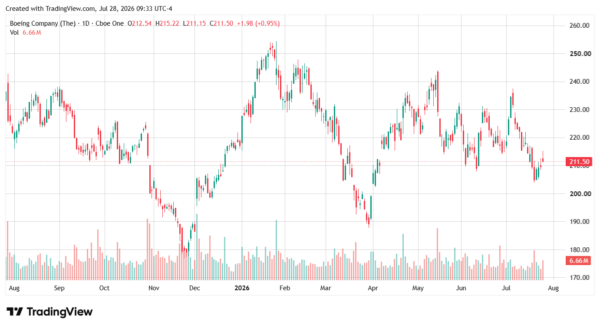
Boeing’s (NYSE: BA)latest earnings report shows the company is making progress even though it is still losing money. For the second quarter of 2026, Boeing reported a loss of $428 million, or 67 cents per share.
Table of Contents
The company lost more money than many analysts expected. However, there was also good news. BA’s revenue increased to $24.6 billion, up about 8% from the same time last year. The increase came mainly from delivering more airplanes to customers.
Gold has dipped more than 15% this year. And right now, as you read this sentence, that dip could already be the bottom. Meanwhile, the institutions that print the world's money are dumping their own paper to grab gold at a record pace.
What do they know that the average American doesn't?
One of the biggest reasons Boeing lost money was a $280 million charge connected to its Air Force One project. The company is building two new aircraft for the U.S., but the program has faced years of delays and rising costs. The company said the extra money will help complete the work and meet certification requirements. They still expect to deliver the first new Air Force One aircraft in 2028.
Even with that setback, Boeing’s commercial airplane business continued to improve. During the quarter, the company delivered 171 airplanes, compared with 150 during the same period last year. Delivering more aircraft means Boeing can collect payments from airline customers, which helps improve its financial results.
The company’s commercial airplane division also lost less money than it did a year ago. That shows BA is becoming more efficient as production increases.
Cash Flow and Debt Show Positive Progress
Another positive sign was Boeing’s cash flow. The company generated $631 million in free cash flow during the quarter. Last year, BA was spending more cash than it was bringing in. This year, it generated extra cash, which is an important step toward a stronger financial future.
The company also made progress reducing its debt. At the end of the quarter, the company had about $20 billion in cash and investments while lowering its total debt by more than $1 billion.
Helping, CEO Kelly Ortberg said the company remains focused on improving safety, product quality, and production. He admitted some projects are still difficult, but he believes the company is moving in the right direction.
Production Continues to Increase
The company is also increasing production of its popular 737 Max aircraft. Boeing recently opened another assembly line to help build more planes and is working toward producing 47 aircraft each month. Higher production should allow the company to deliver more airplanes and earn more revenue.
Boeing also shared updates on two other aircraft programs. The company said flight testing has been completed for the 737-7 and 737-10, and it expects both models to receive government certification sometime in 2026. Deliveries to airlines are expected to begin in 2027. Another aircraft, the 777X, is also moving closer to entering service. Boeing expects to begin delivering that long-range jet to customers in 2027.
Investors Focus on the Recovery
Although BA missed Wall Street’s earnings expectations, many investors focused on the company’s overall progress instead of the quarterly loss. The company is delivering more airplanes, bringing in more cash, and slowly improving its finances.
Boeing has faced many challenges over the past several years, including the 737 Max crisis, the pandemic, supply chain problems, labor issues, and expensive government contracts. Those problems have not completely disappeared, but the company appears to be making progress.
The defense business remains a challenge because projects like Air Force One continue to cost more than expected. However, Boeing’s commercial airplane business is becoming stronger, which is helping balance those losses.
Looking Ahead
Overall, Boeing’s latest earnings report shows a company that is still in recovery. It is not back to full strength yet, but it is moving in the right direction. By building and delivering more airplanes, improving cash flow, and reducing debt, BA is taking important steps toward becoming profitable again.
Today’s editorial pick for you
Walmart Stock Looks Expensive, But Catalysts Justify a Buy
Posted On Jul 28, 2026 by Chris Markoch
Walmart (NASDAQ: WMT) stock trades at a premium most retailers can only dream of. Shares command roughly 39 times trailing earnings and about 38 times forward estimates, well above the retailer’s historical range and far pricier than most consumer staples peers. That valuation alone gives investors pause, especially after Walmart’s stock retreated from its 52-week high near $137 to trade around $112 today.
Table of Contents
But a rich multiple isn’t automatically a reason to sell. Walmart is building real competitive advantages that could justify paying up. Walmart+ membership income jumped 45.6% in the U.S. segment last quarter, a sign the loyalty program is gaining serious traction against Amazon Prime. The company’s “dark store” fulfillment network is delivering to nearly 36% of store-fulfilled orders in under three hours, with some markets seeing delivery windows compressed to under 30 minutes.
Q1 FY27 results showed the underlying business remains healthy. Total revenue climbed 7.3% to $177.8 billion. Adjusted EPS rose 8.2% to 66 cents. Global eCommerce sales grew 26%, now representing 23% of total net sales.
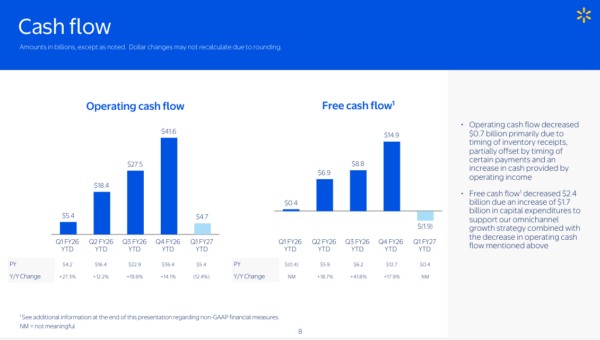
Yet one number stands out as a genuine concern: free cash flow turned negative $1.9 billion for the quarter, a $2.4 billion swing from the prior year. That gets at the heart of evaluating WMT stock right now. That is, are expanding growth engines enough to offset deteriorating near-term cash generation?
Walmart+ And Dark Stores Are Reshaping The Growth Story
Walmart’s investment thesis increasingly hinges on services, not just merchandise. Walmart+ delivered record first-quarter net adds, and membership fee revenue climbed at a double-digit pace. That recurring, high-margin income stream mirrors what makes Amazon Prime so valuable to its parent company.
The dark store strategy compounds that advantage. By converting portions of existing stores into micro-fulfillment hubs, Walmart is using its 4,600-plus U.S. footprint as a logistics network Amazon (NASDAQ: AMZN) can’t easily replicate. Store-fulfilled delivery grew approximately 45% last quarter. Expedited deliveries under three hours made up roughly 36% of those orders.
This matters because speed drives frequency. Faster delivery windows encourage customers to treat Walmart as a daily-use app rather than an occasional destination. Advertising revenue is also benefiting, with Walmart Connect up 44% as more digital engagement creates monetizable ad inventory. Together, these pieces support a bull case for durable margin expansion, even if the stock already prices in some of that optimism.
Strong Comp Sales Show Momentum Across Every Segment
Walmart’s core retail engine hasn’t skipped a beat. U.S. comp sales rose 4.1%, driven by accelerated transactions and broad-based share gains across income tiers. Sam’s Club posted even stronger comp growth of 5.9%, fueled by 6.2% transaction growth.
International net sales climbed 10.1% in constant currency, with China posting 22.3% growth and Flipkart contributing to operating income gains. General merchandise saw its strongest share gains in five years.
That breadth matters. It’s not one segment carrying the company. Grocery, general merchandise, international, and membership income are all contributing, which reduces the risk that a single soft category could derail guidance. Management’s Q2 FY27 outlook calls for adjusted EPS of 72 cents to 74 cents, implying continued double-digit growth versus last year’s comparable quarter.
Technical Picture Reflects The Valuation Debate
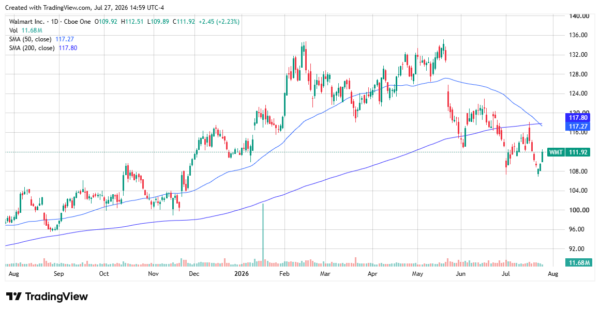
WMT’s chart tells the same story as its fundamentals: a name searching for direction. Shares surged from around $104 in November to a peak near $137 by April, then reversed sharply, falling below both the 50-day ($117.27) and 200-day ($117.80) moving averages.
The stock now sits around $112, roughly 5% below its 200-day average. That’s a bearish signal technically, though today’s 2.2% bounce suggests buyers are stepping in near current levels. A close back above the 50-day average would signal the correction may be ending. Until then, the technical setup favors caution.
Priced For Perfection, But Perfection May Be Coming
Walmart isn’t cheap by any conventional measure. At 38 times forward earnings, the stock demands flawless execution. The negative free cash flow quarter adds a legitimate reason for skepticism, driven largely by a $1.7 billion jump in capital expenditures supporting the omnichannel buildout.
But that capex is buying something valuable: a delivery network and membership ecosystem that could widen Walmart’s moat for years. Investors willing to look past one messy cash flow quarter may find a company still executing well ahead of a valuation that already assumes it will.
For those comfortable paying up for quality, Walmart’s catalysts heading into earnings make a compelling case that expensive doesn’t have to mean overvalued.




Tidak ada komentar:
Posting Komentar