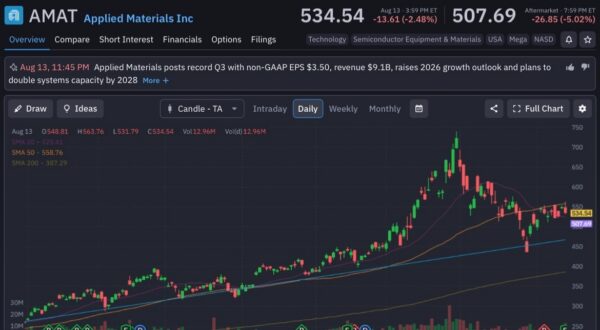
And yet, AMAT got slammed. Shares closed at $534.54, down 2.48%, before falling another 5.02% to $507.69 after hours despite the record quarter. The message is simple: investors are demanding enough growth to justify what is already priced into the stock.
But the bigger development isn’t that AMAT sold more equipment or that the stock sold off, by now, everyone knows it’s priced in. The elephant in the room is the Semiconductor Systems revenue climbing to $7.04 billion, while its non-GAAP operating margin expanded to 38.0% from 33.2% a year ago, showing that the spending tied to the complex chip manufacturing is becoming a larger and more profitable part of the business.
That takes us a step beyond the thesis from last quarter. We already knew AI was forcing chipmakers into more complicated manufacturing, advanced packaging and memory architectures. Now we’re seeing the financial payoff from that pressure land directly in AMAT’s numbers.
And management isn’t expecting the cycle to fade after Q3. It raised its outlook for 2026 growth and said customer demand visibility has improved enough to expect another strong growth year in 2027, particularly across DRAM, leading-edge foundry/logic and advanced packaging.
The manufacturing arms race we talked about last quarter is starting to look like a much bigger business for Applied Materials.
A pioneer who spent $17 million building AI-powered market tools — part of a platform used by 180,000 people worldwide — is stepping forward with an urgent warning.
He says the biggest AI stocks are about to become the market's biggest losers, and he's identified where the real money will flow next.
DRAM And Advanced Packaging Are Turning Into AMAT’s Growth Engine
The part I really like about this quarter is that the growth isn’t coming from some vague increase in “AI demand.” The areas of semiconductor manufacturing that AI is making more difficult are becoming a bigger part of AMAT’s actual business.
That lines up almost perfectly with the manufacturing problems we laid out last quarter. AI systems need more memory, faster movement of data and increasingly sophisticated ways of packaging chips together, which means chipmakers need more equipment to build them.
Applied is already positioning itself deeper inside that spending cycle, launching new systems for HBM, advanced packaging and 3D stacking, while Semiconductor Systems revenue reached $7.04 billion in Q3.
This is why I don’t see AMAT’s record quarter as just another strong semiconductor cycle. The mix is shifting toward some of the most equipment-intensive parts of the AI manufacturing buildout.
AMAT Is Making More Money From The Same AI Buildout
The stronger part of this cycle is showing up in the margins, because Applied Materials isn’t having to sacrifice profitability just to keep pace with the surge in equipment demand. Non-GAAP gross margin reached 50.4% in Q3, up from 48.9% a year ago, while non-GAAP operating margin expanded to 34.0% from 30.7%.
Semiconductor Systems is doing even more of the heavy lifting, with its non-GAAP operating margin reaching 38.0% versus 33.2% a year ago. Applied also generated a record $3.04 billion in operating cash flow and $2.33 billion of free cash flow during the quarter.
That combination makes the after-hours selloff harder to explain away as a deterioration in the business. The company is growing quickly, expanding margins and producing substantial cash at the same time.
There is still a valuation problem for the stock, though, and the market’s reaction may be telling us that record results are no longer enough on their own. Applied Materials now has to keep delivering growth at a level that can justify increasingly high expectations, particularly with management already pointing to another strong year in 2027.
Earnings Pop Became An After-Hours Selloff
AMAT’s chart is giving investors a pretty clear message – the fundamentals just got stronger, but the stock still has something to prove. Shares closed the regular session at $534.54, down 2.48%, before falling another 5.02% to $507.69 after hours despite the record quarter.
That reaction puts the $500 area on my radar, because a move back toward that level would erase a meaningful chunk of the recent advance and leave the stock fighting to regain its footing. The $550 area is the more immediate hurdle on any recovery, with the supplied chart showing the 20-day and 50-day moving averages around $549 and $559, respectively.
I wouldn’t read the after-hours move as evidence that the AMAT thesis has broken. If anything, the disconnect between the company’s numbers and the stock reaction is what makes the setup worth watching. Applied just delivered record revenue, record EPS, expanding margins and stronger visibility into 2027; the market simply wanted more.
AMAT Still Has The Manufacturing Cycle Behind It
I wouldn’t chase the stock after this reaction, but I also wouldn’t mistake a disappointing market response for a deterioration in the business. If Applied Materials can hold the $500 area and reclaim the $550–$560 zone, the chart can begin catching up with what the fundamentals are already telling us.
The AI manufacturing arms race is still accelerating, and Applied Materials remains one of the companies selling the tools needed to keep it running.
Today’s editorial pick for you
Alphabet Stock Options May be Gunning for a Near-Term Pop
Posted On Aug 14, 2026 by Joshua Enomoto
Alphabet (NASDAQ: GOOG)isn’t exactly carrying a whole lot of weight for the broader technology space. On a year-to-date basis, the ticker has gained a little over 9%, which is quite modest for its standards. Moreover, GOOG stock is down 2.37% in the trailing month ending Aug. 12. There doesn’t seem to be much excitement for the name, which from a contrarian’s perspective makes the idea intriguing.
Table of Contents
No, I don’t think it’s a wise idea just to randomly acquire securities merely because they’re on a downtrend. Of course, Warren Buffett has taught us that we should look to be greedy when others are fearful but there’s the thing: we have to be strategic in our contrarianism. Here, I believe GOOG stock presents a fundamentally sound argument.
Look, Alphabet isn’t exactly trouble-free. Plus, in the age of artificial intelligence, other players have arguably made bigger strides. Combine corporate concerns with the overall economy and you have reason to be cautious with Alphabet stock. Nevertheless, the underlying company is the undisputed stalwart in search and commands a litany of attractive and viable brands.
So, whenever GOOG stock encounters a period of prolonged weakness, my estimation is that this negative circumstance won’t last long. Google is probably a permanently relevant brand and I’m going to (reasonably) assume that institutional players will bid up any discounted opportunities.
Specifically, I anticipate a conspicuous swing in Alphabet stock over the next three weeks. If so, the 350/355 bull call spread expiring Sep. 4 may be a tempting idea. To be sure, it’s risky because of the near-term expiration date. However, at a net debit of $210 — with the opportunity to make a maximum profit of $290 should GOOG rise through the $355 strike at expiration — the overall cost isn’t too onerous.
That said, there are huge probabilistic risks with the above call spread that should be acknowledged.
Silver hit an all-time high earlier this year, then corrected. If that spooked you, consider this:
In the 1970s bull market, silver had multiple 30-40% pullbacks on its way to a total gain of 3,700% within the decade. Every one of them felt like the end. Investors who panicked missed the rest of the move.
The fundamentals haven't changed: vaults are draining, the paper market is cracking, the supply crisis is structural.
One former CIA analyst says this pullback isn't a warning - it's a gift.
Black-Scholes Doesn’t Have Great Things to Say About GOOG Stock
At time of writing, Alphabet stock trades at $342.37. Given the full profitability target of $355, you’re looking at about a 3.7% move higher over the next three weeks. It’s quite aggressive as the implied volatility (IV) for the Sep. 4 options chain is only 28.28%. Historically, the IV would usually land at this time around 43%.
Right now, the options market is signaling unusually low forward mobility for GOOG stock. When applying the Black-Scholes formula, the anticipated probability of the ticker reaching $355 at expiration is only 29.67%. That’s super low and much of it stems from the historically low IV.
Making matters worse, the probability of the 350/355 call spread breaking even at expiration is only 34.7%. No matter how you cut it, this trade — under the presupposed framework of Black-Scholes — is doomed to suffer a negative expected value (EV) over the theoretical long run.
Still, we shouldn’t just give up on the trade idea before we’ve fully assessed the risk. Because the equities market has not been proven to be determinative, no one can tell you what Alphabet stock is precisely worth in the future. By logical deduction, when experts do assign probabilistic estimates, those numbers are based on presuppositions.
What is a presupposition? If you ever get cornered by a street evangelist who tells you that there’s only one way to ultimate truth, that’s a presupposition. By necessity, no one knows what will happen in the great beyond. So, as convincing as religious experts may be, they’re reasoning under uncertainty.
And that’s what Black-Scholes — just another reasoning mechanism under uncertainty. In this case, the framework offers an implied probability of GOOG stock reaching the $355 target at expiration through a presupposed random walk.
In other words, under random conditions and given the initial volatility expectations, we’d expect Alphabet stock to hit $355 on Sep. 4 around 30 times out of 100. It will break even around 35 times out of 100, which are obviously not great odds.
The thing is, you don’t have to accept these numbers as gospel truth.
Order Flow Imbalance Potentially Signals Upside for Alphabet Stock
Primarily, the reason why you shouldn’t take Black-Scholes-derived probabilistic estimates at face value is the random walk itself. As other experts have demonstrated, the market is reflexive. It doesn’t operate in a vacuum but responds to various catalysts and influencing agents.
Subsequently, I believe that order flow imbalances represent a major influencing factor. For example, if GOOG stock suffers a prolonged downward trend, that is likely to trigger buy-the-dip sentiments from institutional players. And that’s why I anticipate a near-term pop in the coming weeks.
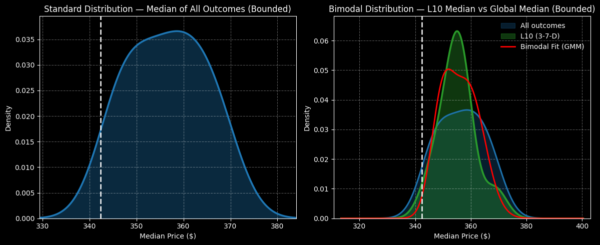
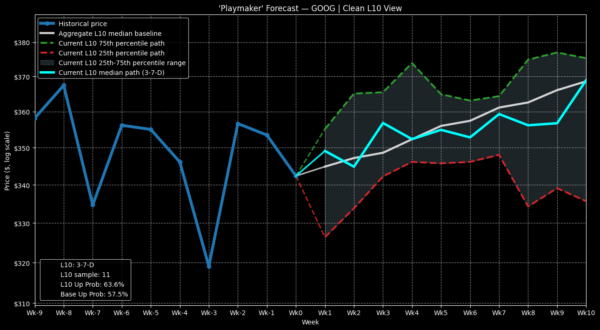
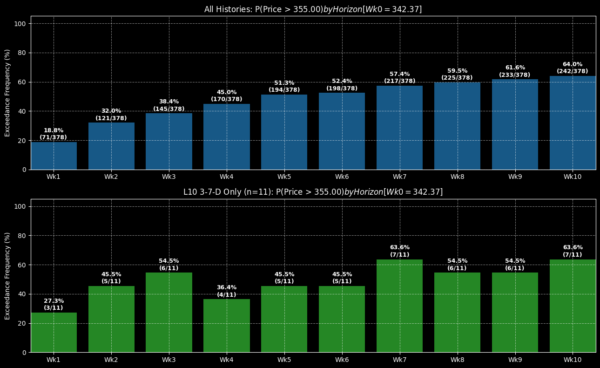
Specifically, in the last 10 weeks, Alphabet stock has only managed to print three up weeks, leading to a downward slope. Under this 3-7-D quantitative sequence, the ticker tends to rise above the random baseline for the next three to four weeks, followed by a period of underperformance relative to the baseline. That’s why I’m interested in near-expiry call options.
Under 3-7-D conditions, which has only flashed 11 times on a rolling basis since January 2019, Alphabet stock has hit the equivalent of the $355 strike price a total of six times at the end of week 3 (Sep. 4). Of course, the extremely small sample size forces us to view these observed stats with a massive grain of salt. Nevertheless, on the surface, the success ratio is 54.5%.
What’s interesting is that, largely as a consequence of the small sample size, the probability of hitting breakeven under my model is also 54.5%. Basically, when the aforementioned signal flashes in the charts, we tend to see an exuberant move higher.
Now, I’m going to keep a relatively conservative view on GOOG stock, ignoring the really high payout trades because of the low IV. For me, the $355 strike represents a balanced perspective.
Expected Value Calculations Are the Cherries on Top
If you assumed that Black-Scholes is telling the ultimate truth, the EV calculations would be wildly bad. For the 350/355 bull spread, you would be expected to win $86.04 (29.67% x $290) and lose $147.69 (70.33% x $210). That’s an outrageous net loss of $61.65, assuming you bet on this exact trade multiple times over the long run.
However, the calculus shifts dramatically under my nonrandom inductive model. Under this framework, you would be expected to win $158.05 and lose $95.55. That comes out to an expected net gain of $62.50, which is basically the inverse of the Black-Scholes model.
Because our approaches are producing completely different expectations, you’ll want to sit down and research GOOG stock. Still, if you do give credence to inductive reasoning, there may be a compelling opportunity here.




Tidak ada komentar:
Posting Komentar