Editor's Note: Larry Benedict — the hedge fund legend who beat the S&P 500 by 18 times in 2025 and made his clients $95 million during the 2008 crisis — says Trump's installation of a new Federal Reserve chair is triggering the most significant shift in U.S. markets in nearly 20 years. He has already identified the one ticker he believes will be at the center of the money flows — and he's revealing it completely free.Click here to see the details or read more below…
The cuts are part of what management called broader “organizational changes.” Netflix didn’t explain what those changes are. Product, technology, legal, and human resources teams will take the biggest hit. It’s the company’s largest workforce reduction since 2022.
Co-CEO Greg Peters said the company wasn’t growing fast enough. That’s a curious statement on its face. Netflix has delivered solid sequential and year-over-year (YOY) revenue and earnings per share (EPS) growth. It also forecasts 2026 revenue of $51 billion to $51.4 billion, an increase of 13% to 14%. Management is targeting an operating margin of 31.5%.
Investors seem unmoved for now. NFLX stock slipped about 0.1% in after-hours trading. That’s neither a vote of confidence nor a rebuke. The real verdict may come next Tuesday.
Why Netflix Is Cutting Jobs While Revenue Keeps Growing
Reducing headcount is a tried-and-true way to goose the bottom line. Fewer salaries mean lower operating expenses. Those savings flow straight to margins. With roughly 16,000 full-time employees at the end of 2025, a 6% cut is meaningful but hardly existential.
The internal memo struck a confident tone. Management said the business is strong and growing. It also said Netflix remains on track to hit its full-year forecast. The stated goal is more discipline about where people and resources go.
That’s what makes the move feel a little odd. If the business is on track, why the urgency? And why say growth isn’t fast enough? One reading is that Netflix is reallocating, not retreating. Money saved in back-office functions can fund live sports, games, and advertising. Another reading is less flattering. Management may see slower growth ahead than its guidance implies.
What to Watch in Netflix’s Q3 Earnings Report on Oct. 20
Netflix guided for Q3 revenue of roughly $12.9 billion with an operating margin of about 33.2%. Consensus EPS sits near $0.82 to $0.84. For context, Q2 revenue was $12.56 billion, up 13.4% YOY. Diluted EPS came in at $0.80 with a 33.4% operating margin.
Investors will want answers on three fronts. First, whether a restructuring charge is coming and how large it will be. Second, what the “organizational changes” actually involve. Third, whether full-year revenue and margin targets still hold.
Keep in mind that Netflix’s Q3 forecast came in below Wall Street’s expectations. A modest beat against a lowered bar may not be enough. The tone of the post-earnings interview with Peters and co-CEO Ted Sarandos could matter more than the numbers.
Did the Skydance Selloff Bury Netflix’s Layoff News?
Is this a case of bad timing, or good timing? Netflix made its announcement the same day Skydance (NYSE: SKYD) shares plunged more than 22%. That pulled plenty of media-sector attention elsewhere.
Much of Skydance’s drop was mechanical. Shares began trading without the right to roughly 471 million warrants distributed to former Paramount Skydance holders. Still, the stock fell further than the warrants’ value alone would explain. Investors are still trying to settle on a fair value for the company.
That matters for Netflix. Skydance closed its acquisition of Warner Bros. Discovery on Oct. 6. It now controls the studios, networks, and streaming assets of both Paramount and Warner Bros. That’s a far larger rival than either company was alone.
Netflix still commands the largest share of the streaming market at around 19%. But competition is intensifying. Amazon’s Prime Video and Disney+ are close behind.A consolidated Skydance adds another heavyweight to the field.
Netflix is also spending on several fronts at once. Live sports rights aren’t cheap. Neither is the constant need to refresh original content. Both will continue to weigh on earnings, even as headcount cuts provide some offset.
Netflix Layoffs Expose a Perception vs. Fundamentals Gap
This is where perception and fundamentals may be diverging. Fundamentally, Netflix is growing revenue in the low teens with operating margins above 30%. Few media companies can say that. Perceptually, the market sees a maturing streamer facing better-funded rivals and costly bets.
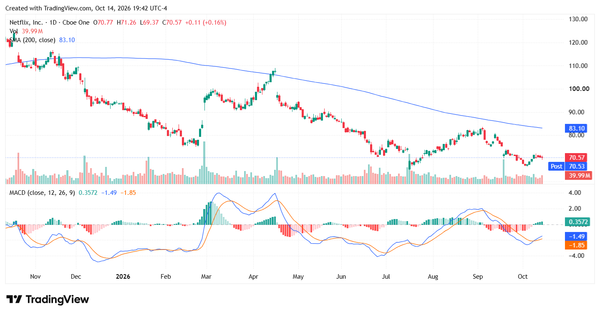
The layoffs cut both ways. A leaner streaming company could expand margins faster than expected. But “we’re not growing fast enough” is not what investors want to hear about a stock already down 24%. Next Tuesday’s report will show which story the market chooses to believe.
Today’s editorial pick for you
LEVI Stock Could Surge as Consumer Trends Create New Opportunities
Posted On Oct 19, 2026 by Joshua Enomoto
It’s not so much that Levi Strauss (NYSE: LEVI) has been a terrible investment idea. Sure, on a year-to-date basis, LEVI stock has its head slightly below parity, which is never ideal. However, given its direct ties to the consumer economy, the apparel giant could have suffered even worse losses. Further, sentiment may be coming back strong, with the equity up over 5% in the trailing month.
Table of Contents
Naturally, this all raises the question: is LEVI stock enjoying a one-off fluke? Or does it really have the momentum to make things interesting for debit-side options traders? I believe it’s more of the latter case.
Yes, there is an argument that LEVI stock may have burned too brightly. In the last five sessions, the ticker jumped over 10%, which is a strong performance for any security. But for Levi Strauss, lingering questions about the consumer market may make some speculators hesitant — they may prefer to wait for confirmation, as technical analysts often say.
Nevertheless, a nagging criticism awaits the confirmation-seekers: once that (bullish) confirmation arrives, Wall Street will simply rerate the new risk-reward profile of the equity in question. In other words, the confirming event will almost destroy the speculative opportunity you see right now — before the confirmation of Levi Strauss stock.
Obviously, nobody can fully guarantee whether a big move will materialize or not. However, if we had some inductive inference to believe in an undervalued opportunity, we could potentially buy LEVI stock with greater confidence (rather than sit on the sidelines waiting for confirmation).
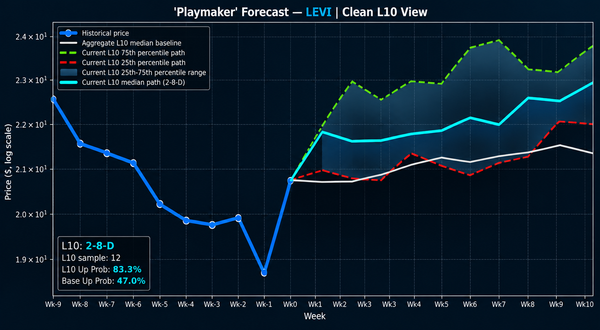
I believe such an early warning signal has already materialized. In the last 10 weekly candlesticks that Levi Strauss stock printed, only two of these sessions resulted in net positive price action. Typically, when this extremely bearish state flashes in the chart, LEVI tends to march higher, potentially placing the $22 price target for the November monthly options chain as a reasonable objective.
Fundamentally, my near-term optimism for Levi Strauss stock centers on the concept of mean reversion. Basically, the theory is that publicly traded securities of stable, relevant enterprises may attempt to find an equilibrium following a sharp corrective period. However, in some cases, the target security may overshoot before settling into the baseline.
I don’t think it’s controversial at all to believe in this approach; it’s probably one of the most common technical principles. However, it’s worthwhile attempting to quantify the methodology rather than simply betting on red-stained securities.
With LEVI stock, we know that it’s not merely structured in a garden-variety bearish state. Rather, as I stated earlier, only two of the last 10 weekly candlesticks resulted in net positive action, with the overall trend across the 10-week period being negative. This particular bearish state has only materialized 12 times on a rolling basis in the past five years — thus, we know that this is a rare occurrence.
But the important point here isn’t that the market currently considers Levi Strauss stock bearish — everybody knows it. The question is, what typically happens next? Does LEVI’s bearish state continue to stay bearish? Or, as I suspect through mean-reversion theory, does it transition from its current bearish state to a future bullish one?
Thanks to historical data, we can create a program to apply an exceedance ratio at the equivalent of the $22 strike for the Nov. 20 monthly options expiration date. Under the framework of a transition from a bearish state to a bullish one, we can expect an exceedance ratio of 50%; that is, of the 12 times that the aforementioned bearish state has materialized, Levi Strauss stock happened to exceed the $22 strike on expiration six times.
Of course, there will always be variations in the market. If I had to guess a probabilistic range, it would be somewhere between 33.3% and 50%. That makes the 21/22 bull call spread expiring Nov. 20 an intriguing idea.
A Low-Cost Trade That Tempts Speculators
One aspect that stands out for the 21/22 bull spread is the low nominal cost. At $45 per spread, speculators will be betting that Levi Strauss stock rises through and triggers the $22 second-leg strike price on expiration. If it does, the maximum profit would be $55, translating to a payout of over 122%.
The other plus is the favorable asymmetry. Because the payout is over 100%, you would be profiting more than you would be betting, assuming that the trade pans out perfectly. Of course, we don’t live in a perfect world but under risk-management principles, you should aim to maximize your payout rather than to seek high probabilities in lieu of a high payout.
That said, the expected value of the $22 spread leads to sharply negative expectancy at $20.04 below zero or an expected return on capital (ROC) of -44.53%. Primarily, the reason is that the probability of LEVI stock hitting $22 on expiration is only 24.96% — a calculation derived from OptionCharts.io’s Probability Distribution screener.
Because Wall Street isn’t about to give us more payout without us accepting more risk, we would need a probability bump to make this trade worthwhile. But that was the whole exercise that we recently conducted — the market assigns a probability of 25%; we think it may be as high as 50%.
Who has the correct answer?
Leveraging the Philosophy of Probabilistic Systems
Honestly, since we’re dealing with the unknown future, nobody knows what “correct” absolutely means until the event in question eventually falsifies the underlying claim. Until then, everybody is forecasting a price from a presuppositional framework.
My presupposition is that, under certain acute circumstances, public securities will likely exhibit nonrandom trading behavior. On the flip side, the probabilities that the Street is using presuppose a random walk model. Now, I’m sure that high-level traders themselves don’t believe in the random walk exclusively. But it can’t be helped that standard options pricing mechanisms imply random markets.
So yes, if you wholeheartedly believe that LEVI stock will undergo a random walk between now and the Nov. 20 expiration date, the lower probabilities would make more sense. However, if you believe in state-to-state transitions, the data points to LEVI being a bullishly biased name.





Tidak ada komentar:
Posting Komentar