It's the 10 stocks my team and I like most for the months ahead. Each one explained in plain English: what the company does, why we like it now, and what could go wrong.
It normally sells for $29.97 on our website. Right now it's free.
p.s. Once the new quarter's list comes out, this edition gets replaced. Grab it here while it's still up.
Today’s editorial pick for you
Big Bank Earnings Winners and Losers: Why the Market Got It Half Right
Posted On Oct 16, 2026 by Chris Markoch
Big bank earnings season is underway, and the scorecard is messier than the headlines suggest. Bank stocks came into the week under pressure. The Invesco KBW Bank ETF (NASDAQ: KBWB) was roughly 12% below its mid-August peak while the S&P 500 and Nasdaq were hitting records. Climbing bond yields and worries about funding costs were weighing on the group.
Table of Contents
The big bank earnings that followed didn’t always match that gloomy mood. Several banks beat estimates and still sold off. One missed and barely flinched. That gap between perception and fundamentals is where investors should focus.
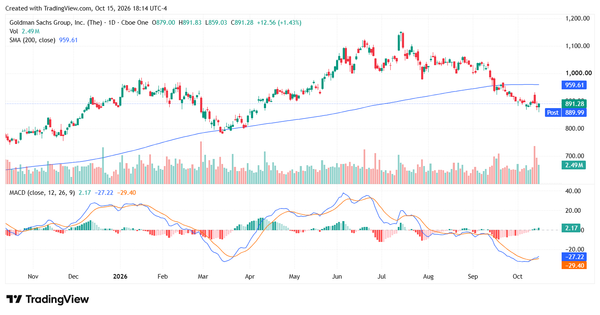
Goldman Sachs set the tone on Tuesday. The firm posted diluted EPS of $17.01, well above the $13.65 consensus. Revenue rose 23% from a year earlier to $18.68 billion.
Equities trading was the engine. Equities revenue jumped 72% to $6.44 billion as volatile markets kept clients repositioning. Investment banking also beat, with segment revenue of $3.23 billion against estimates of $2.86 billion.
There were soft spots. Fixed income, currency, and commodities revenue was essentially flat at $3.47 billion. EPS also fell from $20.98 in the second quarter.
Still, Goldman is investing in its next leg of growth. It agreed to buy NEOS Investments and LCN Capital Partners to expand its alternatives platform. It also returned $4.49 billion to common shareholders. Shares moved higher after the report. That reaction looks justified.
Big Bank Earnings Winner: Morgan Stanley
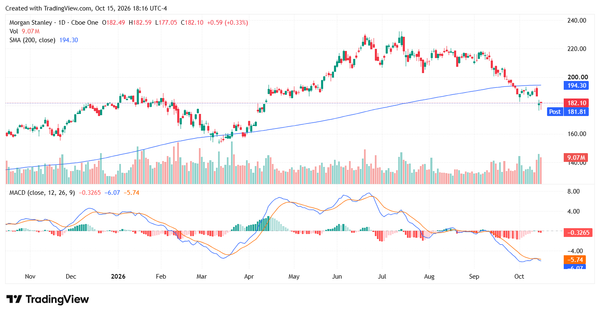
Morgan Stanley may be the week’s most underappreciated winner. EPS of $3.03 beat the LSEG consensus of $2.91. Net revenue rose 12% to $20.34 billion.
Wealth management is the reason to own this stock. The division posted record revenue of $9.1 billion and record pretax profit of $2.8 billion. Net new assets hit a record $232 billion. Total client assets across wealth and investment management climbed by nearly $400 billion to a record $10.5 trillion.
The institutional side held up too. Equities revenue surged 41% year over year. Return on tangible common equity was 22.6%, the fifth straight quarter above 20%.
So why did shares fall more than 3%? Investors focused on softer fixed income and investment banking, plus a carry reversal in investment management. That’s perception overriding fundamentals. One fair caution: just over half of the net new assets were tied to IPOs. Those flows can ebb. But a record asset base generates recurring fees regardless of trading conditions.
Big Bank Earnings Winner: JPMorgan Chase
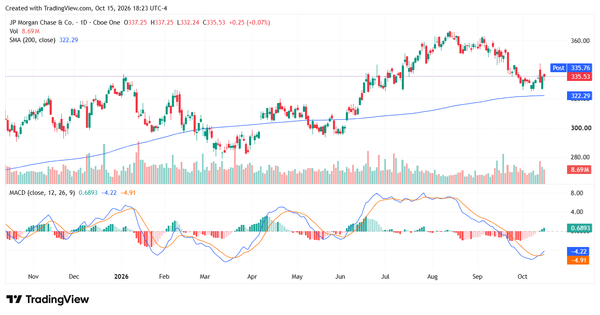
Calling JPMorgan Chase a winner requires some explanation. The bank posted its first quarterly earnings miss since the fourth quarter of 2023. EPS of $5.57 came in below the $5.85 LSEG consensus.
Context matters. The shortfall partly reflected $658 million in investment securities losses, worth about $0.18 per share after tax. Excluding that, EPS was $5.75, still a miss. But a narrow one.
The core engine is accelerating. Net interest income climbed 13% to $27.1 billion. Full-year 2026 NII guidance rose to about $106.2 billion from $105.5 billion. Management also floated a 2027 NII outlook near $107 billion. Return on tangible common equity of 20% beat the 17% through-cycle target.
The market got this one right. Shares reversed a 3% premarket drop and traded higher after the open. Investors looked past volatile trading lines and paid for durable lending income. The risk to watch is capital return. Net common stock repurchases were just $664 million this quarter.
Big Bank Earnings Loser: Bank of America
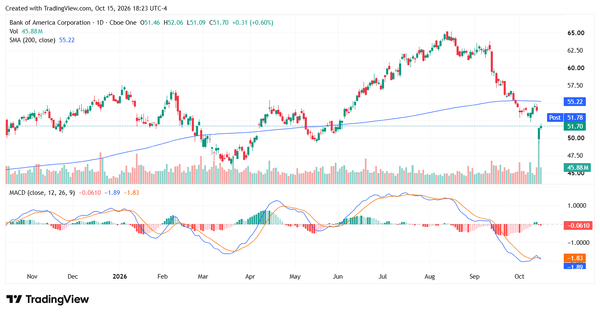
Bank of America is the clear loser of big bank earnings season so far. Adjusted EPS of $1.08 missed the $1.10 consensus. Revenue of $29.96 billion fell short of the $30.56 billion estimate.
Headline results looked worse. A $1.2 billion regulatory charge tied to Bank Secrecy Act and anti-money laundering consent orders cut $0.17 from EPS. GAAP EPS dropped to $0.91. Net income fell to $6.9 billion from $8.3 billion a year earlier.
The capital markets business is the deeper problem. FICC revenue fell 17% to $2.6 billion. Investment banking fees declined 11% to $1.8 billion. Rivals rode a trading boom. Bank of America largely missed it.
Investors had fair warning. In September, CEO Brian Moynihan guided to flat trading revenue and lower banking fees. The stock fell about 5% that day. It dropped again on the actual report.
The banking franchise isn’t broken. Net interest income rose 8% to $16.4 billion. Management guided to 2027 NII growth of 8% or more. That’s real, but it isn’t enough to change the narrative right now.
What About Citigroup?
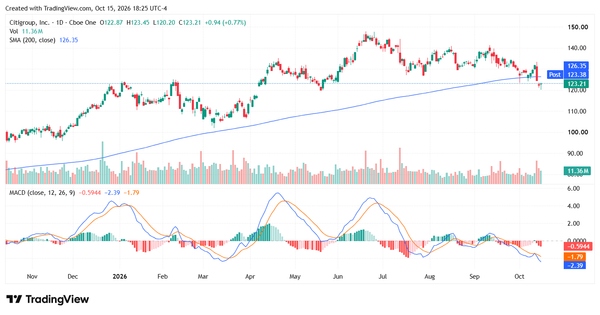
Citigroup is the hardest call, and I don’t think it belongs in the loser column. The stock fell about 5.6% on Tuesday despite an earnings beat. The results didn’t justify that.
Citi earned $2.85 per share against a $2.65 consensus, on its strongest third-quarter revenue in a decade. Revenue rose 8% to $23.85 billion. Management raised the dividend 12% and expects to exceed its 2026 return target.
The selloff likely reflects worries about seasonally weaker second-half trading and rising investment spending. That’s a perception problem, not a fundamentals problem. For contrarian investors, Citi may be the most interesting setup of the week.
How to Position Your Portfolio After Big Bank Earnings
This round of big bank earnings separated diversified franchises from banks leaning on a single engine. Goldman and Morgan Stanley captured the equities boom. JPMorgan proved its lending machine can carry a soft trading quarter.
Bank of America lacked both advantages this quarter. Investors punished it accordingly.
The bigger lesson is about reactions. Morgan Stanley and Citigroup sold off on strong results. When price action and fundamentals diverge this sharply, fundamentals usually win over time.
Today’s editorial pick for you
Alphabet Faces a $205 Billion Test as Earnings Approach
Posted On Oct 16, 2026 by Ian Cooper
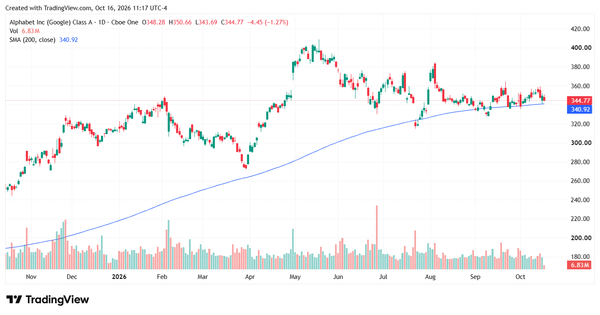
Alphabet (NASDAQ: GOOGL), the parent company of Google, YouTube, and Google Cloud, has scheduled its third-quarter earnings call for October 28 at 4:30 p.m. Eastern. For investors in Alphabet, the report offers another chance to see how its advertising business and expanding AI operations are working together.
Table of Contents
There is plenty to watch. Cloud growth has accelerated, but building the infrastructure behind that growth is expensive. Meanwhile, Google still needs to show that its search business can keep attracting users and advertisers as AI changes how people find information.
Estimates call for earnings of $3.02 per share on revenue of $127.67 billion. That compares with earnings of $2.87 per share and revenue of $102.35 billion a year earlier, implying roughly 5% earnings growth and 25% revenue growth.
Every major AI firm now relies on massive data centers. But these monstrosities suck up our electricity. They drain our water supplies. They steal precious land. Yet AI companies are requesting 700 gigawatts of new electricity – enough to power every home in America!
Until now, AI investors have piled trillions into the data-center boom. But according to investing legend Marc Chaikin, a new technology's coming... called AI "micro clusters." And they'll render all current data centers obsolete. The company he believes is behind this $248 trillion "White Swan" event could soar starting Nov. 16th.
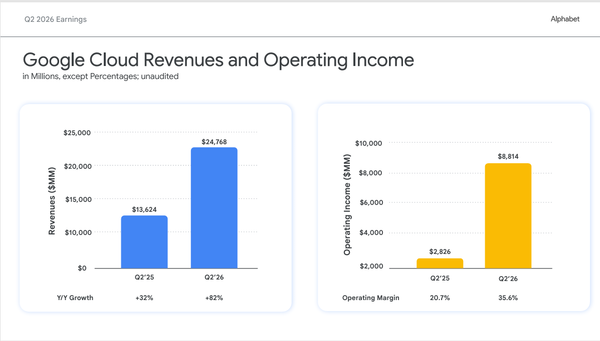
Google Cloud could be the biggest focus of the report. In the second quarter, Cloud revenue climbed 82% to about $24.8 billion. Alphabet also began recognizing revenue from sales of its tensor processing unit systems, or TPUs, which are specialized chips used for AI workloads.
That momentum has some analysts raising their expectations. JPMorgan analyst Doug Anmuth now expects third-quarter Cloud revenue to double from a year earlier, according to Barron’s. He also raised his Alphabet price target to $425 from $420, citing greater contributions from TPU sales.
For investors, the distinction matters. Strong growth can become harder to impress with when expectations are rising just as quickly. The quality of that growth deserves attention, too. Investors should look for management to explain how much comes from ongoing cloud usage, how much comes from hardware sales, and what that mix means for profitability.
Search Still Pays Much of the Bills
Cloud may attract the excitement, but Google Search remains central to Alphabet’s financial health. Second-quarter revenue from Google Search and related activities reached about $63.3 billion, up from $54.2 billion a year earlier. YouTube advertising revenue also increased, reaching about $11.1 billion.
The next report should help investors assess whether that advertising momentum is holding up.
The key question is how effectively Google can turn changing search habits into revenue. AI-generated answers may make the service more useful, but usefulness alone does not tell investors how much advertisers will pay or how profitable those interactions will become.
I would watch for management’s comments on search activity, advertiser demand, and the economics of AI-powered features.
YouTube also deserves attention. Its results can help show whether advertising strength extends beyond Search. Broad growth across both businesses would provide more reassurance than a strong result concentrated in just one area.
The Spending Bill Could Shape the Reaction
Alphabet previously raised its 2026 capital spending outlook to $195 billion to $205 billion. Management also said spending would increase significantly in 2027. Second-quarter free cash flow was negative as infrastructure investment absorbed more than the cash generated by operations.
That creates a practical challenge: Alphabet needs capacity to meet demand, but shareholders also want evidence that the investment will produce attractive returns.
Watch for changes to the spending outlook, progress in cash generation, and commentary on future costs. A revenue beat could lose some shine if it comes with another spending increase and little explanation of the payoff.
Ultimately, this earnings report needs to connect growth with financial discipline. Strong Cloud demand, healthy advertising, and a convincing explanation of infrastructure spending would strengthen Alphabet’s case. Investors do not need every AI investment to pay off immediately. But they do need to see that the company is moving toward durable profits and stronger cash flow. On October 28, that progress may matter more than the headline earnings number.




Tidak ada komentar:
Posting Komentar