But what's happening economically in America right now is being taken advantage of by our politicians.
To them, record-high markets are the perfect cover for them to quietly take control of American companies – and set America up for a future EVEN WORSE than Socialism.
If that sounds too extreme, just consider what we've already seen:
The federal government recently paid $8.9 billion for a stake in Intel – one of the biggest tech companies in the world...
The Pentagon spent $400 million to become the largest shareholder of a rare-earth mining company...
And the White House now holds a "golden share" in U.S. Steel – effectively guaranteeing the Oval Office authority over key business decisions!
Add it all up, and Washington has taken ownership stakes in some 30 companies since January 2025.
Dr. Ron Paul
Former U.S. Congressman and Presidential Candidate
Today’s editorial pick for you
GE Aerospace Earnings: The $170 Billion Engine Behind Its Growth
Posted On Oct 20, 2026 by Grayson Cavern
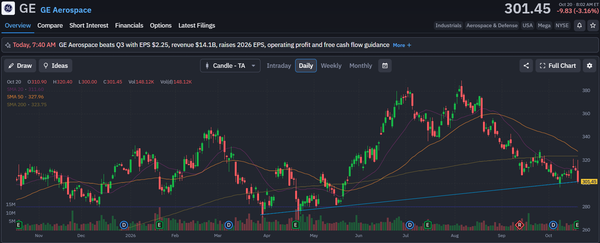
GE Aerospace (NYSE: GE) just delivered a 36% jump in adjusted earnings per share, a 49% surge in orders, and another upgrade to its 2026 outlook. Yet the stock fell 3.16% to $301.45, trading below all three major moving averages. Investors have a strong earnings report to digest, but the next leg higher depends on whether GE can turn its swelling commercial-services business into more consistent cash generation.
Table of Contents
The company’s third-quarter results show why demand remains strong. Revenue climbed 16% to $14.12 billion, while adjusted revenue increased 18% to $13.29 billion. Adjusted operating profit rose 30% to $2.99 billion, lifting the operating margin to 22.5% from 20.3% a year earlier. Adjusted EPS reached $2.25, compared with $1.66 in Q3 2025.
GE also raised its full-year earnings, operating-profit and free-cash-flow guidance. The engine powering those upgrades is its commercial aftermarket business, supported by a backlog exceeding $170 billion. The catch: free cash flow fell 14% during the quarter, leaving GE Aerospace with something to prove even after raising the bar.
Commercial Engines & Services generated $10.34 billion in Q3 revenue, up 21% year over year, while segment operating profit climbed 21% to $2.89 billion. Orders jumped 58% to $15.27 billion, with service orders rising 23% and equipment orders more than tripling.
The revenue breakdown shows where the momentum is coming from. Services revenue grew 17%, internal shop-visit revenue increased 12%, and spare-parts revenue rose more than 20%. LEAP engine shop-visit revenue grew over 40%, while total engine deliveries increased 8%. GE is benefiting from a large installed engine fleet that requires maintenance, repairs, and replacement parts, alongside continued demand for new engines.
That aftermarket footprint gives GE a more durable revenue stream than equipment deliveries alone. Airlines need engines maintained to keep aircraft flying, and the work can generate repeat business over an engine’s service life. GE’s commercial-services backlog now exceeds $170 billion, giving management substantial contracted demand to work through.
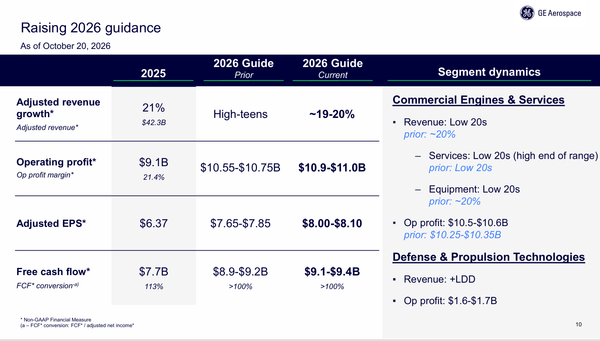
Management expects commercial-services revenue to grow at a low-double-digit rate in 2027. For 2026, it raised its Commercial Engines & Services revenue-growth outlook to the low 20s and operating-profit forecast to 10.5billion – 10.6 billion. The segment is now doing the heavy lifting, although its margin edged down 10 basis points to 27.9% as inflation and business mix offset some benefits from volume and pricing.
The Guidance Upgrade Comes With a Cash-Flow Test
GE raised its full-year 2026 adjusted EPS guidance to 8.00–8.10, up from 7.65–7.85. It now expects adjusted operating profit of 10.9 billion–11 billion and free cash flow of 9.1 billion–9.4 billion. Adjusted revenue growth is projected at roughly 19%–20%.
Those revisions imply management expects the strong operating performance to continue into Q4. Nine-month free cash flow already reached $6.73 billion, up 13% from the prior year, which leaves GE needing roughly 2.37 billion–2.67 billion in Q4 to reach its new full-year range.
The latest quarter, however, went in the opposite direction. Operating cash flow slipped to $2.20 billion from $2.56 billion, while free cash flow fell to $2.04 billion from $2.36 billion. GAAP profit rose 12% to $2.81 billion, but the GAAP profit margin contracted 80 basis points to 19.9%.
One quarter does not establish a cash-conversion problem, especially in a business where delivery schedules and working-capital movements can shift between periods. Still, investors should watch the Q4 cash tally closely. GE Aerospace is raising its earnings expectations while promising more than $9 billion in annual free cash flow, so the next report needs to show that higher profits are reaching the cash-flow statement.
Defense Adds Support, but Commercial Still Leads
Defense & Propulsion Technologies provides another source of growth. Q3 revenue increased 7% to $3.47 billion, orders climbed 18% to $4.27 billion, and operating profit rose 8% to $475 million. For the first nine months of 2026, segment revenue advanced 13%, and orders grew 33%.
GE also signed a contract worth up to $2.9 billion to support F414 engines powering the U.S. Navy F/A-18 and EA-18G aircraft. Its agreement to acquire Consolidated Precision Products would expand capacity for mission-critical castings used across commercial engines, aftermarket operations and defense programs.
The opportunity comes with execution risk. GE is working to meet rising demand while dealing with supplier constraints, inflation, and the challenge of expanding production capacity. A larger backlog can support future revenue, but only if the company can deliver the work at attractive margins and on schedule.
GE Needs to Reclaim Its Trend
The stock’s technical picture remains weaker than the earnings report. GE closed at $301.45, below its 20-day simple moving average at $311.60, its 50-day at $327.96 and its 200-day at $323.75. Shares have retreated from summer highs near $380, and the latest decline has brought the price toward a rising support trendline around $300.
That level is the immediate line to watch. Holding near $300 could give buyers a base from which to challenge $312, the first meaningful resistance area. A stronger recovery would need to clear the 324–328 zone, where the 200-day and 50-day averages sit. A decisive break beneath the rising trendline would leave the chart vulnerable to another leg lower.
GE Aerospace Is a BUY
GE Aerospace is a buy, supported by accelerating commercial-services demand, a $170 billion-plus backlog and higher earnings guidance. The company has built a formidable aftermarket engine, and its defense business adds another source of growth.
But after the latest selloff, I would look for cash flow to confirm the earnings momentum and for GE to reclaim its moving averages before expecting the stock to return to its summer highs. The fundamentals are strengthening; the chart still needs to catch up.
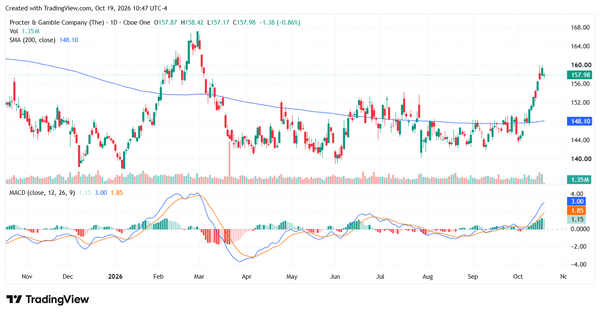
People may put off a vacation or a big purchase when money gets tight, but they still need laundry detergent, diapers, food, and razors. That gives Procter & Gamble (NYSE: PG) a steady source of demand. However, the challenge is keeping shoppers loyal when cheaper alternatives are sitting on the same shelf.
Table of Contents
Ahead of its October 22 earnings report, the question is whether Procter & Gamble can keep shoppers coming back while dealing with higher costs and persistent inflationary pressures.
The maker of Tide, Pampers and Gillette is scheduled to report its first quarter of fiscal 2027 before the opening bell. Its results should offer a useful look at household spending and how much consumers are willing to pay for familiar brands. Analysts expect earnings of $1.89 per share, down about 5% from the same quarter last year. Revenue is projected to reach about $22.7 billion, an increase of 1.4%.
A small earnings beat would be welcome. But stronger sales trends and a reassuring outlook could carry more weight than a few extra pennies in quarterly profit.
I don’t trust Sam Altman at all … And neither should you. Because my research tells me he is hiding something … Something so potent, so revealing … It could spark the biggest monetary crisis of our lifetime.
That’s why I suspect he’s using every tool at his disposal to keep this from getting out.
But on Dec. 18, around 4 p.m. … He will be forced to reveal a document that’s currently confidential. When he does, it will immediately trigger a $40 trillion wealth shift …
One number worth watching is sales volume, which measures how much product Procter & Gamble sells.
For this report, improving volume would help demonstrate that P&G’s products remain attractive at current prices. Weak volume, particularly alongside heavier discounts, would raise questions about how much the company must spend to defend its business. Investors should also look for improvement across several product categories. A strong performance from one division is helpful, but broader growth would make the recovery more convincing.
P&G previously estimated that higher raw material, energy, and transportation costs would reduce fiscal 2027 earnings by approximately $1 billion after taxes. That is a substantial obstacle, even for a company of its size.
The connection is straightforward. Making household products requires ingredients, packaging, factory operations, and transportation. When those expenses rise, P&G must absorb the increase, find savings, or charge customers more.
Each Option Has Limits
Raising prices can push shoppers toward competitors. Cutting expenses too aggressively can weaken product development or marketing. Absorbing higher costs leaves less profit from each sale. That makes profit margins especially important.
Investors will want to see whether productivity improvements are helping offset cost pressures. They should also listen for any change in management’s assumptions about the months ahead.
Even if quarterly earnings meet expectations, a warning that costs are getting worse could overshadow the headline numbers.
P&G entered fiscal 2027 expecting reported and organic sales growth of 1% to 3%, with core earnings between $6.89 and $7.11 per share. Maintaining the outlook would suggest management still believes its plans are achievable. Raising it would provide a stronger signal. A reduction would invite questions about whether weaker demand or higher expenses are becoming more persistent.
Shareholder Payments Remain Part of the Appeal
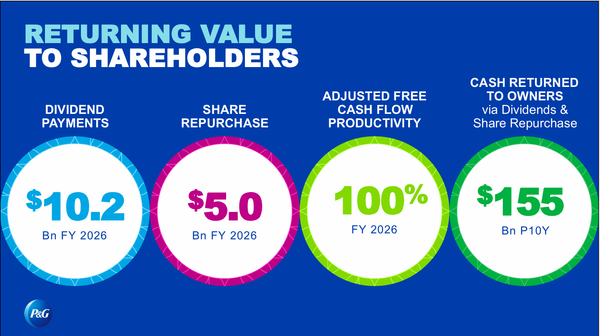
Procter & Gamble has projected roughly $10 billion in dividends and approximately $5 billion in share repurchases for fiscal 2027. Ultimately, Procter & Gamble doesn’t need spectacular growth to deliver a reassuring report. It needs to show that customers still value its products, cost controls are working, and its annual targets remain realistic.
For Procter & Gamble, the challenge is convincing shoppers that its brands are worth the money and keeping enough of each sale to grow profits. If the company shows improving demand while keeping its outlook intact, investors may feel more confident. But if customers are pulling back and costs keep climbing, a modest earnings beat may offer little comfort. On October 22, the most encouraging result would be evidence that P&G can grow without asking already stretched shoppers to pay much more.




Tidak ada komentar:
Posting Komentar