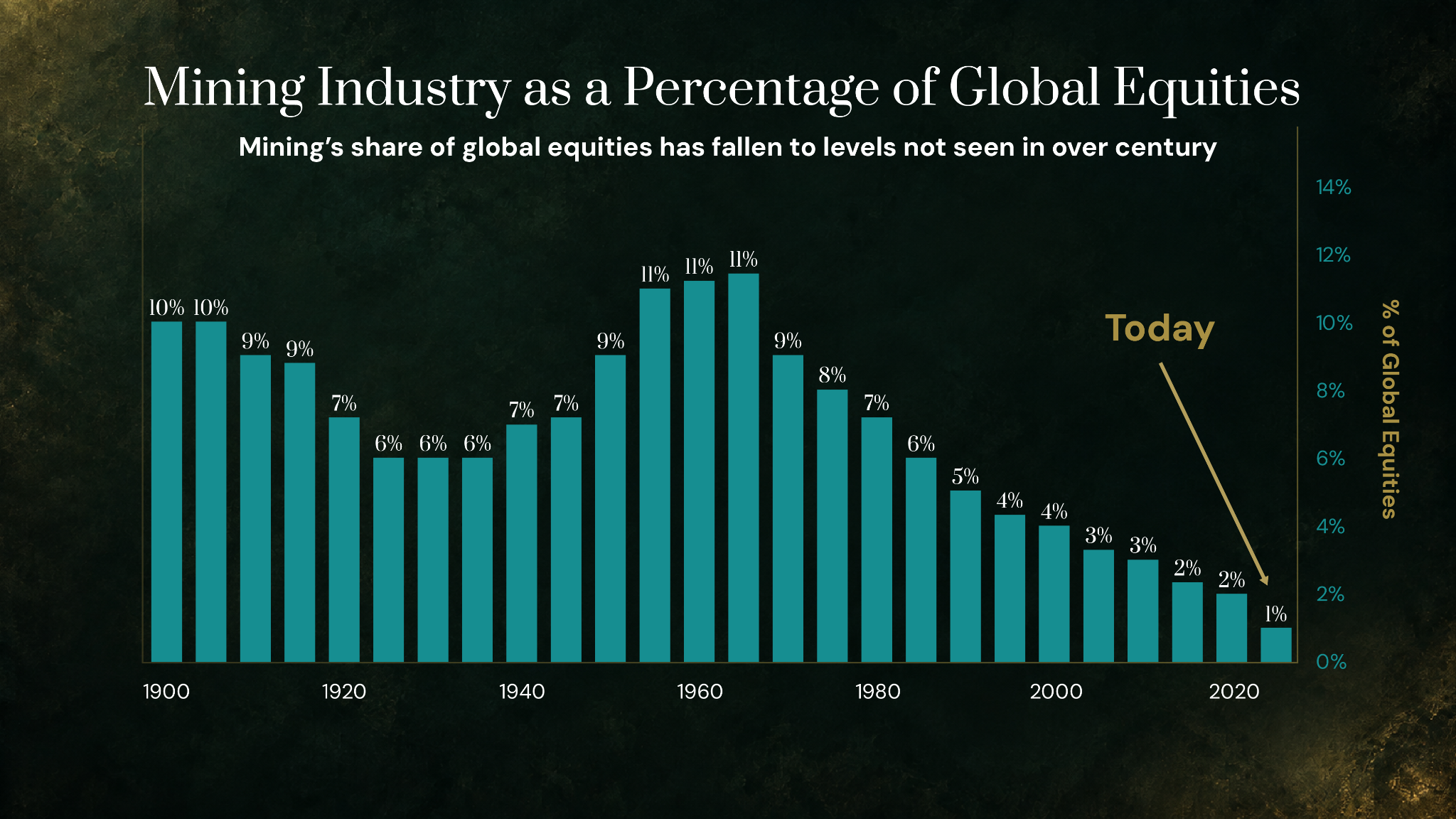
Bottom line: The trillions of dollars currently betting on AI cannot flow into the tiny universe of gold stocks without making early investors very rich.
Now…
If you think money from growth/tech/AI isn't going to flood into gold stocks in the coming market correction… think again.
I've spent more than 20 years studying gold and mining companies – traveling to mines around the world.
If you want to potentially profit when the AI trade finally goes off the cliff, here's all you need to know:
Only a small percentage of an enormous pool of money in AI/tech has to rotate into gold stocks for this tiny sector to hand early investors a generational fortune.
Garrett Goggin, CFA, CMT
Lead Analyst and Founder, Golden Portfolio
Today’s editorial pick for you
NVIDIA’s $109 Billion Earnings Test Could Fuel the Next Rally
Posted On Oct 15, 2026 by Ian Cooper
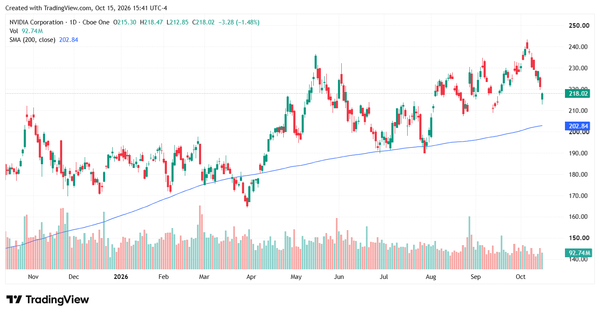
NVIDIA (NASDAQ: NVDA) will release earnings on November 17 after the market closes. Wall Street expects another big quarter from the artificial intelligence chipmaker. But when investors already anticipate strong growth, impressive numbers alone may not be enough. NVIDIA also needs to show that customers remain willing to keep spending heavily on AI infrastructure.
Table of Contents
Ahead of its November earnings report, investors have plenty to consider. Revenue expectations are approaching $109 billion, analysts continue to issue bullish calls, and concerns about the financing behind the AI boom are becoming harder to ignore.
For shareholders, the question is straightforward: Can NVIDIA deliver enough growth to keep those concerns from taking over the conversation?
Estimates have NVIDIA’s quarterly revenue at about $108.98 billion. That sales estimate implies growth of roughly 91% against revenue of $57 billion in the same quarter last year.
The company itself has forecast third-quarter revenue of $108 billion, plus or minus 2%. That puts Wall Street’s current estimate slightly above management’s midpoint, suggesting analysts expect the company to do somewhat better than its central forecast.
Still, beating the published estimate is only part of the challenge.
Investors also develop their own expectations, especially for a company that attracts this much attention. A modest earnings beat could receive a muted response if shareholders were counting on something much bigger.
That makes management’s outlook for the following quarter particularly important.
The Business Investors Will Watch Closely
NVIDIA’s data-center business remains central to the story.
In its previous quarter, data-center revenue reached $89 billion, up 117% from a year earlier. Total company revenue climbed 106% to $96.2 billion, while adjusted earnings reached $2.22 per share. Those figures help explain why expectations remain so high. Investors want evidence that demand can keep expanding even after such extraordinary growth.
They will also be listening for updates on NVIDIA’s Vera Rubin platform. In August, the company said the platform was ramping into full production, with systems running at partners including Microsoft Azure, Google Cloud, Oracle Cloud Infrastructure, and CoreWeave.
For investors, the practical questions involve delivery schedules, customer adoption, and how smoothly new products translate into sales.
Profitability deserves attention, too. NVIDIA forecasts a third-quarter gross margin of about 74%, compared with 75% in the previous quarter. Gross margin measures the revenue remaining after direct product costs, before other operating expenses. Investors will want to understand whether any pressure is temporary or could persist as the product mix changes.
Recent Upgrades and Higher Price Targets
More recently, BNP Paribas analyst Karl Ackerman raised his price target to $345 from $285. Barron’s reported that his optimism included the growing opportunity from AI agents, which require additional computing hardware.
Other firms have reinforced existing bullish positions. Cantor Fitzgerald reiterated its Overweight rating with a $350 target on October 1. Rosenblatt reiterated Buy with a $390 target on September 29. Those were renewed endorsements, rather than fresh rating upgrades.
Taken together, these calls show continued confidence in NVIDIA’s growth opportunity. But price targets are forecasts, and they depend on assumptions about demand, profits, and what investors will pay for those profits.
The earnings report will give investors fresh evidence to judge those assumptions.
What Could Complicate the Outlook?
NVIDIA does not need to prove that AI is a meaningful business. Its results already demonstrate that. What shareholders need now is confidence that the next stage of growth can support the expectations attached to the stock. A strong quarter would help. Clear evidence of durable demand, healthy profitability, and continued customer investment would make the report far more convincing.
Today’s editorial pick for you
Domino’s Pizza Beat Q3 Estimates, but the Sales Engine Is Losing Steam
Posted On Oct 15, 2026 by Grayson Cavern
Domino’s Pizza (NASDAQ: DPZ) has a problem that a quarterly earnings beat cannot fix on its own. The company generated $1.19 billion in revenue and $4.60 in diluted EPS for the third quarter, topping Wall Street’s estimates on both lines. Yet U.S. same-store sales barely grew, international comps slowed, and management pulled back its full-year sales expectations. Meanwhile, DPZ has slid from roughly $370 in August to below $300.
Table of Contents
The stock is now caught between a business that can still manufacture earnings growth and a sales trend that is losing momentum. The distinction runs through the entire report: Domino’s is squeezing more out of its operating model, but the underlying demand picture is getting harder to defend.
Trading millionaire Larry Benedict challenges conventional Wall Street wisdom with a bold claim: “Diversification is for dummies.”
Instead of spreading investments across multiple stocks, he focuses on trading just one ticker repeatedly using his specialized system.
Now, he's revealing the exact ticker he's trading today, his complete strategy, and a second trading rule that he says most people have never followed.
Revenue rose 3.4% year over year to $1.19 billion, ahead of the $1.18 billion analyst consensus. EPS climbed 12.7% to $4.60, beating expectations of $4.37, while operating income increased 8.3% to $241.8 million. On the surface, those are respectable results. The comparable-store figures tell a less comfortable story.
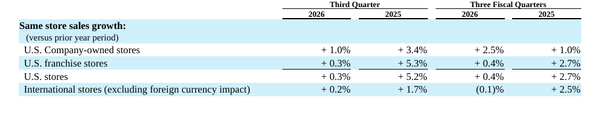
U.S. same-store sales grew just 0.3%, down from 5.2% a year earlier. International comps increased 0.2%, compared with 1.7% last year. Global retail sales growth, excluding foreign currency effects, slowed to 3.2% from 6.3%. U.S. retail sales grew 2.1%, while international retail sales increased 4.3%.
Source: Domino’s Pizza
Domino’s is still selling more across its system, but the pace has cooled sharply. Comparable-store sales strip away much of the benefit from opening new locations, giving investors a cleaner read on how existing restaurants are performing. When that measure nearly stalls in both the U.S. and international markets, a headline earnings beat deserves a closer look.
Part of the answer sits in the supply chain. Revenue benefited from higher order volumes and a 2.2% increase in food-basket pricing, while supply-chain gross margin expanded to 12.2% from 11.3%, helped by procurement productivity. Share repurchases also supported EPS growth.
Those levers are doing their job. Better purchasing economics can protect margins, and repurchases allow earnings to be spread across fewer shares. But neither can substitute indefinitely for stronger customer demand. If established stores keep struggling to grow sales, Domino’s will have less room to lean on operational efficiencies to keep the earnings line moving higher.
Management Has Cut Its Sales Expectations
The revised outlook is the part I would keep in focus. Domino’s now expects U.S. same-store sales growth toward the low end of its low-single-digit range, while international comparable sales are expected to be approximately flat. The company also reduced its 2026 U.S. net store growth target to 125–150 locations, citing macroeconomic pressure on development and franchisee profitability.
That is a meaningful change in tone after a quarter that beat estimates. The reported numbers describe the business over the last three months; guidance tells investors what management believes it can deliver next. Lower expectations for comps and store openings make the forward growth profile less compelling, even with earnings holding up.
New CEO Joe Jordan has emphasized customer engagement and franchisee profitability. Both priorities land directly on the problem in these results. Domino’s needs to give customers a reason to order more frequently while keeping the economics attractive for the franchisees operating its stores.
Promotions can bring customers through the door, especially when budgets are tight. The trade-off is that discounting can pressure ticket size and store-level profitability if incremental orders fail to compensate for lower prices. The company needs traffic that sticks, not a short-lived sales bump purchased with margin.
Slower store development adds another complication. Domino’s relies on its franchise network to extend its reach without carrying the full cost of every new restaurant. When franchisees face weaker economics, expansion becomes harder to justify, and that removes one of the growth levers that can offset sluggish sales at existing locations.
DPZ Is Fighting to Hold the High-$280s
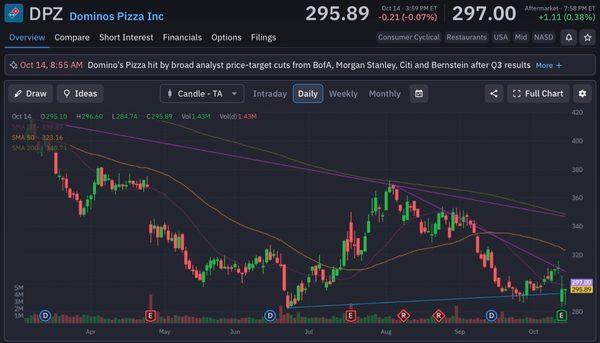
The chart has been pricing in this loss of momentum for months. DPZ closed October 14 at $295.89, below its 20-day simple moving average at $298.85, its 50-day at $323.16 and its 200-day at $348.71. The retreat from the August high near $370 has left the stock in a sustained downtrend, with each moving average sitting overhead as potential resistance.
The first level to reclaim is $299–$300. Getting back above the 20-day average would offer an early sign that buyers are willing to defend the recent bounce. Beyond that, $315–$323 is the more demanding test, with the 50-day average near $323. A move through that zone would improve the technical picture; until then, rallies remain vulnerable to sellers stepping back in.
Support sits around $285–$290, near the rising trendline on the chart. DPZ has recently bounced from this area, making it the line bulls need to defend. A decisive break would undermine the attempt to establish a floor and raise the risk of another leg down.
The Stock Needs a Better Sales Story
Domino’s still has real advantages: franchise scale, supply-chain leverage and a business model capable of producing earnings growth in a difficult consumer environment. Q3 showed those strengths in action. It also showed how much work remains on comparable sales, and management’s lower outlook makes it difficult to dismiss that weakness as a temporary quarterly wobble.
My bias remains cautious until the sales trend improves. This means I would treat DPZ’s bounce as an attempt to find a bottom, not proof that one is in. The next leg of the bullish thesis needs healthier demand at existing stores. Without it, operational efficiency can keep earnings respectable while the stock continues to struggle for a higher multiple.





Tidak ada komentar:
Posting Komentar