Below is an important message from one of our highly valued sponsors. Please read it carefully as they have some special information to share with you.
Dear Reader, Hi, I’m former CIA and Pentagon official Jim Rickards. Forbes once called me “the James Bond of gold”… That’s because my connections have allowed me to visit places that are off-limits to 99% of people. From secretive gold vaults in Switzerland (whose locations I’m not allowed to disclose)…
To the largest and most secure gold mines around the world… Even to high-level gatherings on Wall Street and in Washington, where I meet with people like Ben Bernanke and Tim Geithner. Thanks to this background, I have the inside scoop on the gold market that most people simply don’t have.
AutoZone Q4 Earnings: AZO Is Spending Big To Keep The Old-Car Trade Alive
Posted On Sep 22, 2026 by Grayson Cavern
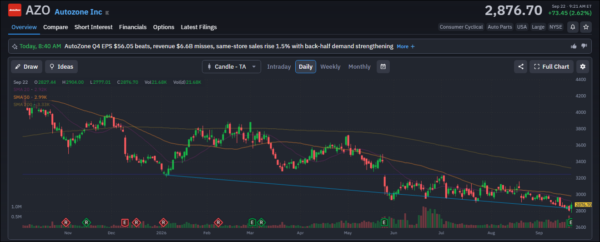
AutoZone Inc. (NYSE: AZO) spent $2 billion in Q4 buying back its own stock during fiscal 2026 at an average price of $3,496 a share. The stock is now sitting around $2,877.I started there instead of the $56.05 EPS beat or the $6.6 billion revenue number because that gap tells us something about where the market stands today.
Table of Contents
See, AZO is still generating growth, still buying back stock aggressively and still expanding its store network, yet the shares are trading roughly 18% below the average price management paid for its own stock during the year.
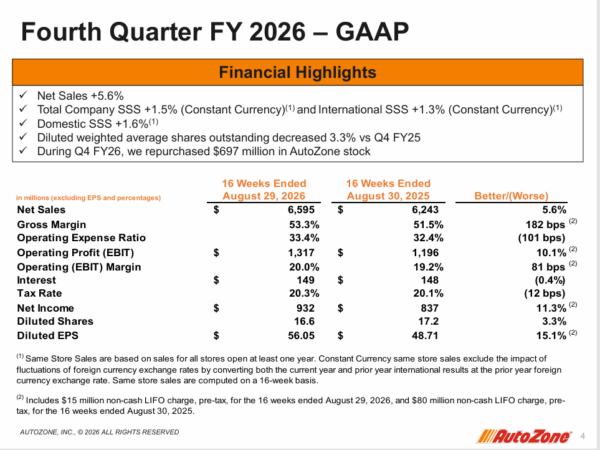
Now under the hood, Q4 sales rose 5.6% to $6.59 billion, net income reached $931.6 million, and diluted EPS jumped to $56.05 from $48.71. At the same time, domestic same-store sales came in at 1.6%, while total-company constant-currency comps landed at 1.5%. A quarter earlier, those figures were 4.1% and 3.9%.
That gives me a very specific way to read Q4 – the vehicle-preservation thesis is still producing demand, while AutoZone is pouring more capital into capturing that demand. The next part of the trade is figuring out what those investments are earning.
The preservation thesis from Q3 has another quarter behind it now, and one part of the business is making the case even harder to dismiss.
Domestic commercial sales jumped 8.6% to $1.91 billion in Q4, taking full-year commercial sales growth to 10.6%.
I like that number because commercial customers are professional repair shops, dealers, service stations, fleet owners and other businesses that need parts to keep vehicles working. The consumer comp may have slowed, but the professional side is still pulling hard. That gives AutoZone a nice demand setup heading into FY2027. Management said the first eight weeks of Q4 were difficult before sales strengthened during the final eight weeks, and it expects sales in all three countries to accelerate in the new fiscal year.
Now I want to see that acceleration show up in the comp numbers. A stronger commercial business gives AutoZone another source of growth, while the aging-vehicle thesis keeps feeding the broader replacement-parts market. If that combination pushes domestic comps back toward the levels seen earlier in FY2026, the stock gets a very different fundamental backdrop.
AutoZone Is Putting More Money Behind The Thesis
Management isn’t sitting around waiting for demand to arrive as AZO opened 374 stores during FY2026, taking the network to 8,031 locations. Inventory increased 10.1%, compared with 7.4% growth in annual sales, while capital spending rose to $1.50 billion from $1.37 billion.
That’s a meaningful capital commitment to a thesis that management clearly expects to keep working. Then adjusted after-tax ROIC fell from 41.3% to 35.8%, a 550-basis-point decline. That changes how I look at those 374 new stores. Store growth gives AutoZone more physical reach. Inventory gives customers a better chance of finding the part they need. Distribution investments can improve delivery speed. Commercial expansion can pull more repair-shop business into the network.
And all of those investments can create future earnings, but I want to see the return on that capital stabilize as the revenue catches up. If FY2027 brings the acceleration management expects and ROIC starts recovering, the investment cycle begins to look much more productive. If sales accelerate while returns continue sliding, the market has a different set of numbers to work with.
The Margin Bridge Tells Us Where The EPS Came From
Q4 gross margin expanded 182 basis points to 53.3%, and management gave us a clean bridge for the improvement: tariff refunds contributed 145 basis points, and a net non-cash LIFO benefit added another 105 basis points, while a higher commercial mix pulled in the other direction. That tells me how much weight to put on the margin expansion.
Those two disclosed benefits contributed 250 basis points of the 182-basis-point reported improvement. Strip them out mechanically, and the underlying bridge points to roughly 68 basis points of pressure.
I wouldn’t forecast future margins by simply removing those items. I’d use the bridge to separate operational improvement from quarter-specific assistance. Operating expenses also moved to 33.4% of sales from 32.4%, with AutoZone attributing the increase primarily to deleverage from its growth initiatives.
So the FY2027 setup becomes pretty clear: stronger sales need to start carrying more of the expense load from the expansion program.
AZO’s Buyback Now Has A Price Tag
This brings me back to where we started. AZO repurchased 579,000 shares during FY2026 for $2.0 billion, paying an average of $3,496 per share. It finished the year with another $1.61 billion available under its authorization. With AZO around $2,877 on your chart, the market has placed the shares substantially below the company’s FY2026 average repurchase price.
That’s a benchmark I can actually trade around. The chart has already broken the $3,250-$3,300 support zone that repeatedly held through 2026. AZO now sits below the 20-day average near $2,920, the 50-day near $2,990 and the 200-day near $3,330, with the long-term descending trendline still overhead.
For me, the next signal is straightforward: can improving FY2027 comps and commercial growth start pulling those returns higher while the stock works back through its moving averages? The business is still getting paid to keep America’s cars alive.
Now AZO has to show that the next billion dollars it puts behind that business can earn its way back into the stock.
Today’s editorial pick for you
Meta Platforms Stock Gets a Fresh AI Catalyst From Muse
Shares of Meta Platforms surged 11% on Monday, producing their strongest daily percentage gain since April 2025. The stock also reached its highest closing level since October 2025. While several factors may be supporting the rally, enthusiasm surrounding Muse appears to be one of the biggest catalysts. For investors who have spent months questioning Meta’s massive AI spending plans, Muse offers something they have been waiting to see: a potentially marketable product that ordinary consumers are eager to use.
Jeff Z. studies recurring monthly buying patterns to uncover one new trade idea each month. Inside Monthly Money Flows, he shares the reasoning behind each idea, including the entry, target, and stop levels he’s watching.
Your first full year is $1 and includes the Calendar Stocks Blueprint, Crash Course Video Series, and Options 101.
Meta Platforms CEO Mark Zuckerberg has described the company’s AI vision as a push toward “personal superintelligence.” The idea is to create technology that understands individual users, adapts to their preferences and assists them with increasingly complicated tasks.
Muse is an early example of how that strategy could work.
Introduced on September 8, the AI assistant is designed to do more than answer questions or generate text. It can perform multistep assignments such as collecting information from several online accounts, completing web forms, comparing products and making purchases.
Muse can even negotiate certain online transactions on behalf of a user.
Consumers can interact with the assistant through the dedicated Muse app or access it through WhatsApp. That integration could prove especially valuable because WhatsApp already has a massive global user base. Instead of asking people to adopt an entirely unfamiliar service, Meta can place its AI tools inside platforms they already use regularly.
Meta Platforms Is Turning AI Spending Into a Catalyst
The rapid rise of Muse is contributing to an impressive month for Meta’s stock.
Shares have gained approximately 29% since the beginning of the month, putting the company on track for its strongest monthly performance in more than 13 years.
That is a significant turnaround.
Earlier in the year, investors reacted negatively when Meta increased its spending projections for 2026. The company is now expected to invest between $130 billion and $145 billion in capital expenditures this year. Much of that money will be directed toward data centers, computing equipment and the infrastructure needed to develop and operate advanced AI systems. Even for a company as profitable as Meta, that is an incredible amount of money.
The biggest concern was not whether Meta could afford the investment. Its core advertising business continues to generate substantial revenue and cash flow. The bigger question was whether the company could turn all that AI infrastructure into profitable new products.
Muse is beginning to ease some of those fears.
Meta Platforms Is Building Several Paths to Revenue
The basic version of Muse is currently free, which gives Meta an opportunity to attract a large audience. However, the company also offers paid subscription levels priced at $20 and $100 per month. Those subscriptions could create a new stream of recurring revenue if users decide that Muse saves enough time or provides enough value to justify the monthly expense. The higher-priced tier could be particularly attractive to business owners, professionals and other customers who regularly handle complicated online tasks.
Subscriptions are not Meta’s only potential AI revenue source.
The company recently introduced the Meta Model API, allowing developers and businesses to pay for access to its underlying AI models. It represents the first time Meta has directly charged enterprise customers and developers for this type of access.
Meta Platforms Stock Breaks Higher as Momentum Accelerates
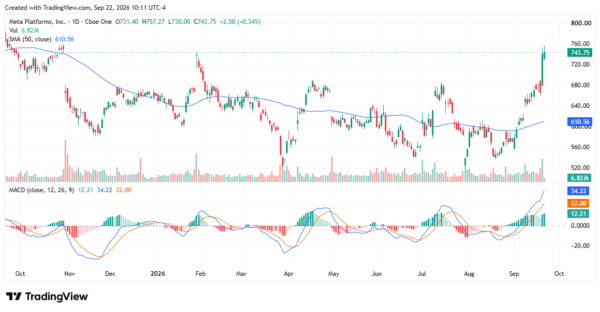
The chart suggests META stock has entered a significantly stronger technical setup. META closed at $743.75 on September 22, well above its 50-day moving average near $610.56. More importantly, the stock has broken out of the trading range that dominated much of the summer, with the recent move carrying shares toward the $760 area.
Momentum indicators are reinforcing the breakout. The MACD line sits around 34.2, compared with approximately 22.0 for the signal line, producing a positive histogram of roughly 12.2. Both lines have moved sharply higher since August, indicating that buying momentum has accelerated rather than simply producing a one-day spike.
The next important test is the $760 area, followed by the $800 level. A sustained move through those zones could keep the bullish trend intact. Conversely, a pullback toward the recent breakout area would give investors a better indication of whether the move has established new support.
Meta Platforms Stock Gets a New AI Growth Catalyst
For months, Wall Street largely saw billions of dollars flowing into data centers and advanced computing systems. Now investors can see a popular consumer product emerging from that investment. If Muse can maintain user interest, convert free customers into paying subscribers and expand across Meta’s collection of platforms, it could become an important new growth engine. More importantly, it could demonstrate that Meta Platforms’ expensive pursuit of personal AI is capable of producing real commercial results.








Tidak ada komentar:
Posting Komentar