Editor's Note: Our colleague, the former $900 million hedge fund manager Larry Benedict, has discovered a way to make money from gold… WITHOUT buying a single ounce. Read on to learn more…
Dear Reader,
A former hedge fund manager has discovered a unique way to pull cash from the gold markets.
Royal Caribbean: 2 Wall Street Firms See a Buying Opportunity
Posted On Sep 30, 2026 by Ian Cooper
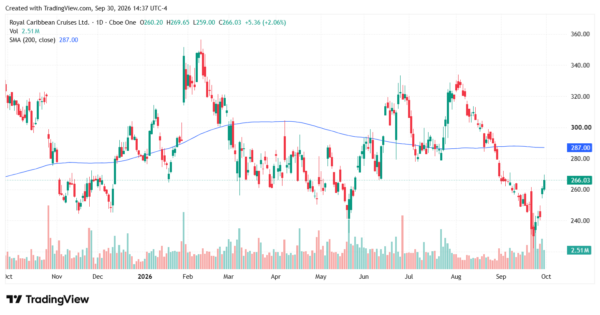
Keep an eye on oversold shares of Royal Caribbean (NYSE: RCL). Royal Caribbean stock has attracted fresh attention from Wall Street after Bank of America and Deutsche Bank upgraded the shares to Buy following a sharp pullback.
Bank of America (NYSE: BAC) maintained its $330 price target, while Deutsche Bank (NYSE: DB) kept its target at $299. Their argument is straightforward: The shares have become cheaper, while demand for the company’s vacations appears to be holding up.
That combination of a lower valuation and resilient travel demand is the foundation of the bullish case. But investors still need to consider whether Royal Caribbean can maintain strong pricing, manage rising capacity, and turn its Sandals investment into another source of growth.
RCL Stock Offers a Lower Price for a Strong Business
Bank of America believes the underlying business remains strong. Its analysts pointed to returns on invested capital in the high teens and EBITDA margins approaching 40%. Those figures suggest Royal Caribbean is generating substantial earnings from its operations and putting the money invested in its business to productive use.
The company also has an investment-grade balance sheet, another point in its favor. That matters in an industry where building ships requires enormous amounts of capital and weaker travel demand can put pressure on cash flow.
For RCL stock, the significance is that investors are getting exposure to a business with strong operating economics at a lower share price than before the recent selloff. The question is whether those economics can remain intact as the cruise industry adds capacity.
Perhaps the most encouraging part of the analysts’ case is that consumers still appear willing to spend on travel. Bank of America said travel spending has grown at a mid- to high-single-digit rate since February. Cruise spending showed even stronger momentum, accelerating to growth in the mid-teens during July and August.
For Royal Caribbean, those trends support the idea that the stock’s decline may reflect investor worries more than a meaningful deterioration in vacation demand. Still, spending across the industry does not guarantee the same results for every operator.
Comments from Royal Caribbean at a recent Bank of America conference also gave the bank confidence in the company’s outlook. Its analysts expect fourth-quarter 2026 net yield growth of at least 4%, which they believe would lead the industry.
Looking ahead, Bank of America believes Royal Caribbean could guide for 2027 net yield growth of 2% to 3%, consistent with its historical framework.
Sandals Could Add Another Growth Catalyst
There is also a new piece to the growth story: Royal Caribbean’s announced $3 billion investment for a 50% stake in Sandals Resorts. Bank of America estimates the transaction could add 3% to 4% to EBITDA in the near term. Beyond that initial contribution, the bank sees opportunities for Royal Caribbean to help improve the resort business through its pricing experience, purchasing capabilities, and loyalty program.
The idea is that Royal Caribbean could apply some of its operating strengths to Sandals, helping the business generate more profit from its existing properties. Customer relationships could also offer opportunities to introduce travelers to different vacation options.
Bank of America estimates the venture could deliver annual EBITDA growth in the low- to mid-teens through 2030, potentially lifting Sandals’ EBITDA from about $600 million to $900 million. Those are projections, however, and realizing them will depend on execution.
Rising Cruise Capacity Could Pressure RCL Stock
Of course, there are reasons the shares became cheaper.
Competing cruise capacity in the Caribbean is expected to increase by a high-single-digit percentage in 2027, according to the firm. More available cabins could make it harder to raise prices if demand fails to keep pace. Fuel costs remain another concern, although Royal Caribbean has hedged more than half of its 2027 fuel exposure. That provides some protection, but it does not eliminate the risk of higher costs.
The capacity issue may be the biggest test of the bullish thesis. Royal Caribbean can benefit from strong demand, but if industrywide capacity grows faster than bookings, pricing power and net yields could come under pressure.
Is Royal Caribbean Stock a Buying Opportunity?
Even with those risks, the upgrades suggest both banks see a more appealing balance between potential rewards and possible setbacks after the selloff.
For investors, the key question is whether Royal Caribbean can keep growing earnings while managing competition and costs. If demand remains resilient and management delivers, the lower valuation could prove attractive. The opportunity rests on that performance, and upcoming bookings, pricing, and guidance will help investors judge whether the analysts’ optimism is justified.
In other words, the Royal Caribbean stock story now comes down to execution. Strong travel demand, healthy net yields, and potential growth from Sandals provide several catalysts, while rising cruise capacity and costs remain important risks to monitor.
Today’s editorial pick for you
Bullish Stocks: 3 Hot Picks Wall Street Analysts Are Watching
Posted On Sep 30, 2026 by Ian Cooper
Wall Street analysts can be a useful source of investment ideas. When they upgrade a stock, raise a price target, or begin coverage with a bullish rating, it gives investors a reason to take a closer look. These bullish stocks are attracting attention for very different reasons, ranging from artificial intelligence infrastructure growth to a potential retail turnaround. The important part is understanding what’s behind the call.
Table of Contents
Sometimes, an analyst sees stronger earnings ahead. Other times, a stock has fallen enough to make its valuation attractive. A company might also be gaining ground in an industry that’s growing faster than investors realize.
Still, a bullish rating shouldn’t replace your own homework. Earnings, debt, competition, valuation, and the stock’s trading trend all deserve attention.
With that in mind, CoreWeave, Amazon, and Target have attracted positive analyst commentary. Each offers a different investment story, from growing demand for artificial intelligence infrastructure to changing shopping habits and potential earnings improvement.
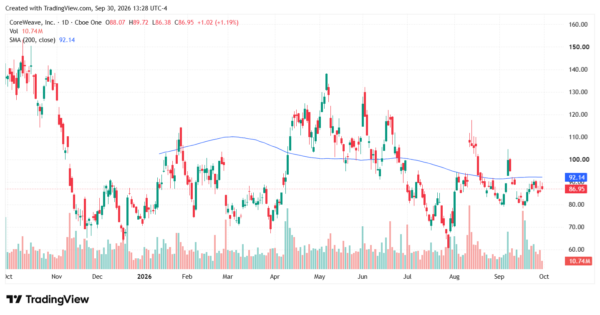
William Blair initiated coverage of CoreWeave (NASDAQ: CRWV) with an Outperform rating, highlighting its position in the expanding market for AI computing services.
The appeal is easy to understand. Developing and running AI requires enormous computing resources. Companies need access to powerful chips and the infrastructure supporting them, but building that capacity themselves can be expensive and complicated.
William Blair described the company as a leading AI cloud provider, pointing to approximately $130 billion in committed backlog when the more than $25 billion of new customer commitments announced in early Q3 are added to the $104 billion revenue backlog reported at the end of Q2. CoreWeave also reported second-quarter 2026 revenue of $2.58 billion. That combination points to substantial demand for its services, although the backlog remains subject to delivery and service requirements.
For investors, that backlog is worth watching. Customer commitments can help a company plan expansion and provide some visibility into future revenue. The bigger question is whether CoreWeave can convert that demand into profitable growth while funding the infrastructure required to serve its customers.
Bullish Stocks for October: Amazon
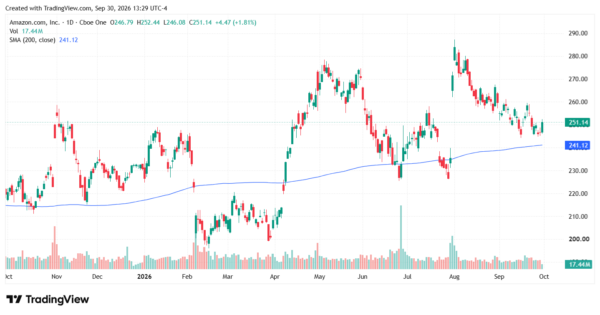
Rosenblatt maintained its Buy rating on Amazon (NASDAQ: AMZN) and raised its price target to $360 from $335. Analyst Scott Devitt believes investors are overstating the threat that AI shopping assistants pose to Amazon’s business.
The concern centers on agentic commerce. Put simply, that means AI tools could handle more shopping tasks for consumers. Instead of browsing pages of products, a shopper might ask an assistant to compare choices, find a price, and help complete a purchase. That raises an obvious question: If people spend less time browsing Amazon, will advertisers have fewer opportunities to reach them?
It’s a reasonable concern. Advertising depends partly on getting products in front of potential buyers, and changes in how people shop could affect that process.
But a different shopping process doesn’t automatically mean Amazon loses the sale. An AI assistant still needs somewhere to source products and complete orders. Price, availability, delivery, and customer service will continue to matter, regardless of how shoppers find an item.
That is the foundation of Rosenblatt’s argument. The firm says the market is treating agentic commerce as a potentially binary threat to Amazon’s advertising model, while Amazon still controls a massive retail ecosystem and can adapt as the shopping process changes.
That creates a plausible opportunity for Amazon to remain involved even as the shopping experience changes.
The investment case depends on adaptation. Can Amazon keep attracting purchases and help advertisers reach customers as AI becomes more involved?
Rosenblatt’s higher target reflects confidence in that outlook. Investors should still monitor advertising performance and evidence that new shopping tools support profitable growth.
Bullish Stocks for October: Target
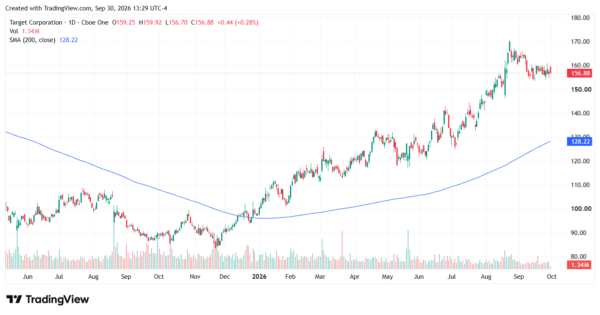
HSBC upgraded Target (NYSE: TGT) to Buy from Hold and raised its price target to $190 from $125. The firm sees an attractive valuation when potential earnings upside is considered.
Analyst Joe Thomas also pointed to evidence that a traffic-driven recovery is underway. Target’s second-quarter comparable sales rose 3.8%, including a 2.7% increase in store-originated sales, while underlying profit and EPS were about 5% ahead of consensus, according to the analyst.
For a retailer, improvement can come from several places: more shoppers, larger purchases, better inventory management, or fewer discounts needed to clear merchandise.
Even modest progress can matter when expectations are subdued. But an inexpensive stock needs more than an optimistic forecast. Investors should look for improving sales trends, healthy margins, and earnings supported by sustainable customer demand.
The key issue for Target stock is whether improving traffic can develop into durable sales and earnings growth. HSBC’s thesis assumes the recent improvement can translate into earnings upside, but investors will need to see that recovery continue in subsequent quarters.
Three Bullish Stocks Worth Researching
These calls offer three distinct starting points: AI infrastructure growth at CoreWeave, confidence in Amazon’s ability to adapt, and potential earnings recovery at Target.
That makes these three bullish stocks less of a single investment theme and more of three separate analyst theses to investigate. CoreWeave depends heavily on AI infrastructure demand and backlog conversion. Amazon faces questions about how AI could change online shopping and advertising. Target needs to demonstrate that improving customer traffic can support a lasting turnaround.
The next step is testing those arguments against results. Watch whether each company delivers the progress its bullish case requires.
An analyst’s endorsement can put a stock on your radar. Business performance and the price you pay should determine whether it earns a place in your portfolio.




Tidak ada komentar:
Posting Komentar