 If you still haven't downloaded my "Safe Trade Options Formula" book... ...please take a few seconds and download it right now before your new temporary download link expires. I eventually plan to charge for this book, so do yourself a favor and download it now... That way, no matter how much it is in the future, you'll have a copy on your computer already. Make sense? FREE: Safe Trade Options Formula << Download Now Good Trading,
Bill Poulos p.s. Go here to save a copy of my "Safe Trade Options Formula" book to your computer before I start charging for it.
Today's Featured Article
Oklo’s Revenue Transition Gives Bulls a New Reason to WatchReported by Thomas Hughes. Article Published: 8/11/2026. 
Key Points
- Oklo reported its first quarterly revenue in Q2 2026, though the amount remains small and came from services rather than commercial reactor power.
- Oklo’s liquidity of more than $3 billion gives it room to fund accelerated development, even as losses and cash use rise.
- Oklo’s Groves Isotope Test Reactor and planned Aurora deployments remain key milestones, but timing, regulation and construction risk still matter.
- Special Report: A 17-year investing experiment investigated in Dublin
Oklo’s (NYSE: OKLO)Q2 results reflect a shift echoed by its price action, suggesting there is nothing but upside ahead. The caveat is that, robust and improving as the outlook is, the upside is relative to market dynamics, which also suggest volatility, the potential for whipsaw action and sharp, potentially long-lasting corrections. The critical details are revenue and the timeline to profitability. The company shifted from a pre-revenue pure-play to its initial revenue phase in Q2, outperforming expectations while accelerating its investment plans. Initial revenue is microscopic—just over $1 million—but is expected to grow as projects advance and capabilities scale. Oklo’s Revenue to Ramp Exponentially Over the Mid- and Long Term
Oklo’s growth trajectory is underpinned by a three-pronged approach, with only the first phase in play today. That phase involves radioactive isotopes useful for health and industrial applications. Revenue is expected to ramp incrementally in the second half of 2026 and then more aggressively in 2027. The second prong involves fuel fabrication and recycling, which is expected to begin generating revenue in 2027. Deals with companies such as Centrus Energy Corp (NASDAQ: LEU) set Oklo up to secure its own supply while providing services to the industry. The most important prong, however, involves small modular reactors, which are slated for deployment by 2028. They will account for the bulk of the company’s revenue-generating capacity. Looking ahead, the forecast is robust, with consensus estimates suggesting an exponential growth curve. Revenue is expected to ramp to the $300 million to $400 million range by 2030 and then reach the mid-single-digit billions by 2035. Profits are expected early in the next decade but may arrive sooner if project advancement accelerates. The company recently joined an effort involving hyperscalers and the Trump administration to reduce the time and cost of deployment. Oklo’s Loss Widens, but Dilution Threat FadesAs counterintuitive as it may be, Oklo’s widening loss is offset by its causes and the fading threat of dilution. Losses are tied to strategy advancement and project derisking rather than increasing operational losses. The balance sheet is also well-capitalized, leaving little threat of additional dilution. Although dilution has been a factor, it has increased the company’s capitalization and capacity to execute its strategy. Oklo’s more than $3 billion in cash, equivalents and investments provides a multiyear runway. In this scenario, Oklo won’t need a cash infusion until well after its first two revenue streams have begun ramping, if at all. That reduces the threat of future dilution and, along with it, short-selling pressure. Short selling is a factor in OKLO’s price action and potential for a reversal. Short sellers leaned hard into this trade, capping gains in late 2025 and driving the stock price down approximately 80% from its high. However, they will likely begin covering their positions given the transition to revenue, improving outlook and capital runway. 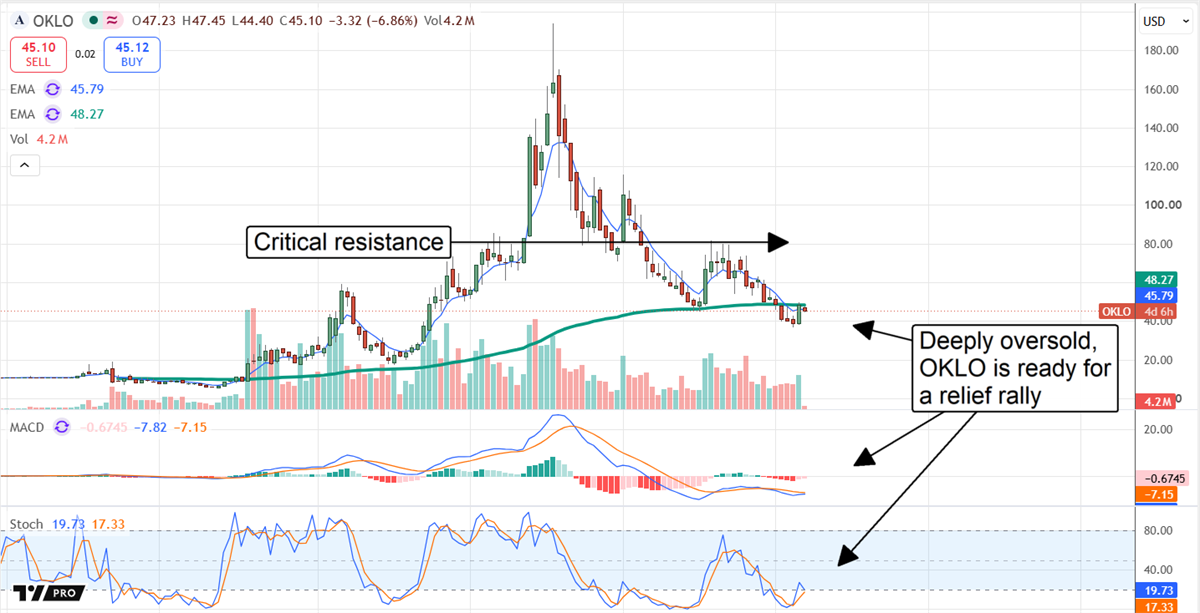
Deeply Oversold, Oklo’s Market Is Ripe for a ReboundOklo’s market sell-off hit extreme lows in summer 2026, setting up a potential relief rally in Q3. The lows were accompanied by significant divergences in the MACD and stochastic indicators, reflecting weakening bearish control and a high probability of a rebound. The question is how high OKLO’s price may go, and the spring highs near $80 are the likely target. This is the strongest technical target available, aligning with analysts' sentiment trends and the consensus estimate, which is just a few dollars higher. In this scenario, $80 could trigger a sell-off, potentially a deep one, as the market establishes a base and forms a more obvious reversal pattern. Not only does $80 represent approximately 100% upside from recent lows, but it also marks a significant technical resistance point that could trigger profit-taking and short selling. Oklo’s next major milestone is the ramp-up of isotope production at the Idaho test facility. It will be followed by the commissioning of a Texas isotope reactor sometime in late 2027. The biggest risks revolve around timing, including regulatory hurdles and construction delays. Mitigating factors include government support, which helps accelerate and derisk the projects, but it does not eliminate the possibility of delays or roadblocks. What the market gets wrong about Oklo is that it is neither a flash-in-the-pan AI-adjacent play nor a traditional electric utility with high cash burn and a long pathway to revenue. Instead, it is a multipronged play on nuclear technology, including high-margin green energy. While the runway to revenue and profits is long, deployments appear likely, as revealed by early testing, and the potential for cash flow and profits is immense. Once operational, Oklo’s reactors, which are well-suited for a wide range of applications, will run for 10 to 20 years without refueling. This will allow its fuel business to generate high-margin revenue, while the isotope business does the same. . |



Tidak ada komentar:
Posting Komentar