Editor's Note: Please see the following from Dr. David Eifrig, a former Goldman Sachs Vice President and professional trader. He has just released an urgent investigative exposé on the $7.2 Trillion "Mar-a-Lago Trade" -- an idea Bloomberg has said may cause "a dire shift of fortunes for America."
Shopify Delivers Strong Q2 Results as Revenue and Profit Rocket
Posted On Aug 05, 2026 by Ian Cooper
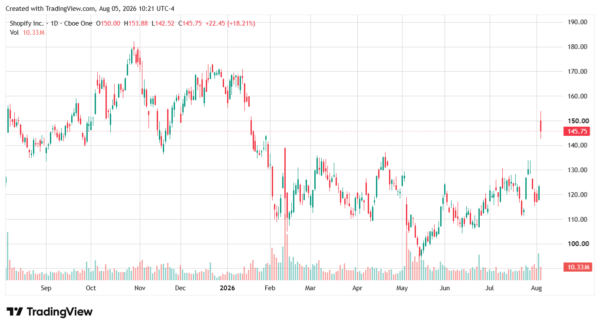
Shopify (NASDAQ: SHOP)just posted an impressive second quarter, posting strong growth in both revenue and profit as more businesses continued to use its e-commerce platform. The company exceeded Wall Street expectations, driven by higher sales across its subscription services and merchant solutions business.
Table of Contents
During the second quarter, SHOP’s net income came in at $1.5 billion, or $1.16 per share. That’s a significant increase from $906 million, or 69 cents per share, during the same period last year. Adjusted for one-time expenses, the company reported earnings of 42 cents per share. Analysts expected adjusted earnings of 40 cents per share.
Revenue also came in higher than forecast. Total revenue reached $3.58 billion, up from $2.68 billion a year earlier. Analysts had predicted revenue would reach about $3.45 billion, making Shopify’s results another positive surprise.
The company’s growth was fueled by strong performances in both of its primary business segments: Subscription Solutions and Merchant Solutions.
Subscription Solutions, which includes monthly plans and software tools that businesses use to operate their online stores, generated $802 million in revenue during the quarter. That’s solid growth compared with $656 million in the same quarter last year.
Even stronger was Merchant Solutions, Shopify’s largest source of revenue. This division includes payment processing, shipping services, financing, and other tools that help merchants manage their businesses. Revenue from Merchant Solutions climbed to $2.78 billion, up from $2.02 billion a year earlier.
Another important measure of the company’s success is Gross Merchandise Volume (GMV), which jumped to $115.57 billion during the second quarter, compared with $87.84 billion year over year. The increase in GMV indicates that consumers continued spending through Shopify-powered stores despite ongoing economic uncertainty.
Investors also received encouraging guidance for the months ahead.
SHOP expects revenue in the third quarter to grow at a low-thirties percentage rate compared with the same period last year. The company also expects gross profit dollars to increase at a mid-to-high twenties percentage rate, suggesting management remains confident about continued demand.
At the same time, the company plans to keep operating expenses under control. The company expects operating expenses to represent between 33% and 34% of revenue during the third quarter. Maintaining disciplined spending while growing revenue could help support continued profitability.
Building a Broader E-Commerce Platform
In addition, Shopify has spent the past several years expanding beyond its original online storefront business. Today, the company offers payment processing, fulfillment tools, financing options, marketing features, and other services designed to help merchants manage every aspect of their businesses from a single platform.
That strategy appears to be paying off. As merchants adopt more Shopify products, the company generates additional recurring revenue while strengthening customer loyalty.
The latest results also demonstrate SHOP’s ability to outperform market expectations. Beating analyst forecasts on both earnings and revenue is often viewed positively by investors because it signals stronger-than-expected business performance.
Bottom Line for Shopify
With revenue climbing more than $900 million year over year, profit rising sharply, and merchandise sales reaching record levels, Shopify has considerable momentum. If the company delivers on its third-quarter outlook, it could continue rocketing even higher.
Overall, Shopify’s continued growth in online commerce, increasing merchant activity, and greater adoption of its expanding suite of business services make the stock even more attractive. Strong financial results, healthy sales growth, and optimistic guidance suggest the company remains well-positioned for the remainder of the year.
Today’s editorial pick for you
If You Want to Buy AMD Stock, You’ll Statistically Do Better by Waiting
Posted On Jul 31, 2026 by Joshua Enomoto
Since this is the internet, I need to be explicit about this Advanced Micro Devices (NASDAQ: AMD) story: I am not making a permabear argument. With artificial intelligence rapidly becoming our flagship technology, AMD stock over the long run should be a strong investment. However, in the near term, especially for those trading AMD options, a cautionary approach is best.
Table of Contents
Sure, I’m coming late to the game. On Wednesday, AMD stock dropped 5.51%. In the trailing five sessions, the ticker has sank more than 21%. If you look at the situation from the perspective of technical analysis, you can’t help but notice that the security has fallen off a sideways consolidation channel. With sellers apparently panicking, the fallout could get ugly.
I would also venture to say that the consensus among retail traders is to let the selloff fully die out before engaging. I’m not going to put too much faith in my chart-interpreting abilities but Advanced Micro Devices stock does look like a falling-knife scenario. But what’s fascinating is that the market may have already provided a clue as to our current juncture.
Back in early July, I discussed the trading narrative for AMD rival NVIDIA (NASDAQ: NVDA). Specifically, I mentioned that I was intrigued by the 205/210 bull call spread expiring Aug. 7. Now, unless a miracle happens, this trade will almost certainly get blown up (in a bad way). But keep in mind that up until the close of July 22, this trade was very much in the money.
Just as importantly, take a look at the Markov simulator that I provided in that article. Because NVDA stock was projected to decline in performance in the fifth week following the flashing of the underlying quantitative signal, I chose the Aug. 7 expiration date to cut off my exposure. Unfortunately, reality pushed up projected events to week 3 — but the key takeaway is that the downturn did eventually come.
Larry Benedict — who beat the S&P 500 by 18X in 2025 and made clients $95M during the 2008 crisis — says Trump installing a new Fed chair is triggering the most significant shift in U.S. markets in nearly 20 years.
Readers had chances at 62% in 2020, 117% under a month in 2022, 89% in 17 days after Jackson Hole. One ticker at the center.
For AMD Stock, It’s Not About Storytelling but Data
Generally, it’s understood that you can’t precisely predict future market behaviors. For decades, if not centuries, analysts have attempted to scour financial prints, technical charts and more recently, quantitative models to predict where a target security may head next. In arguably most cases, these efforts are nothing more than marketing BS.
However, that doesn’t mean we should give up on the idea of probabilistic forecasting. Just like in the NVIDIA case above, I can’t tell you exactly where AMD stock is going to land with absolute certainty. If I did, I certainly wouldn’t share it with anyone. Instead, I would simply trade this proprietary intelligence and basically print my own money.
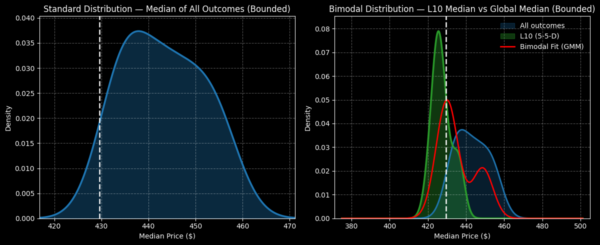
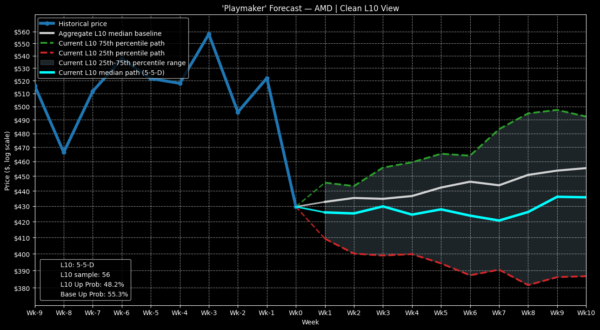
I don’t know where exactly Advanced Micro Devices stock will end up. No one does. But I can tell you — thanks to my Markov simulator — where AMD has historically ended up given specific quantitative conditions.
With NVIDIA, the ticker printed four up weeks over the past 10 weeks, leading to a downward slope. Under this 4-6-D sequence, the next five weeks typically resulted in upside, with the next five weeks usually seeing choppy pessimism. Of course, the laws of nature are not guaranteed to repeat, but the above scenario has been the median response.
Let’s consider AMD stock. In the past 10 weeks, the ticker has witnessed a 50/50 split between positive and negative sessions; however, the overall slope has been negative. Under this 5-5-D sequence, the statistical expectation is for the median share price to gradually decline to the end of week 7. Then, over the next three weeks, shares tend to pop higher.
Still, the lift would be considered modest relative to how AMD stock usually performs as an aggregate expectation. In other words, if you were bullish on Advanced Micro, you’d be better off waiting as the expected performance under the signal is likely going to be worse than the performance under a random hold.
Don’t Believe Me? Check Out the Volatility Skew
It’s not just the historical data that is clouding the case for Advanced Micro Devices stock; rather, it’s the current hedging behavior among smart money traders.
Take a look at the volatility skew for Sep. 18 options chain. Here, the implied volatility (IV) — or the expectation of market movement — for far out-the-money (OTM) puts stands at an astronomical 1,000%. On the other end of the scale, the IV for far OTM calls is only 88.48%. In laymen’s terms, options traders are heavily prioritizing downside protection over upside convexity.
Granted, no one who studies options-based transactions is surprised by the stark picture in the volatility surface. As I mentioned at the top of this article, AMD stock has suffered heavy losses in recent sessions. If the smart money felt that this was a discounted opportunity, you’d likely see call IV elevated. After all, if most folks are selling, this would be a cheap time to buy in volatility terms.
However, the smart money doesn’t view AMD stock as a discount — they view it as a falling knife that is liable to lacerate unsuspecting bulls who do not look at the data. And that’s the overarching point here. I don’t know jack about the markets, seriously. But what I do know are numbers.
Look, I’m not saying be near-term bearish on Advanced Micro Devices stock because that’s how I interpret the charts. I personally don’t know where AMD is going to go. I’m just saying the data, under the specific condition that I outlined, tends to demonstrate negative performance before a turnaround occurs.
If you want to heed the warning, great. If you have an alternative model that suggests differently, use that instead. I’m just showing you the cards that I’m working with and why I believe what I believe.
How Should We Approach Advanced Micro Devices Stock?
From a conservative standpoint, the takeaway from the above data and inductive analysis is to wait until a little after mid-September to reengage AMD stock. Of course, nobody knows exactly how circumstances will pan out. But based on prior trends, that would be the forecasted time period when AMD may start looking interesting for the bulls again.
For those who actively want to speculate, you may consider the 430/420 bear put spread expiring Sep. 18. No, it’s not the most exciting trade because the maximum payout for AMD stock falling through the $420 strike at expiration is only around 53%. Plus, the net debit per spread is a pricey $655. That’s a direct consequence of the hedging activity that has made put options very expensive.
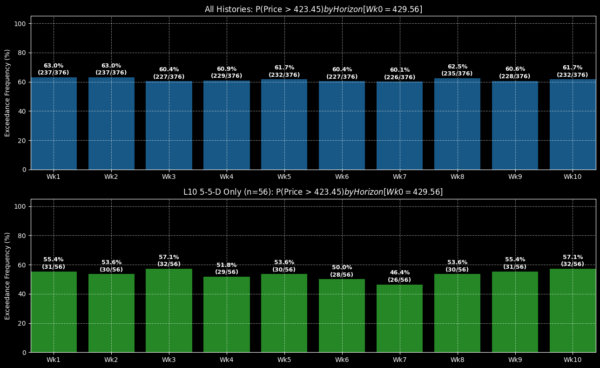
However, what’s enticing here is the breakeven price of $423.45. Right now, Wall Street assigns a probability of profit of 48%. However, the actual odds could be a little bit higher.
Since January 2019, the 5-5-D sequence has flashed 56 times on a rolling basis. Of this count, there have been 26 instances where AMD stock has ended up above the $423.45 breakeven price at week 7 (Sep. 18), meaning that there have been 30 cases where AMD slipped below this threshold. As such, the conditional probability of profit could be 53.6%, not 48%.
Granted, that’s not much of a difference relative to Wall Street’s odds. But you also have to consider that being bearish on Advanced Micro Devices stock is no longer the contrarian wager — it’s the expected outcome. So, the bottom line is, if you’re going to be bearish, be prepared to pay. Otherwise, if you’re looking for a discount, you statistically stand a better chance of waiting.





Tidak ada komentar:
Posting Komentar