Editor's Note: Our colleague, the former $900 million hedge fund manager Larry Benedict, has discovered a way to make money from gold… WITHOUT buying a single ounce. Read on to learn more…
United Airlines Delivers Strong Q2 Earnings, Why the Stock Sold Off Anyway
Posted On Jul 17, 2026 by Chris Markoch
United Airlines (NASDAQ: UAL) delivered a second-quarter beat that most companies would be thrilled with. Revenue grew 16% year-over-year to $17.7 billion. Adjusted EPS of $1.99 came in near the top of guidance. Management raised full-year guidance despite absorbing nearly $6 billion in unexpected fuel costs. And yet UAL shares fell 1.33% on earnings day, closing at $119.37. That gap between the fundamentals and the price action is where this story gets interesting.
Table of Contents
Understanding why a strong quarter didn’t move the stock higher requires looking past the headline numbers. It means examining what United is actually paying for fuel and how investors felt before the report. It’s also worth exploring how the options market is offering income-generating opportunities for UAL investors who are frustrated by one persistent airline-sector problem: the lack of dividends.
Ever been right about a stock's direction and still lost money? It happens to almost every beginner and it's almost never bad luck. It's a checkpoint you skipped before placing the trade. Bill Poulos put the 7 that matter most on one page.
Normally $29.97. Free today. Takes about 30 seconds.
Fuel Costs Remain the Biggest Challenge for United Airlines
United’s core story this quarter was pricing power that narrowly outran cost inflation. Total operating revenue hit $17.7 billion, up 16% year-over-year, with total revenue per available seat mile (TRASM) up 12.1%. Yields rose 12% as well, which management pointed to as proof that demand remains strong even as fares climb.
The airline needed every bit of that revenue because fuel told a different story. The average fuel price per gallon jumped 79.4% year-over-year to $4.19, and fuel expense rose 84% to $5.1 billion for the quarter. Based on oil prices as of July 14, United now expects almost $6 billion in incremental full-year fuel expense versus its original 2026 budget. Management says it’s recovering roughly half of the increase so far, with recovery expected to climb to 80–90% by the third quarter and 100% by the fourth.
That’s something that investors shouldn’t be quick to gloss over. United is passing along most, but not all, of its added fuel cost, and the gap is closing each quarter. Adjusted pre-tax margin fell from 11.0% to 4.8% year-over-year. That’s a steep drop, even with the top-line strength.
Reading the Chart: A Sell-the-News Reaction
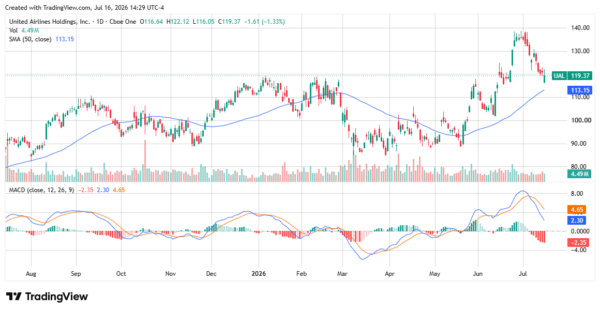
UAL’s chart tells a story of a stock that ran too far, too fast, and is now catching its breath. Shares climbed from roughly $90 in March to an intraday high near $140 in early July — a rally of more than 50% in about four months. Since that peak, the stock has pulled back to the $119 level, still comfortably above its 50-day moving average near $113, but clearly rolling over from a short-term high.
The MACD indicator backs that read. Momentum turned negative in the days leading into earnings, with the MACD line crossing below its signal line after a strong run higher. That’s a classic sign of a stock cooling off after an aggressive advance, not necessarily a reversal of the broader uptrend. The 50-day average is still rising and still well below the current price, which is typically a bullish long-term signal even during a short-term pullback.
Put together, the earnings-day drop looks like a “sell the news” reaction. Traders who bought the March-to-July rally took profits on a genuinely good quarter, rather than reacting to any real deterioration in the business. That’s a common pattern after a stock has moved this fast, and it doesn’t necessarily change the longer-term picture.
The Airline Dividend Problem
Here’s where I’ll admit a longstanding bias that I, along with many investors, hold against most airline stocks: they generally don’t pay you to wait. Airlines run on thin margins and high fixed costs. If they do offer dividends, those are usually among the first things cut when fuel spikes or demand softens. United doesn’t currently pay one. If shares chop sideways or drift lower for a few quarters, buy-and-hold investors get nothing for their patience.
That’s part of why Delta Air Lines’ (NYSE: DAL) recently announced 15% dividend increase stands out by comparison. It gives investors a tangible reward for holding through volatility that United shareholders simply don’t get. But United’s situation isn’t hopeless for income-minded investors. It just requires a different tool than a dividend check.
An Options-Based Approach Worth Considering
With UAL sitting at $119.37 and September 18 options showing elevated implied volatility in the high-40% to low-50% range — still inflated from the earnings event — a covered call is worth a look for investors who already own shares and want to generate income while United works out its next direction.
Selling the September 19 $130 call, currently priced around $6.70, would collect roughly 5.6% of the stock’s current value in premium over about two months. That premium provides a cushion if shares drift sideways or dip modestly, and it still allows for meaningful upside — UAL would need to rally over 8.9% for the shares to get called away at $130, which is below the stock’s recent July high near $140.
For investors who don’t yet own shares but like United at a lower entry point, a cash-secured put tells a similar story from the other side. Selling the September 19 $110 put, priced around $5.06, generates immediate income while committing to buy shares roughly 8% below today’s price if the stock falls that far. The effective cost basis, if assigned, would work out to around $104.94 — a level the stock hasn’t traded at since before its spring rally began.
Either approach turns United’s lack of a dividend into a source of engineered income instead, using the options market rather than the balance sheet. It’s not a substitute for real dividend income, and it comes with real trade-offs: covered calls cap upside, and cash-secured puts require being comfortable owning the stock if it falls further. But for investors already inclined to hold UAL through this fuel-cost cycle, it’s a way to get paid for the wait.
Is United Airlines Stock a Buy After Earnings?
United’s second quarter showed a business successfully navigating a genuine fuel-cost shock, with guidance raised despite it. The stock’s earnings-day dip looks more like short-term profit-taking after a steep rally than a referendum on the results. For investors sitting on shares and wishing United would pay them to hold on, the options market currently offers a reasonable way to generate that income while the fuel-cost recovery plays out over the next two quarters.


Tidak ada komentar:
Posting Komentar