
A Chinese Model Just Cracked the Chip TradeEvery desk on the Street is calling it DeepSeek 2.0. One date this week settles whether they're right.
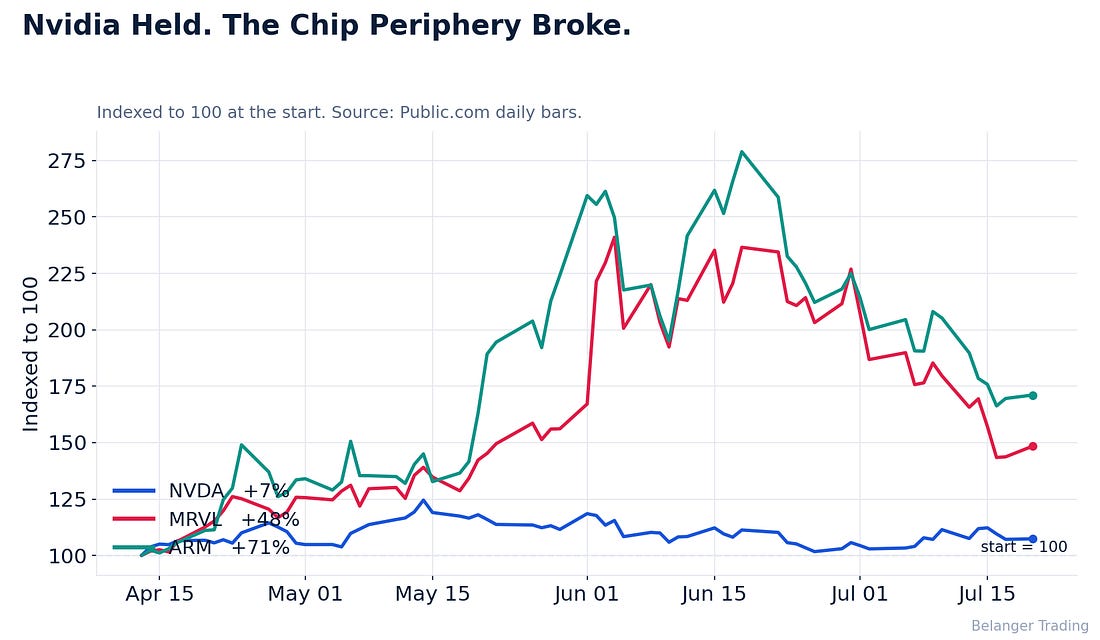
A new AI model out of Beijing just slammed the US chip trade into a bear market. The biggest names in semiconductors had been sliding from their June peak for weeks. Then a Chinese startup dropped one model. In two sessions it tipped them over the edge. They are now more than 20% below that peak, the textbook mark of a bear market. Those names are still up about 65% on the year. But nobody's comforted by that this morning. Every desk on the Street is reaching for the same four words: DeepSeek all over again. So is this really DeepSeek 2.0, or a panic that only looks like it? There is a clean way to tell the two apart, and it settles on a date this week.
The Scare Isn't Cheap AI. It's China Catching Up.Rewind to January 2025. A Chinese lab called DeepSeek said it had trained a top-tier AI model for about $5.6 million. That was pennies against the $100 million-plus the US giants were spending. The fear was instant. If world-class AI suddenly costs almost nothing, who needs all those Nvidia chips? Nvidia lost about $590 billion of its value in a single day. The biggest one-day wipeout any company has ever taken. That was a price scare. Cheap AI, so maybe the world needs far less computing power. This new model is the opposite of cheap. Kimi K3 comes from a startup called Moonshot AI. It is billed as the largest open-weight model ever built. And Moonshot prices it like a premium US model: $3 and $15 per million tokens. Reported as the most a Chinese lab has ever charged. A model that big has to run somewhere: data centers full of the exact chips the market just started dumping. So this is not "AI got free." Moonshot's pitch is that it caught up to the best US models. The company says it got there despite the export controls, not around them, by wringing more out of less compute. Those controls were built to keep China's chips a generation behind. That is a "China caught up" scare, a different animal from a "nobody needs compute" scare. The market grabbed the wrong one off the shelf. The tell is in how that last scare ended. After DeepSeek, the companies writing the checks did not blink. They doubled down. Hyperscaler AI spending was around $400 billion in 2025. For 2026, the four giants guided to roughly $725 billion. Microsoft's Satya Nadella called it the Jevons paradox. Make something cheaper to use, and people use far more of it. Nvidia clawed back that $590 billion within a few weeks, then ran to new highs. That is the decoder. A cheap-AI scare, run once already, that ended with the buildout getting paid more. The Check-Writers Answer on WednesdayThe tape half-knows this, even while it panics. If the market truly believed AI suddenly needs fewer chips, it would gut Nvidia first. It isn't. Nvidia slipped about 3.5% Friday and held. The damage is one rung down. Marvell, ARM, Intel and Micron each sit more than 30% off their highs. Those are the suppliers of the AI buildout beyond Nvidia, the names priced for perfection. That is where it is bleeding out. So what settles it? Not another model out of Beijing. The people writing the capex checks, out loud, in days. Alphabet reports first, this Wednesday. It is one of the exact firms whose spending refuted DeepSeek in January. If those checks keep climbing, the panic is a replay. If one of them flinches and blames cheaper models, this time is different. A model release does not re-rate a trillion-dollar buildout. The spending behind it does. What to Watch
BELANGER TRADING SQUAWK · daily market commentary from the trading desk on what matters on Wall Street Josh Belanger's results are not typical and are not a guarantee of your success. Josh is an experienced investor and your results will vary depending on education, work experience, and background. Josh does not personally participate in every investment alert he provides. Due to sensitivity of financial information, we do not know or track the typical results of our students. Josh’ strategies may not always be accurate, and his investments may not always be profitable. They could result in a loss of an entire investment. We cannot guarantee that you will make money or that you will be successful if you employ his trading strategies specifically or generally. Consequently, your results may significantly vary from his. We do not give investment, tax, or other professional advice. Reference to specific securities should not be construed as a recommendation to buy, sell or hold that security. Specific securities are mentioned for informational purposes only. All investments involve risk, and the past performance of a security, industry, sector, market, financial product, investment strategy, or individual’s investment does not guarantee future results or returns. Investors are fully responsible for any investment decisions they make. Such decisions should be based solely on an evaluation of their financial circumstances, investment objectives, risk tolerance, and liquidity needs.
|




Tidak ada komentar:
Posting Komentar