
Monday's headline read like the biggest order in the history of the AI trade. On paper… but the tape hit the stock 5% for it. The report: Nvidia is in talks to backstop as much as $250 billion of debt. That debt pays for a 10-gigawatt data center campus for OpenAI. Under the rule that has paid for three years, that stock rips. It opened higher, got sold all day, and closed a dollar off its low. The companies doing the spending closed green on the same tape. Microsoft, Alphabet, Apple. Oracle up 4.3%. If you own it, the best headline in the company's history reached into your account and took money out. The customers got paid instead. So what do you actually own?
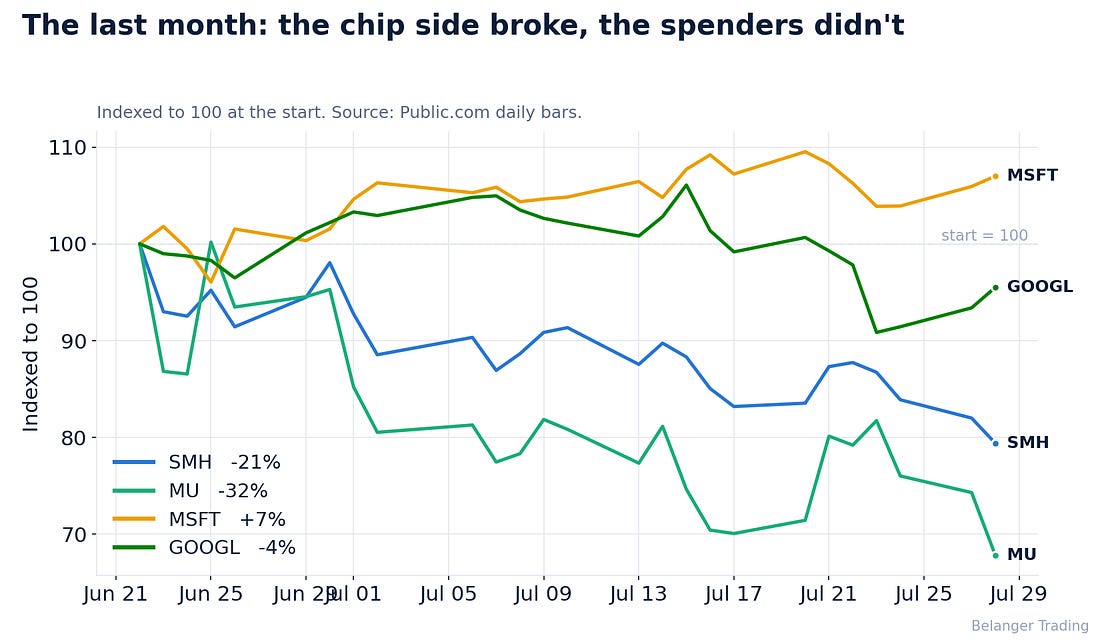
Nvidia Was Safe Because Someone Else Was PayingThat arrangement came apart, and not in one session. Through Monday's close, over the last 21 trading days, SMH, the biggest chip ETF, is down about 14%. Micron is down about 26%. Microsoft is up about 10%. Over the past year those two sides read backwards: SMH up 88%, Microsoft down a quarter. Nvidia was the holdout. The complex bled all month while it sat flat. Monday it stopped holding. The same headline paid the other way last September. On the first OpenAI-Nvidia deal, $100 billion of it, Nvidia rose 3.9%. Microsoft, Meta and Amazon fell. That was Nvidia buying in: money into OpenAI for a stake. Monday's $250 billion is a backstop: all of the risk, none of the ownership. The tape did not change its mind about chips. It changed its mind about who carries the bill. An order is a customer paying Nvidia. A backstop is Nvidia promising to pay if the customer can't. It puts Nvidia's balance sheet behind somebody else's rent. The Street's line all year: the shovel sellers get paid no matter how the AI bet turns out. That ends the second the shovel seller signs for the buyer's debt. And the buyers' credit is already cracking, on the record. S&P cut Oracle to BBB- on July 9, one notch above junk, on its concentration in OpenAI. OpenAI has no investment-grade rating. It burned $3.7 billion in the first quarter on $5.7 billion of revenue. These deals are not graded on demand anymore. They are graded on who eats the loss. The Last Supplier That Did This Wrote Off $700 MillionLucent was the telecom equipment giant of the last buildout. It put up to $2 billion behind WinStar, a customer that used Lucent's money to buy Lucent's gear. In 2001, WinStar came back for another $90 million. Lucent said no. WinStar was forced into bankruptcy. Lucent wrote off $700 million. One $90 million no, and a $700 million hole in the seller's own books. That is what happens when the seller is also the lender. The equipment makers kept printing highs for months after the market rolled over. Then they ate the lost sales and the bad loans at once. Jim Cramer, on CNBC's Mad Money Monday night: "What we learned in 2000 is that you don't lend to customers who buy your goods." A backstop is not a loan. It is the same trade in a cheaper wrapper: the bill only shows up if the customer can't pay. Lucent's number was $2 billion. Nvidia's is $250 billion. And the crowd is on the wrong side of it. BofA's July fund manager survey puts "long global semiconductors" at 82%. That is the most crowded trade in the survey's history, and BofA's own words are "no one is short." The survey closed July 9. The headline landed July 27. Everybody long. Nobody short. On the side that just got handed the credit. Through Tuesday afternoon the selling widened past Nvidia. Micron and AMD got hit. Alphabet and Microsoft held green. Nvidia was flat. The desk's Stock Market Crash Watch page walks the dials this shows up in first: breadth, credit, and who is leading. Demand is not what moved here. No order has been cancelled. What changed is the terms. This is not a sell call on a report nobody has signed. It is a re-label. Nvidia is a credit trade wearing a chip ticker until Oracle's rating says otherwise. The chip side is not the safe side anymore. Anyone still calling it that is trading a rule that stopped working a month ago. What to Watch
BELANGER TRADING SQUAWK · daily market commentary from the trading desk on what matters on Wall Street The content on BelangerTrading.com, including historical market data, trading strategy documentation, and analytical context, is published for informational and educational purposes only. This is not investment advice, investment recommendations, or personalized guidance. No one at BelangerTrading.com, including Josh Belanger, is a registered investment adviser, and we do not provide investment, tax, or legal advice. Contributors and employees at BelangerTrading.com may use trading strategies or hold positions in securities discussed on this website. We publish historical data and strategy context; contributors may participate in trades based on these strategies, but we do not publish individual trading results or performance. This content is not a recommendation to buy, sell, or hold any particular security or strategy. Your actual results will vary significantly based on numerous factors including timing of entry and exit, execution prices, capital size, position sizing, trading skill and discipline, market conditions, volatility, liquidity, tax treatment, brokerage fees, and other factors beyond your control. Past performance does not guarantee or predict future results. All investments involve risk, and trading strategies may result in substantial loss, including loss of your entire investment. Your investment and trading decisions are entirely yours, and you are solely responsible for them. Before trading, conduct your own due diligence and consult qualified financial, tax, and legal professionals regarding your specific situation.
|




Tidak ada komentar:
Posting Komentar