 If you still haven't downloaded my "Safe Trade Options Formula" book... ...please take a few seconds and download it right now before your new temporary download link expires. I eventually plan to charge for this book, so do yourself a favor and download it now... That way, no matter how much it is in the future, you'll have a copy on your computer already. Make sense? FREE: Safe Trade Options Formula << Download Now Good Trading,
Bill Poulos p.s. Go here to save a copy of my "Safe Trade Options Formula" book to your computer before I start charging for it.
This Week's Exclusive News
Dave & Buster’s Q1 Miss Raises the Stakes for Its Turnaround PlanWritten by Thomas Hughes. Originally Published: 6/17/2026. 
Key Points
- Dave & Buster’s missed Q1 expectations as comparable sales fell, keeping pressure on a stock already trading near multiyear lows.
- The company returned to positive adjusted free cash flow, giving management more flexibility as it tries to stabilize the business.
- The turnaround case depends on whether remodels, menu changes and better guest traffic can offset weak discretionary spending.
- Special Report: Three oil giants buried the same discovery for 50 years
Dave & Buster’s (NASDAQ: PLAY) price action is not encouraging for bulls. The stock has trended lower for more than two years and could continue to drift lower. The Q1 earnings release failed to meet expectations, setting the stage for new lows. The caveat is that PLAY stock is already trading at historically low levels, near the lows seen during the height of COVID-19 fear, and the release showed signs of traction.
While comps remain an issue, the Back-to-Basics strategy is improving food sales and cash flow metrics, both of which are central to the stock’s outlook. In this scenario, PLAY’s downtrend may be played out, and a price recovery could lie ahead. 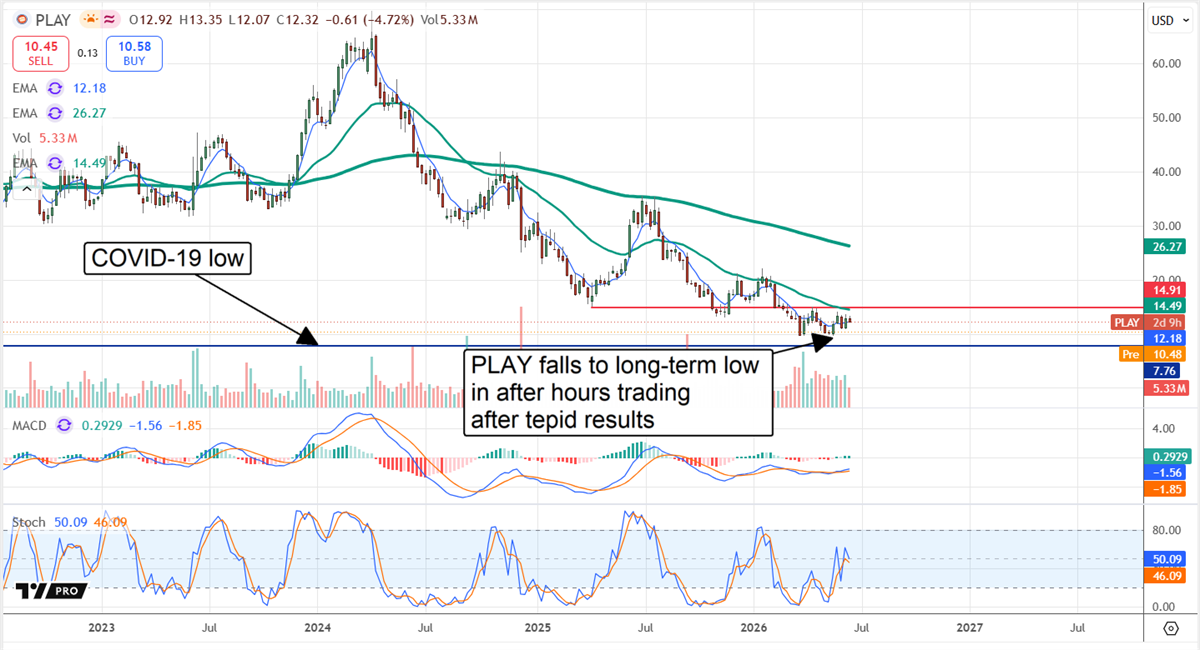
Dave & Buster’s Reverts to Free Cash Flow in Q1Dave & Buster’s is a growth story gone awry, but it is also trying to become a recovery and capital-return story. The company has historically used cash flow to fund opportunistic share repurchases, which could remain in play if the turnaround gains traction. Although Q1 results fell short of expectations, Dave & Buster’s reported a small quarterly profit and returned to positive adjusted free cash flow. The result was modest compared with prior periods, but it was enough to help the company build cash despite continued investment in new stores and remodels. Looking ahead, management plans a less aggressive capital expenditure year for 2027 than initially reported, focusing on free cash flow (FCF) and the leverage it provides. Dave & Buster’s did not buy back shares in Q1 but will likely do so as the year progresses, given the FCF outlook. As it stands, trailing-12-month activity contributed to a 0.7% average share count reduction in FQ1. Institutional trends suggest they, too, may buy PLAY stock in July and throughout summer 2026. The group owns more than 90% of the stock and, after selling in 2025, returned to buying in 2026. Q1 activity reflects group rotation, with selling spiking alongside buying, but the overall balance is bullish for investors. Activity in early Q2 is less robust overall but still comes with a more bullish balance of approximately $2 bought for every $1 sold. The likely outcome is that buying accelerates at lower stock prices, with critical support in the $8 to $10 range. Dave & Buster’s Falters on Weak Store TrafficDave & Buster’s Q1 results revealed some budding strengths but also persistent weaknesses. The company’s $559.2 million in net revenue was down 1.5% year over year (YOY) and came in $21.4 million below consensus on a 5.4% decline in comp sales. Comp sales are the critical factor in PLAY’s rebound thesis and are expected to provide a catalyst this year. As weak as the Q1 results are, management remains confident in the outlook for positive full-year comps and new-store growth. Store count is up approximately 4% as of Q1’s end and is expected to rise by another 100 to 200 basis points by year-end. The margin news is also uninspiring, but again, there is a catalyst at hand. Gross margin expanded incrementally but was offset by higher costs, resulting in profit compression. Cost increases tied to wages, labor and other drivers are accelerating deleveraging as revenue declines. The catalyst is a return to positive comp sales, revenue growth and improving margins. Analysts Wait and See: Trends Highlight Deep Value OpportunityDave & Buster’s analyst trends have contributed to the stock price decline and remain bearish, but the market may have overreacted to the change. Trading around $12, the stock remains deeply discounted to analysts’ average price target, leaving meaningful upside if the turnaround gains traction. A move toward that target is unlikely without clearer evidence of recovery, but improving comps and profitability could provide the catalyst investors need. Until then, analysts remain cautious, with the consensus rating at Hold and the average price target near $20. Dave & Buster’s risk this year is high oil prices and inflation. High oil prices are underpinning inflation and impairing discretionary spending. In this environment, it may be difficult for PLAY to grow comp sales. Debt is also a risk. The company carries significant debt, and maintenance spending cuts into cash flow. If the turnaround fails to gain traction by year-end, the company’s ability to continue as-is will be in jeopardy. Catalysts include a renewed focus on targeted store remodels, menu changes, new games and Eat-and-Play offers. Management’s Back-to-Basics strategy appears to be helping food and beverage sales, but the stock likely needs clearer evidence that those gains can translate into better traffic, stronger comps and improved margins. The company is also still opening new stores and expanding internationally through franchise partnerships, giving it longer-term growth levers if the core business stabilizes. . |



Tidak ada komentar:
Posting Komentar