
A Message From Paradigm Press
Below is an important message from one of our highly valued sponsors. Please read it carefully as they have some special information to share with you.
Dear Reader,
URGENT: If you own a home, please review the map below.
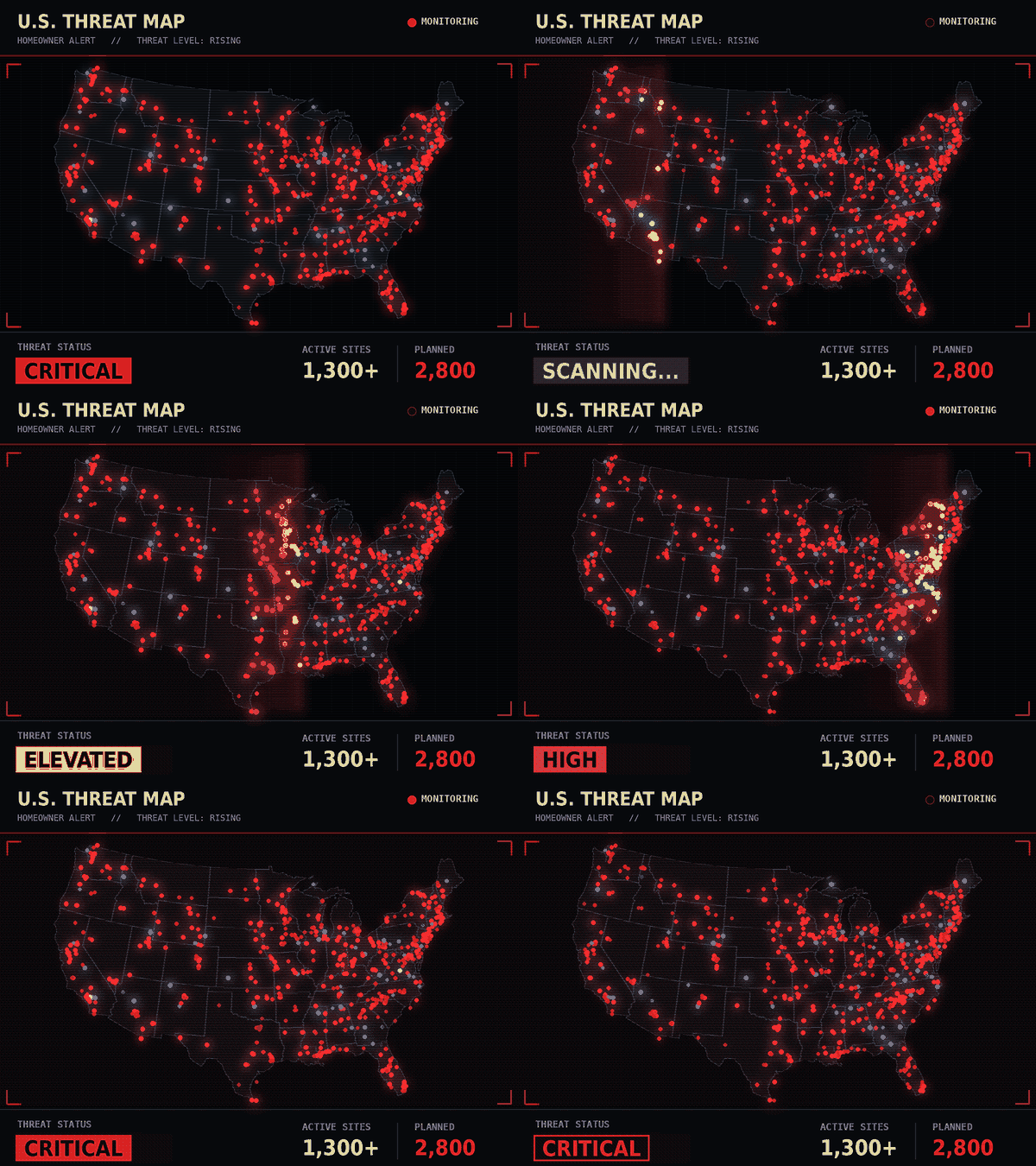
Look closely. Find where you live.
Do you see a red dot near you?
There are more than 1,300 of these red dots scattered across the country.
This threat is tearing apart American communities, homes and families, one by one.
In Georgia, families have been forced to sell their homes.
In Ohio, entire neighborhoods are being torn down. One family is packing up 23 years of their life.
At Lake Tahoe, nearly 50,000 residents will be without power.
Town halls are packed. Protests have erupted in dozens of states. Homeowners are begging for it to be stopped.
But it doesn’t seem to matter.
Because 2,800 more red dots are already on the way.
If there isn’t one near you now, there will be SOON.
I spent decades advising the Pentagon and the U.S. intelligence community on threats to this country.
I helped run the Pentagon’s first ever financial war game. I’ve studied attacks on our currency, our markets and our economy.
But what’s happening right now is unlike anything I’ve ever seen.
BUT there’s still hope.
There’s one man that can stop this threat from spreading any further… before it ruins more American families.
And he isn’t in Washington.
>> Click here for the full details, and what it means for you <<
Regards,
Jim Rickards
Featured News from MarketBeat
SpaceX's Wild Ride Puts 2 Space Stocks and a Weekly-Payout ETF in Focus
By Nathan Reiff. First Published: 11/18/2026.

Key Points
- SpaceX shares have fallen 12% since the company's IPO roughly six months ago, with Tesla merger speculation adding further investor uncertainty.
- Rocket Lab posted 73% year-over-year revenue growth and a $3.6 billion backlog, with its 2027 Neutron rocket launch seen as a major future catalyst.
- Intuitive Machines' NASA lunar contracts could be worth up to $15 billion, while the SPCI ETF provides weekly distributions despite being down 42% since its 2026 launch.
- Special Report: Every Day Trader Needs To See This Black Friday Offer
Less than six months after the IPO of SpaceX (NASDAQ: SPCX), the company has been on a turbulent journey that continues to attract investor attention—although not always for positive reasons.
Elon Musk's aerospace firm made headlines for its dramatic post-IPO price drop, although it is now down a more modest 12% since its launch. The company's largely successful November 2026 Starship launch was a positive development, while speculation about a potential merger with Tesla (NASDAQ: TSLA) has introduced another layer of uncertainty for investors.
For investors looking beyond SpaceX, two companies offer distinct growth opportunities: Rocket Lab (NASDAQ: RKLB) and Intuitive Machines (NASDAQ: LUNR). Meanwhile, the Tuttle Capital Space Industry Income Blast ETF (BATS: SPCI) offers another way to gain exposure to the industry. It uses an options strategy to provide weekly distributions, although those payouts don't eliminate the risk of losses.
Rocket Lab's Neutron Rocket Could Catalyze Growth in 2027
Though no single space stock can rival SpaceX's name recognition and market capitalization at this point, Rocket Lab may be the strongest contender. Its operations also include manufacturing satellites, rockets, and other craft; developing launch technology; and exploring defense applications, among other activities—all of which put it in direct competition with SpaceX.
The most recent earnings report highlights Rocket Lab's success in building its business, including 73% year-over-year (YOY) revenue growth and a massive $3.6 billion backlog at the end of the quarter. More than 55 spacecraft are in various stages of development or production, a sign that Rocket Lab is significantly scaling its operations.
Perhaps the biggest catalyst in the coming quarters will be the company's Neutron rocket, which is slated to launch in 2027. In the meantime, investors can expect increased costs associated with development and production. If the Neutron launch is successful, it would significantly expand the scope of Rocket Lab's missions and allow it to rival the offerings of other launch service providers, including SpaceX. However, both the outcome and timing are uncertain, and investors will need to be prepared to wait several months or longer before the company could see this benefit.
Another potential catalyst is Rocket Lab's acquisition of satellite company Iridium Communications (NASDAQ: IRDM), a major purchase that could significantly boost Rocket Lab's satellite business and is slated to close sometime in 2027. This is another reason analysts are broadly bullish on RKLB shares.
Intuitive Machines' NASA Contracts Could Fuel Future Growth
Intuitive Machines offers a different angle on the space industry by carving out a niche in the lunar transportation, infrastructure, and services market. Its relationship with NASA has been key to its success. In November 2026, the company announced that it had been selected for NASA's Commercial Lunar Payload Services 2 (CLPS 2) program. This multi-award contract could be worth as much as $15 billion in the coming years.
While the program is not exclusive to Intuitive Machines, the company may have an advantage over its competitors thanks to its prior CLPS task-order awards, including two earlier this year. As an established government partner, it may have a leg up in competing for future contracts.
Of course, these contracts don't necessarily mean immediate or steady revenue, as illustrated by a recent shift in the company's revenue outlook in its latest earnings report. Investors must be willing to accept some uncertainty, although analysts' Moderate Buy rating suggests they believe LUNR is worth the risk.
SPCI Offers Weekly Distributions, But Risks Remain
Unlike some other space ETFs, which primarily aim to capture price momentum across the industry, SPCI attempts to generate returns while using a put spread strategy to provide regular distributions.
Investors should expect to pay a bit more for an actively managed fund with this unique structure than they would for a traditional ETF. SPCI's expense ratio of 0.99% reflects that. The fund's weekly distributions may appeal to income-focused investors concerned about its returns: since launching early in 2026, the fund is down about 42%.Those payouts can include a return of capital, meaning the share-price decline alone does not reflect investors' total returns.
With a space ETF like SPCI, investors give up control over which individual space industry companies to target, and the fund's complex structure may make it difficult to assess how it builds exposure to specific companies. This makes the fund an option for investors seeking exposure to the space industry without maintaining an investment in SPCX, despite the uncertainty surrounding the company.
. |


Tidak ada komentar:
Posting Komentar