
A Message From Chaikin Analytics
Dear Reader,
I have a free stock recommendation for you today.
It's not Apple. It's not Nvidia. And it's not any of Elon Musk's publicly traded companies.
This company is powering a radical new engine in America's tech landscape:
The first national AI supercluster.
Right now, giant data centers like Elon's Colossus are gobbling up massive amounts of energy and real estate - yet they still suffer from a fatal flaw in computing precision.
This new AI supercluster is less than 1% the size of Elon's Colossus...
Consumes less than 1% of the electricity...
And yet... it's more than 1 trillion times more powerful, with the potential to speed up AI breakthroughs by 360 times.
That means it could deliver new breakthroughs in five days compared to five YEARS for Colossus.
As this rapid buildout gets underway, it could set off a $248 trillion opportunity in the markets.
And this single company is at the center of it.
Marc Chaikin, the 60-year Wall Street legend known as the "Billionaire Whisperer" for advising titans like Steve Cohen and Paul Tudor Jones, believes this stock could take off on an announcement or press release as soon as December 5.
To get in before then, see today's free stock pick here.
Regards,
Vic Lederman
Publisher, Chaikin Analytics
P.S. It trades on the Nasdaq, and you can buy it in minutes. Just don't wait past December 5.
Get the name and ticker before December 5 here.
This ad is sent on behalf of Chaikin Analytics, 201 King Of Prussia Rd., Suite 650, Radnor, PA 19087. If you would like to optout from receiving offers from Chaikin Analytics please click here.
Further Reading from MarketBeat.com
Viking’s Low-Water Miss Looks Like a Buy-the-Dip Opportunity
Submitted by Chris Markoch. Originally Published: 11/18/2026.
Key Points
- Viking Holdings missed revenue and earnings estimates for the third quarter, but low water levels on European rivers cut an estimated $100 million from results.
- Advance bookings growth is slowing overall, but ocean cruise bookings are rising sharply while river bookings remain flat due to voucher-related accounting adjustments.
- Despite the miss, Viking maintains a strong balance sheet with $4.1 billion in cash and continues share buybacks, suggesting potential opportunity if the stock weakens further.
- Special Report: Consider this your only warning
Viking Holdings (NYSE: VIK) delivered an earnings report that might have been expected to send the stock lower. But investors initially liked what they heard, and VIK shares held on to small gains after the report.
The cruise operator missed on both the top and bottom lines. Revenue of $2.18 billion rose 9.2% year over year but fell short of the roughly $2.21 billion analysts expected. Adjusted earnings per share (EPS) of $1.11 missed the $1.27 consensus estimate. It was also below the $1.20 Viking earned a year ago.
That's a contrast with the company's Q2 2026 earnings report. At that time, Viking beat on both the top and bottom lines, but VIK dropped sharply over concerns about a slowdown in advance bookings.
That slowdown in booking growth continued in the company's third-quarter report. Advance bookings for the 2027 season are 17% higher than at the same point last year. That’s down from 21% in August and 31% in May.
The company also faced a one-two punch from historically low water levels on European rivers, which weighed on revenue. Understanding this combination may explain why investors looked past the earnings miss.
Viking's $100 Million Setback: Low Water Levels Take a Toll
Historically low water levels on European rivers forced Viking to change itineraries during the quarter. The company still operated every scheduled voyage, but some guests canceled. Management estimates the disruption reduced third-quarter revenue and adjusted gross margin by about $100 million.
The impact shows up across the income statement. Occupancy fell to 91.3% from 96.0% a year ago. Net Yield, a key pricing metric, slipped 0.8%. Adjusted EBITDA margin fell to 48.5% from 52.8%. Adding back the $100 million, revenue would have topped the consensus estimate.
Viking also spent to protect its brand. It issued about $165 million in cancellation vouchers, and roughly 60% of affected guests have already rebooked. The company issued another $265 million in goodwill vouchers to guests who sailed despite the disruption. About half of those vouchers have been redeemed, mostly for 2027 sailings. Those rebooking rates suggest customer loyalty remains intact.
In Viking's case, low water levels provide a measurable explanation for the earnings miss, while the company's response suggests an effort to preserve customer loyalty.
A Tale of Two Fleets: Viking's Ocean Growth Outpaces River
The 17% headline number for advance bookings hides a sharp split. Ocean bookings for 2027 are 31% ahead of last year, despite only 18% more capacity. Ocean bookings per passenger cruise day rose about 11% to $873. That business has real pricing power.
The River segment is a different story. 2027 river bookings are flat year over year, despite 13% more capacity. Part of the explanation is accounting: Viking deducts the value of goodwill vouchers from river advance bookings, regardless of which product the guest books. Based on the company's figures, roughly $80 million in redeemed vouchers applies to 2027 sailings.
Even with that adjustment, river booking growth remains soft. But Viking's growth is tilting toward the ocean. Ocean ships will make up 52% of 2027 capacity, and management expects the ocean segment to be the largest driver of capacity growth for several years.
Has Viking Stock Already Absorbed the Bad News?
The miss may already be priced into VIK, presenting a potential opportunity for long-term investors. As of the Nov. 17 close, the stock was down about 14% from the all-time high it reached in August 2026. While the report was weaker than the company's previous results, low water levels in Europe provide a plausible explanation.
That doesn't mean the disruption won't continue to affect revenue and earnings in future quarters. Goodwill vouchers will reduce revenue in the seasons when those guests sail again, including 2027.
But further weakness could create a buying opportunity for investors looking to start or add to a position in Viking Holdings. Ocean demand is strong, and growth in ocean cruises could offset continued softness in river cruise traffic.
The balance sheet gives Viking room to absorb the hit. The company ended the quarter with $4.1 billion in cash and net leverage of 1.2 times. It also bought back $350 million of stock during the quarter under a $1 billion authorization.
Viking's Next Test: Technical Support and Booking Growth
The chart supports a patient approach. VIK trades above its 200-day simple moving average near $86 and its 50-day average near $84. However, the 50-day average crossed below the 200-day in late October, a bearish signal many traders watch.
A pullback toward the $84 to $86 range could offer a better entry point. The October low near $78 marks the next support level.
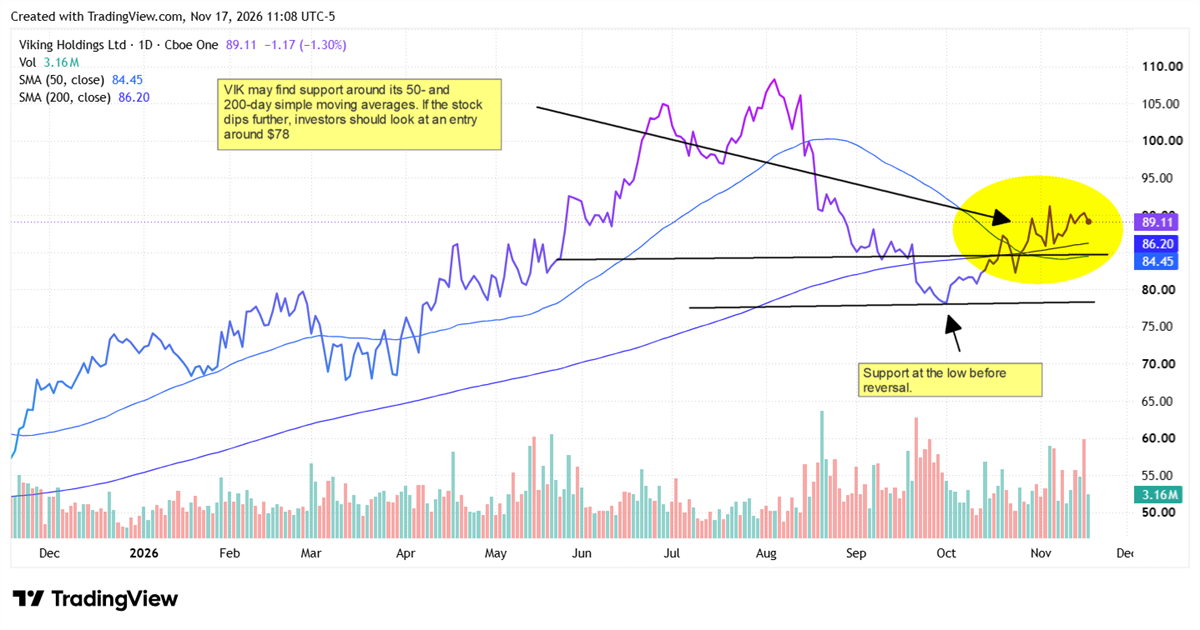
The metric to watch is the gap between booking growth and capacity growth. At 17% versus 15%, that gap is narrow. If 2027 booking growth falls below capacity growth, the bull case weakens. Until then, the slowdown looks like a river problem inside an increasingly ocean-driven company.
. |


Tidak ada komentar:
Posting Komentar