
A Message From Porter & Company
I never thought I’d see this again…
I thought what happened 25 years ago was a once-in-a-lifetime event… but how wrong I was… because a quarter of a century later it’s happening again… and it’s about to upend everything.
For those who understand what’s unfolding, I believe this could be one of the greatest wealth-building phenomena of their lives.
But for those who bury their head in the sand… this change threatens to wipe out years of investment returns.
Here’s the full story:

25 years ago, I started telling friends, family, and anyone who would listen about an unprecedented societal shift that was barreling down on us.
I’d discovered that a new technology was about to unleash massive, almost unimaginable, changes in America.
I likened the impact to that of the railroad boom… the Industrial Revolution… and the rise of personal computing.
At the time, I was working as an investment analyst for an elite research group, but my colleagues and bosses refused to listen to me.
No matter what I said, they simply would not acknowledge the sands shifting beneath their feet.
The legendary Dr. Kurt Richebacher – one of the world’s leading Austrian economists – even called me and my ideas “radical.”
But I was certain this new technology would trigger a transformation that was simply unfathomable to most people and those on the frontier could reap financial returns unlike any the world had ever seen before.
So, I decided to put my entire career – not to mention every cent I had – on the line to spread the story myself.
I left my job as a research analyst, went home to my third-floor apartment in one of Baltimore’s worst neighborhoods, and with a borrowed laptop I wrote my first major financial prediction.
In a report that was read by more than 100,000 people… I explained how the endless miles of new fiber optic cables being laid was creating a new railroad across America.
And that I believed this new “railroad” was going to upend the telecommunications industry and pave the way for a new internet economy.
I also warned it would decimate some of America's most dominant companies like AT&T.
At the time, this was an outlandish idea, with analysts calling AT&T “dominant”, “unstoppable”, and “the giant that no other company can topple.”
But those who were willing to open their minds to my so-called “radical” ideas were not only able to sell these companies before they collapsed…
They also had the chance to get in early on the firms that would go on to command this new internet economy:
Amazon, Adobe, Qualcomm, Sun Microsystems, Uniphase, Texas Instruments, and many others.
While these are household names now, when I first recommended them in the late ‘90s, they were complete unknowns.
Since then, long-term readers will know that I’ve issued a number of other predictions – and while I’m not always right – many of them have come to pass.
Now, I’m coming forward with a new prediction that I believe could be the most important financial and economic story of the next several years.
Both for the good and the bad.
Because as I recently told my subscribers:
“This is the largest infrastructure build-out in America since the railroad boom. You know this will change your life and the lives of all Americans, in many ways.
You know fortunes will be made, fortunes measured in trillions of dollars.
But what you don’t know is: most investors are about to lose everything.”
I’m not talking about quantum computing, augmented reality, or the blockchain. I’m talking about the second wave of artificial intelligence.
You see, right now, there is a new railroad being built.
Hundreds of billions of dollars a year are going into AI data centers – computers the size of cathedrals, drawing electricity measured in gigawatts, rising out of farmland in Ohio, Wyoming, and Texas.
But just as we saw during the railroad boom and the fiber-optic boom, the "builders" are going to get completely crushed by their own infrastructure costs.
Worse yet because this colossal infrastructure build is triggering an efficiency shock that is driving the cost of compute down to near zero… the margins of major software and AI tech darlings could collapse.
So the question is not who is building the data centers. The question is: Which industry can absorb almost unlimited, near-free computing power and still defend its prices?
We have found the answer.
It’s a completely abandoned sector of the market that represents the largest computational puzzle on earth.
More importantly, it is the only industry where the government hands you a legal, federally enforced monopoly to protect your product for decades.
I believe this sector is about to absorb the capex of the AI boom, and it could be among the best-performing sectors of the stock market… the next Mag7.
I’ve recorded a new step-by-step broadcast outlining exactly what is happening, and exactly where this capital is rotating.
During the broadcast, I even give you the name and ticker symbol of my #1 large-cap stock to buy right now for this second wave.
So click here to watch my Ignition Point event immediately.
Good investing,
Porter Stansberry
Exclusive News
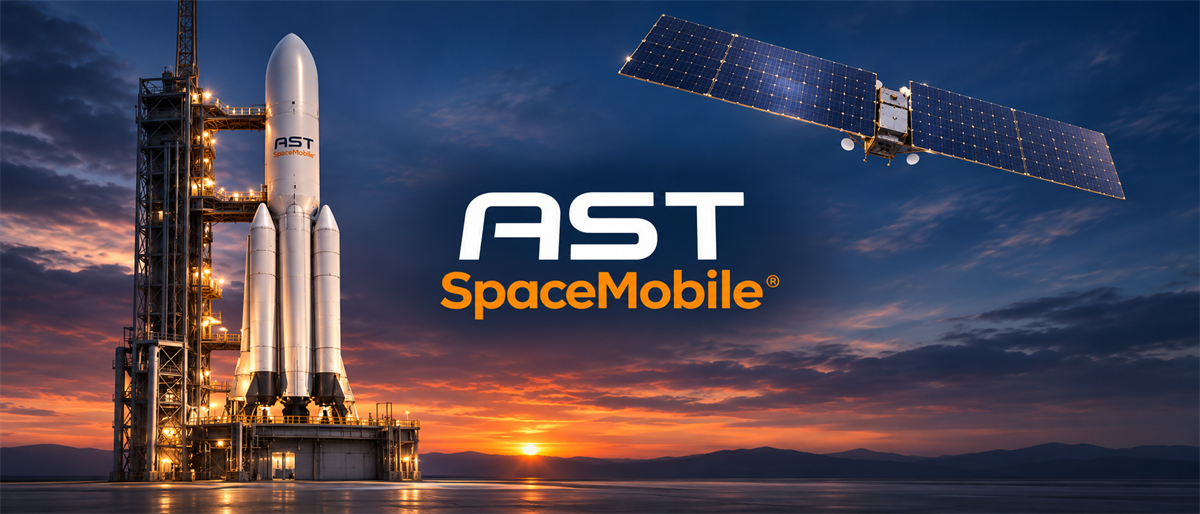
AST SpaceMobile Has a New Rocket Plan, But Its Cash-Burn Problem Isn't Going Away
Author: Jessica Mitacek. Publication Date: 11/11/2026.
Key Points
- AST SpaceMobile shares fell more than 8% after the company missed both earnings and revenue estimates for the third quarter, extending a long streak of misses.
- The company unveiled plans for its own reusable Blacklift rocket using Firefly Aerospace engines, a $1.3 billion deal intended to cut future launch costs.
- Despite rising spending and cash burn, AST SpaceMobile reaffirmed full-year revenue guidance and analysts maintain a consensus Hold rating with significant upside potential.
- Special Report: What AI can't run without, and why the crowd is ignoring it
Despite plans to build its own 20-ton rocket, the market continues to punish AST SpaceMobile (NASDAQ: ASTS).
Shares of the space-based cellular broadband network provider are down more than 8% since the company reported a bearish double miss after the market closed on Monday, Nov. 9.
The Midland, Texas-based company has now missed on earnings for seven consecutive quarters. Its Q3 revenue miss was the third in a row and the eighth in the past nine quarters. After the ensuing sell-off, the space stock was down around 75% from its all-time high on May 28, 2026.
As AST SpaceMobile continues to pursue global commercial direct-to-device (D2D) services before the end of 2026, it remains a sore spot in investors’ portfolios as legal challenges and an increasing threat from SpaceX (NASDAQ: SPCX) mount.
Another Earnings Miss Puts Cash Burn in Focus
On Monday, the company reported earnings per share (EPS) of negative 44 cents, missing the analyst consensus estimate of negative 41 cents.
Although revenue of $42.32 million marked a nearly 188% year-over-year (YOY) increase, it fell short of Wall Street’s expectations of $45.73 million.
Despite the miss, revenue growth wasn’t the only bright spot. AST SpaceMobile said it remains on track to begin intermittent nationwide service in the United States and other key markets before year-end 2026, with an initial rollout planned through partners in Canada, Japan, Saudi Arabia, and the United Kingdom. The company reports more than 60 mobile network operator partners representing over 3 billion subscribers globally.
It also reported validating a satellite-to-ground beam handover with AT&T (NYSE: T), with broader user beta trials expected to begin in early 2027. Additionally, the company is targeting production of six low Earth orbit (LEO) BlueBird satellites per month by December. That effort should help it build its LEO constellation to roughly 45 satellites in orbit by the middle of next year.
Management said the new ASIC offers 10 times the processing bandwidth of its first-generation BlueBird satellites, though deployment and production targets remain subject to execution and launch schedules.
AST SpaceMobile reiterated its full-year revenue guidance of $150 million to $200 million. But investors responded bearishly to the admission that spending is expected to rise through the remainder of 2026 and throughout 2027.
Q4 adjusted operating expenses, excluding the adjusted cost of revenue, are forecast at $130 million to $140 million, with capital expenditures (CapEx) of $400 million to $500 million. Management also expects several hundred million dollars in CapEx in 2027 tied to its recent pursuit of a rocket.
In his earnings call comments, CEO Abel Avellan noted that pursuing AST SpaceMobile’s own rocket, called Blacklift, “offers attractive ownership economics over the long term.”
But the company continues to face an uphill battle in the near term. In Q3, EPS improved just 2.22% despite strong revenue growth, while free cash flow to the firm deteriorated nearly 150% YOY, underscoring the company’s substantial cash burn. Although the net loss attributable to common stockholders of $132 million was an improvement over Q2’s $231 million loss, net cash used in operating activities rose 74% to approximately $169 million from $97 million in Q2.
AST SpaceMobile Plans Its Own Rocket: Blacklift Targets Late 2028 Launches
On Friday, Nov. 6, AST SpaceMobile announced that it will develop its own reusable rockets, called Blacklift. The 20-tonne heavy-lift rocket will use engines from Firefly Aerospace (NASDAQ: FLY) as part of a $1.3 billion agreement.
For buy-and-hold investors, this news couldn’t have come soon enough. While the company will still rely on third-party launch providers for the next two years, the Blacklift announcement marks a major long-term development that could dramatically reduce AST SpaceMobile’s launch expenses.
The agreement with Firefly covers engines for the first three Blacklift rockets, each of which will be capable of deploying five stacked BlueBirds into LEO at a time—a marked improvement over the three BlueBirds deployed at a time under current arrangements with SpaceX’s Falcon 9.
In the interim, the company said external launch agreements cover more than 100 LEO satellites for deployment in 2027 and 2028, while its own Blacklift rocket is targeted to begin launches in late 2028.
“We now have launches planned in 2027 and 2028 with SpaceX, Blue Origin, and others, supporting a planned 100 satellites in orbit,” Avellan said during the earnings call.
Management sees Blacklift as a way to improve launch access and long-term economics, but its development adds execution risk and does not replace the company’s near-term reliance on external launch providers.
Analyst Upside Potential Clashes With Elevated Short Interest
AST SpaceMobile has acknowledged that spending increased sharply this year to support its BlueBird constellation buildout.
Blacklift will add to that spending. But with the company reaffirming its full-year revenue guidance and addressing future cost burdens, its long-term growth outlook remains intact.
Of the 16 analysts currently covering the stock, six assign it a Buy rating, eight assign it a Hold rating, and just two assign it a Sell rating.
Overall, it carries a consensus Hold rating, with an average 12-month price target implying more than 100% upside.
But with a beta of 2.88, ASTS has historically been 188% more sensitive to broad-market movements, adding to the risks facing shareholders and making it an ongoing target for bears. Current short interest is approaching 22% of the float and stands at 67.5 million shares, out of more than 389 million shares outstanding.
Nonetheless, institutional investors continue to scoop up shares. Over the past year, buying has surpassed selling by $2.34 billion, compared with less than $413 million in selling.
. |


Tidak ada komentar:
Posting Komentar