If you haven't picked up the Instant Scanner in my Black Friday sale yet, let me guess where you are.
Maybe you're new to this and not sure you could use it.
Maybe your account is small and you wonder if it's meant for you.
Maybe you just want to see it work before you commit.
All three have the same answer.
Get it for $7. Watch it hand you the list every night — which stock, what price, when to exit. The list reads the same whether you've traded for twenty years or twenty days, and it doesn't ask how big your account is.
And if it's not for you, refund the $7 — and keep the scanner for the full year anyway.
There's no version of that where waiting helps you.
Home Depot’s New CEO Has a $30 Billion Growth Strategy to Prove
Posted On Nov 17, 2026 by Grayson Cavern
Home Depot (NYSE: HD) has spent about $32 billion expanding into professional building materials distribution, assembling a business that reaches contractors and construction projects far beyond its traditional store network. That investment has changed the company’s growth opportunity, but its third-quarter earnings suggest the financial benefits are still developing.
Table of Contents
Third-quarter fiscal 2026 revenue increased 4.9% to $43.40 billion, while adjusted EPS grew 3.2% to $3.86. Richard McPhail, the executive who helped oversee the acquisition strategy as CFO, is about to become CEO. His appointment puts the next phase of Home Depot’s expansion in the hands of someone who understands what the company has bought and what shareholders need to get back from it.
HD’s Q3 earnings offer an early indication that its expanded business is contributing to growth, even as the traditional home improvement market contends with cautious consumers and pressure on discretionary spending. Revenue increased from $41.35 billion to $43.40 billion, while comparable sales rose 2.2%. That comparable-sales increase matters because it shows the existing retail business is still contributing, rather than leaving the growth story entirely dependent on acquired revenue.
The composition of those sales also tells us where demand is coming from. Comparable transactions declined 0.5%, but the average ticket increased 3%, suggesting customers are spending more per visit even as slightly fewer transactions take place. That is enough to keep sales moving higher, although a sustained recovery in customer activity would provide a broader foundation for growth.
But the more critical detail is what happened after those sales came in. Gross profit increased 2.9% to $14.22 billion, while operating income advanced just 2.4% to $5.48 billion. Operating margin consequently narrowed to 12.6% from 12.9%. Adjusted EPS grew 3.2% to $3.86, compared with GAAP EPS of $3.72, which included $0.18 per share in acquired intangible amortization.
This is where the investment case becomes more demanding for me. Home Depot is growing revenue, but its operating profit is not keeping pace, suggesting the company has more work to do before its larger business can deliver stronger earnings leverage.
Home Depot’s $32 Billion Pro Expansion Opens A $1 Trillion Market
The acquisitions explain why Home Depot is willing to accept a longer period of integration before expecting the full financial payoff. HD Supply added approximately $8 billion in enterprise value in 2020, SRS Distribution followed at approximately $18.25 billion in 2024, and GMS added another $5.5 billion in 2025. Together, these transactions represent approximately $31.75 billion invested in building a much broader professional distribution operation.
The strategic value is in what the businesses can offer together. HD Supply strengthened Home Depot’s maintenance, repair, and operations distribution business, SRS added roofing, landscaping, and pool supplies, and GMS brought drywall, ceilings, and steel framing into the portfolio. Home Depot can now serve contractors across more product categories and project requirements, with a wider distribution footprint and more opportunities to become a supplier they rely on repeatedly.
The SRS acquisition alone was expected to expand Home Depot’s addressable market by approximately $50 billion, bringing its total addressable market to around $1 trillion. That figure illustrates the scale of the opportunity, but market size alone does not create shareholder value. The real advantage comes if Home Depot can use its expanded network to win a larger share of contractor spending, cross-sell products, and fulfill more orders efficiently.
Now, the company expects fiscal 2026 sales growth of approximately 4.5%, yet adjusted EPS growth is forecast at only 2%, with operating margin around 12.4%. The company has substantially increased the market it can serve, but the earnings contribution still has room to develop. That gap is what makes the CEO transition important.
Richard McPhail Must Make The Acquisitions Pay Off
McPhail is taking over a strategy he helped shape as CFO, with responsibility for capital allocation, corporate strategy, and business development placing him close to the decisions behind HD’s expansion. His appointment is pivotal to the company moving into a different phase of the acquisition cycle. The priority is shifting from adding distribution businesses and market access to making those businesses contribute more meaningfully to consolidated earnings.
That means investors should pay particular attention to operating margins and returns on invested capital over the coming quarters. A larger distribution network should create opportunities to improve fulfillment, deepen contractor relationships, and generate more sales from existing customers. If those advantages fail to translate into better profitability, the company risks carrying a much larger cost base without earning an adequate return on the capital committed to building it.
The good thing is, HD has the cash generation to support the strategy. Operating cash flow reached $15.50 billion in the first nine months of fiscal 2026, up from $12.98 billion a year earlier. After $2.68 billion in capital expenditures, free cash flow stood at approximately $12.82 billion. However, working-capital outflows declined sharply from $2.69 billion to $358 million, explaining part of the improvement. The cash generation is substantial, but McPhail’s more important task is ensuring the acquired businesses eventually contribute stronger recurring profits.
HD Stock Still Has A $360 Ceiling
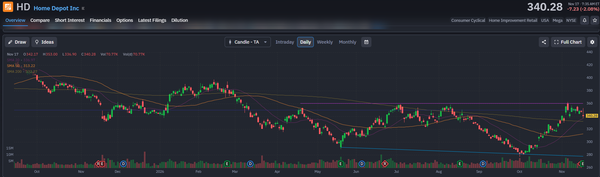
HD shares traded around $340.28 after retreating from the $350 to $360 resistance zone, following a sharp recovery from October’s lows. The stock remains above its 20-day moving average near $336.97, its 200-day average around $332.37 and its 50-day average near $313.22, leaving the broader recovery structure intact.
The $332 to $337 area now provides an important support cluster, while a decisive move above $360 on stronger volume would confirm that buyers are prepared to extend the recovery. A breakdown below that support zone would weaken the setup.
McPhail now has to turn Home Depot’s $32 billion expansion into stronger returns. That is the catalyst that could carry HD beyond its current resistance.
Today’s editorial pick for you
EnerSys’ Flat Sales Hide a Fast-Growing Defense and Data Center Business
Posted On Nov 12, 2026 by Grayson Cavern
EnerSys (NYSE: ENS) generated $949.9 million in second-quarter revenue, virtually unchanged from a year earlier. Yet adjusted operating earnings increased 13.7% to $152.4 million, while adjusted diluted EPS climbed 22% to $3.22.
Table of Contents
The company is finding ways to earn more from its existing sales base, even as weakness in parts of its industrial business holds back revenue growth. The segment breakdown reveals where that improvement is coming from.
PPS generated $103.8 million in revenue, up 21%, while adjusted operating earnings climbed 43.2% to $22.7 million. Its adjusted operating margin reached 21.9%, compared with 18.5% a year earlier. NIS produced $449 million in revenue, up 3.3%, but adjusted operating earnings increased 38.3% to $50.1 million as its margin expanded from 8.3% to 11.2%. Management specifically cited double-digit data-center growth.
Industrial Mobility Solutions (IMS) remains the counterweight. Revenue fell 7.8% to $397.1 million, and adjusted operating earnings dropped 13.4% to $37.5 million. Material handling is still the principal drag. Management sees early signs of recovery, but expects transportation growth to outpace higher-margin material handling next quarter, putting pressure on IMS margins.
It’s easy to see why EnerSys is gaining ground from that contrast. PPS is converting higher sales into faster earnings growth, while NIS is generating substantially more operating profit from modest revenue growth. This means the company does not need every end market to rebound simultaneously if these businesses keep expanding.
Ultralife Could Deepen The Defense Opportunity
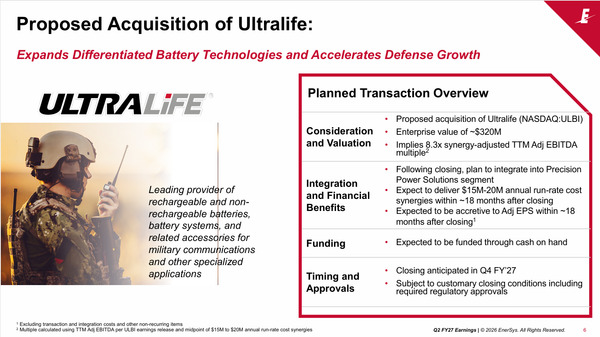
EnerSys‘ proposed acquisition of Ultralife fits the growth already emerging in PPS. Announced October 27, the transaction is intended to broaden EnerSys’ battery technologies and accelerate its position in defense markets. PPS already benefits from demand for soldier power and munitions, and Ultralife could widen the product offering and strengthen EnerSys’ ability to serve U.S. and allied military customers.
The deal remains subject to regulatory approvals and customary closing conditions, and EnerSys excluded Ultralife from Q3 guidance. And I’d treat it as potential growth, not revenue already captured.
Earnings Growth Needs To Translate Into Durable Sales
Adjusted operating earnings rose 13.7% to $152.4 million, while adjusted diluted EPS increased 22% to $3.22. However, the quarter included $44.4 million of 45X manufacturing tax credits, worth approximately $0.80 per diluted share after tax. Excluding that benefit, adjusted EPS was $2.02, still 25% above the prior-year $1.61. Gross margin improved to 29.9% from 29.1%, while the margin excluding 45X edged up to 25.2% from 24.9%. Underlying improvement is real, but headline EPS includes a substantial government incentive.
First-half cash generation improved despite a weaker quarterly comparison. Q2 operating cash flow was $142.8 million and free cash flow $130.4 million, both below the year-ago quarter, which benefited from a federal tax refund. For the first six months, operating cash flow rose to $372.8 million from $219 million, while free cash flow more than doubled to $348 million from $165.1 million. Net debt stood at $554.9 million, with leverage down to 0.8x EBITDA from 1.3x.
EnerSys returned $140.3 million to shareholders, including $130 million in buybacks and $10.3 million in dividends. For Q3, management expects revenue of $935 million to $975 million and adjusted diluted EPS of $3.05 to $3.15, including 45X credits. Data-center and defense gains must keep widening while material handling stabilizes.
ENS Stock Is Still Fighting Its Downtrend
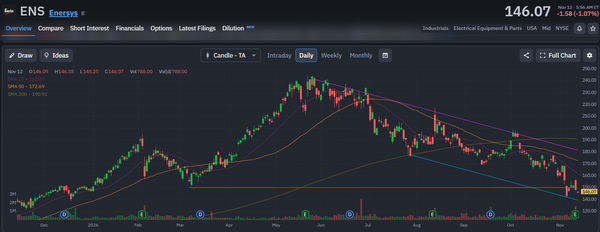
EnerSys shares have fallen to $146.07, putting them below the 20-day, 50-day and 200-day moving averages at $161.83, $172.69 and $190.91, respectively. The stock has been making lower highs since its May peak near $240, and the recent break below $150 shows sellers are still dictating the direction. The 140–145 area is now the next place to watch for buyers to step in.
A bounce from here could give ENS some much-needed relief, but I’d want to see it reclaim $150 first. The 20-day average is the next level to watch, followed by the 50-day. Getting back above those levels would give the recovery some credibility. Right now, though, ENS remains in a clear downtrend, and buyers have yet to show they can turn it around.
Added To The Watchlist
EnerSys is building a stronger earnings base through data centers and defense, with Ultralife offering another potential boost. But IMS remains weak, consolidated revenue has barely grown, and 45X credits lift adjusted EPS even as the stock remains below every major moving average.
I’d keep ENS on the watchlist rather than chase it here. The operating story is improving, but the chart has not turned and management’s near-term sales outlook does not signal a breakout in consolidated demand. A sustained move above $150 would signal buyers are returning. Until then, the downtrend deserves respect.




Tidak ada komentar:
Posting Komentar