Analog Devices (ADI) Bets $1.9 Billion on Industrial Boom Still to Come
Posted On Nov 25, 2026 by Grayson Cavern
Analog Devices (NASDAQ: ADI) delivered record fourth-quarter revenue of $4.37 billion, up 42% year over year, and adjusted EPS of $4.06, beating Wall Street’s $4.32 billion and $3.89 estimates. Yet shares plunged 17.37% to $312.95 post-earnings because investors are looking beyond the record quarter.
Table of Contents
ADI is preparing to spend as much as $1.9 billion expanding capacity while a substantial portion of its customers have yet to return to normal purchasing levels. Management is investing ahead of a recovery that could unlock another growth leg, but it still has to prove that demand will arrive in time to justify the commitment.
Industrial Is Becoming the Other Half of the Story
Our Monday preview asked whether ADI could find another growth engine beyond data centers. The quarter delivered a compelling answer. Industrial generated $2.19 billion, representing 50% of revenue, while automotive contributed $1.04 billion, or 24%. They grew 55% and 21%, respectively. Communications advanced 81%, while consumer increased 7%.
The appeal is the breadth of ADI’s exposure. Industrial spans factory automation, aerospace and defense, and electronic test equipment, while automotive brings opportunities in advanced vehicle systems. ADI can participate in AI infrastructure spending without depending entirely on it. Industrial now accounts for half the business, giving the company a broader foundation for growth.
But the 55% industrial increase needs context. How much reflects a durable recovery across customers, and how much is concentrated in markets already performing exceptionally well?
The Customers ADI Is Waiting For
Management’s inventory commentary gives us the answer. Aerospace and defense, automated test equipment, and data centers are performing above their long-term consumption trends. Across much of the remaining customer base, shipments are still at or below those trends, and broad restocking has yet to materialize. This gap is the opportunity.
See, ADI has delivered record revenue without a full recovery across its customers. Which means that If broader industrial buyers begin ordering closer to their underlying consumption needs, the company could capture another leg of growth without requiring data-center demand to accelerate at the same pace.
But I wouldn’t assume that recovery is already here. Management expects industrial revenue to increase sequentially in Q1, but automotive is expected to decline low-single digits, and consumer could fall 10% to 15%.
A $1.9 Billion Bet on What Comes Next
ADI spent $733 million on capital expenditures in FY2026. For FY2027, management expects between $1.6 billion and $1.9 billion, more than double the previous year’s investment. The spending will support manufacturing capacity expansion.
That decision is understandable. If demand is building and manufacturing capacity is becoming a constraint, waiting until customers order more aggressively could leave ADI struggling to meet it. Expanding ahead of the cycle gives the company a chance to capture that demand.
But the commitment is substantial. ADI generated $5.45 billion in free cash flow during FY2026, equal to 36% of revenue, giving it considerable financial flexibility. Still, acquisitions, dividends and share repurchases also compete for that cash. The expanded manufacturing footprint must generate enough incremental revenue and cash flow to justify the investment.
The Earnings Beat Has a Quality Question
Adjusted gross margin reached 74.5%, compared with 69.8% a year earlier, while adjusted operating margin expanded to 52.3% from 43.5%. That is substantial operating leverage. However, Q4 GAAP operating margin was 42.7%, highlighting the sizeable gap between reported and adjusted profitability.
ADI excluded $415 million in acquisition-related expenses and $3.5 million in transaction costs from Q4 adjusted operating income. Full-year acquisition-related expenses reached approximately $1.6 billion. Much of this reflects acquired intangible amortization, but shareholders still need to see the acquisitions generate benefits that justify their costs.
Q1 guidance adds another complication, in that revenue is expected at approximately $4.4 billion, while adjusted EPS is forecast at $3.82, below the $3.89 consensus estimate. ADI is entering the new year with strong demand, but investors need evidence that growth and margins can support its enlarged capital base.
The Stock Now Has a Recovery of Its Own to Make
I like ADI’s business, but I want to see the $1.9 billion investment committed to capacity expansion translate into stronger orders and profitable growth before getting more aggressive.
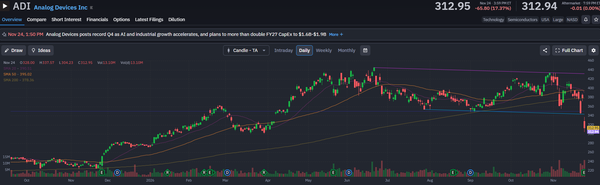
Technically, ADI closed at $312.95, down 17.37%, after breaking below the $350 support area. The selloff also pushed shares beneath their 20-day moving average at $390.51, 50-day at $395.02, and 200-day at $378.36. All three now sit overhead, creating a substantial resistance zone between $378 and $395.
The session low of $304.23 is the first level I’d watch on the downside. A break below it would leave the stock searching for another support area. On the upside, reclaiming $350 would be an early sign that buyers are returning, but I’d want to see the shares push through the 200-day average and eventually the 390-395 cluster before calling this a meaningful trend reversal.
For now, I’d keep ADI on the watchlist rather than rush into the selloff. The business has room to grow, but the chart needs to show that investors are ready to pay for that opportunity again.
Today’s editorial pick for you
Disney’s Streaming Profits Are Arriving As Its $35 Billion Expansion Begins
Posted On Nov 17, 2026 by Chris Markoch
Walt Disney (NYSE: DIS) spent years investing billions in streaming. At the same time, its traditional television business lost ground, leaving investors to wonder when the money would finally show up in the earnings.
Table of Contents
But the fourth-quarter earnings just showed Disney’s streaming investment is now translating into profits. Entertainment SVOD generated $2.57 billion in operating income during fiscal 2026, nearly double the previous year’s contribution, while Experiences produced another record $11.19 billion.
Disney now has three businesses contributing billions in operating profit, and management is preparing to spend $35 billion on content and physical expansion in fiscal 2027. The question is how much more earnings power that investment can create.
Disney Spent Years Promising This Streaming Transformation
Disney’s Entertainment segment generated $46.56 billion in fiscal 2026 revenue, up 10%, while operating income increased 16% to $5.44 billion. Streaming was a major contributor, with Entertainment SVOD operating income reaching $2.57 billion compared with $1.30 billion a year earlier. That’s a substantial change for a business that spent years absorbing the cost of building its subscriber base, securing content and competing for viewers against established platforms.
The fourth quarter delivered another strong reading, with SVOD revenue increasing 19% to $6.05 billion and operating income climbing to $824 million from $402 million. Subscription revenue grew 22%, supported by subscriber growth, higher effective rates, and the additional 53rd week. Advertising revenue increased 6%, although lower advertising rates offset some of the benefit from higher impressions. Disney estimates that the extra week contributed approximately $160 million to quarterly SVOD operating income, so the reported increase overstates the underlying improvement.
There is also a reporting change coming. Disney plans to stop disclosing standalone SVOD operating income from fiscal 2027, folding the measure into its broader Entertainment reporting. I would prefer the company kept that figure available. Streaming has only recently become a meaningful profit contributor, and investors should be able to track whether subscriber growth and higher engagement continue translating into better margins. Disney has finally put a number on streaming’s earnings contribution, just as it prepares to take that number away.
Management To Spend More On Parks & Experiences
Experiences generated $39.57 billion in fiscal 2026 revenue, up 9%, and $11.19 billion in operating income, an increase of 12%. That makes it Disney’s largest segment by operating profit. Q4’s revenue climbed 15% to $10.11 billion, while operating income increased 20% to $2.25 billion. Even excluding the additional week, the full-year segment delivered record revenue and operating income.
Domestic performance was particularly strong, with fourth-quarter Parks & Experiences operating income increasing 36% to $1.25 billion. International operating income fell 7% to $347 million, as weaker attendance at Hong Kong and Shanghai weighed on results. Global guest numbers increased 4% after excluding the extra week, while per-capita spending rose 4% at domestic parks and 5% internationally. Disney is getting more spending from visitors, although the international results show that demand is not moving uniformly across its destinations.
The company plans approximately $9 billion in fiscal 2027 capital expenditures, much of it directed toward Experiences. New cruise ships, park expansions and attractions built around established franchises give Disney several ways to monetize the same intellectual property. The economics can be attractive because a successful franchise can generate admissions, hotel bookings, merchandise and cruise demand. However, the investment only makes sense if those new attractions and capacity produce returns that justify the additional spending.
ESPN Is Becoming Part of A Larger Distribution Strategy
Sports generated $18.63 billion in fiscal 2026 revenue, up 5%, while operating income increased 7% to $3.09 billion. Fourth-quarter operating income jumped 53% to $1.39 billion, supported by an 18% increase in subscription and affiliate fees and 20% growth in advertising revenue. The additional week and NFL transaction contributed to the comparison, while higher programming costs absorbed part of the improvement.
ESPN networks recorded their highest annual consumption since fiscal 2015, with hours watched increasing 10% during the year. Disney is extending that reach by bringing sports content into Disney+ in more markets and building its bundle offering around live events, subscriptions and advertising. This gives the company more opportunities to monetize sports across different distribution channels, although premium rights remain expensive.
Management expects approximately $26 billion in cash content spending during fiscal 2027, up around 9%, alongside the $9 billion capital expenditure budget. That’s a combined $35 billion commitment. Disney forecasts approximately $11 billion in free cash flow, compared with $10.57 billion in fiscal 2026, and double-digit adjusted EPS growth. Most of the expected earnings improvement will arrive in the first half, making the second-half performance an important test of how much momentum the company can sustain.
DIS Is Approaching A Breakout, But The Earnings Must Follow
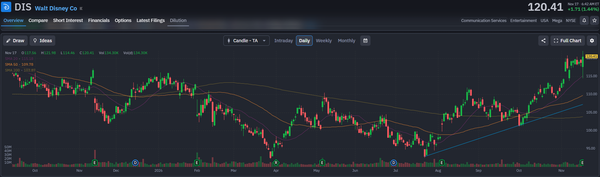
Disney shares reached $120.41 on November 17, trading above the 20-day moving average at $115.18, the 50-day at $109.78 and the 200-day at $103.87. The stock has climbed from its July low near $95, reclaimed all three averages, and established a series of higher lows since August. The $120- $121 area is immediate resistance, with the next upside reference around $125. A retreat toward $115 would test whether the former resistance zone can now hold as support.
Disney’s earnings mix is improving, and the stock’s recovery reflects that progress. I see a stronger business than the one investors were evaluating a few years ago. The $35 billion spending programme is the next major test, particularly as Disney reduces visibility into standalone streaming profits. And at $120, I would want to see the company convert its expanding ecosystem into faster earnings and cash-flow growth before chasing the shares higher.



Tidak ada komentar:
Posting Komentar