Editor's Note: BLACK FRIDAY SPECIAL – For a Limited Time Only!
In 2018, when popular media outlets like the MIT Technology Review were calling AI "overhyped," former VC insider Luke Lango went against the grain and claimed that "AI is the future" and "Nvidia is the cream of the crop." Now, Lango is stepping forward with a new prediction, and it once again flies in the face of everything the mainstream media is telling you. And in celebration of Black Friday, we're giving readers a special opportunity to access Luke's investment research at an exclusive Black Friday price. See below for the full story and how to take advantage of this limited-time offer...
Bestselling author and longtime Elon Musk confidant Peter Diamandis predicts it will create...
"A world in which everyone can have access to all the food, water, energy, healthcare, and education that they need and desire."
Furthermore – according to my estimates – it could create $126 trillion in wealth, dwarfing the impact of AI, robotics, clean energy, and driverless cars COMBINED.
Elon himself has said this opportunity is so massive, it could multiply your starting investment 1,000 times over.
But here's the surprising part...
If you want to take full advantage of Elon's audacious plan, you don't want to buy Tesla or SpaceX.
Forget stocks, bonds, crypto, and options. One overlooked asset captures Elon's entire plan — name and ticker revealed here.
And thanks to our special Black Friday Sale, you can now access my investment research at a special discounted price for a limited time.
Luke Lango
Senior Investment Analyst, InvestorPlace
P.S. You'll want to move fast on this one. During Tesla's most recent earnings call, Elon hinted at an imminent Tesla-SpaceX merger, prompting Tesla investor Gene Munster to say, "I would put the odds that these two will combine at 90% today." With our Black Friday Sale underway, now is an opportunity to discover the details behind this prediction at a special discounted price. Get the full story and claim your Black Friday savings before this special offer expires..
Today’s editorial pick for you
5 Cybersecurity Stocks to Own, Not Trade, as Outages Pile Up
Posted On Nov 19, 2026 by Chris Markoch
If you were wondering why you should own cybersecurity stocks, November gave you the answer. Two outages in one week showed how fragile critical systems can be. On Nov. 13, the FAA halted flights nationwide for about four hours after a telecommunications failure. A day earlier, a Microsoft 365 outage disrupted government agencies, courts, and businesses worldwide.
Table of Contents
Neither event has been tied to a cyberattack. Transportation Secretary Sean Duffy blamed aging equipment for the FAA failure. But the lesson for corporate boards is the same. When systems go down, the cost is immediate and public.
These events are crystallizing the threat matrix for enterprises. Legacy infrastructure, cloud concentration, and AI-driven attacks all widen the attack surface. Security budgets will have to grow to match.
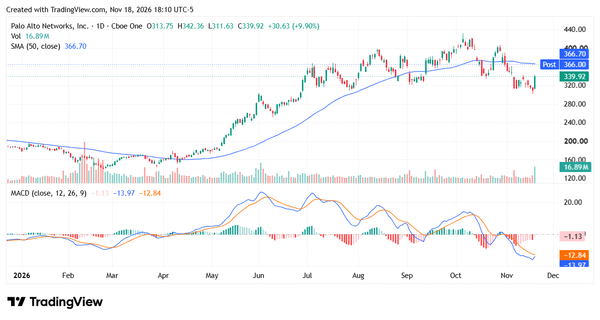
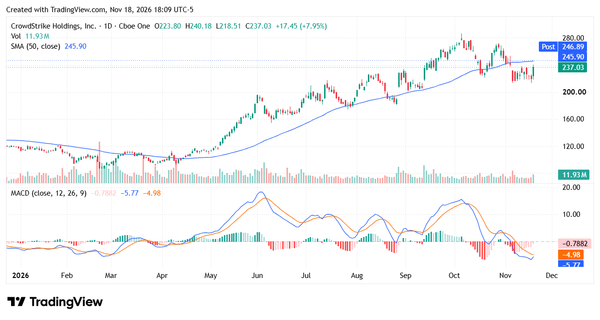
For investors, that makes cybersecurity stocks long-term holdings rather than trading vehicles. The group sold off sharply on Nov. 5, with Palo Alto Networks and CrowdStrike each falling about 10%. Several leaders also report earnings in the coming weeks, so volatility is likely. The five cybersecurity stocks below are built to outlast it.
Palo Alto Networks: Fresh Results Confirm the Platform Story
Palo Alto Networks (NASDAQ: PANW) reported fiscal first-quarter results after the close on Nov. 18. Revenue jumped 39% to $3.44 billion. Next-Generation Security annual recurring revenue (ARR) rose 66% to $9.73 billion.
Management also raised its full-year outlook. It now expects fiscal 2027 revenue of $14.52 billion to $14.57 billion, up 26% to 27%. Remaining performance obligations, a measure of contracted future revenue, grew 35% to $21 billion.
Palo Alto is still buying, too. It announced a $4.5 billion all-stock deal for Applied Compute to bring secure open-weight AI to enterprises. The strategy is consolidation: one platform instead of dozens of tools. The stock entered the report up about 75% this year, so swings are inevitable. The long-term story remains intact.
CrowdStrike: Record ARR Heading Into Its Next Report
CrowdStrike (NASDAQ: CRWD) is expected to report fiscal third-quarter results around Dec. 1. Its last report set a high bar. In the fiscal second quarter, CrowdStrike added a record $333 million in net new ARR. Total ARR grew 25% to $5.84 billion.
The Falcon Flex subscription model is a key driver. ARR from Flex customers more than doubled to over $2.29 billion. All 10 of the company’s largest deals in the quarter were Flex subscriptions. Management raised its full-year net new ARR growth outlook to 34% at the midpoint.
CrowdStrike knows outages firsthand. Its faulty July 2024 software update crashed millions of Windows machines. Yet revenue growth has now accelerated for five straight quarters. That resilience is why it belongs among the cybersecurity stocks worth holding through volatility.
Zscaler: Zero Trust for a Fragile Network
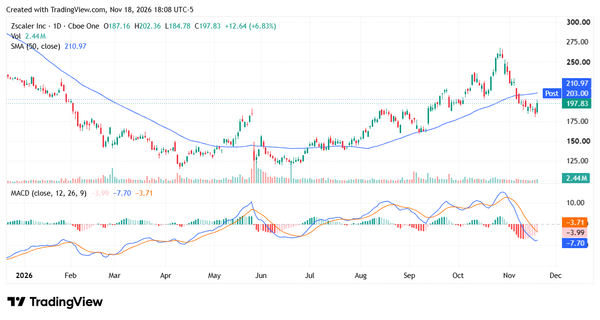
Zscaler (NASDAQ: ZS) is expected to report fiscal first-quarter results in late November. Its zero trust platform connects users to applications without exposing the broader network. That limits how far an attacker can move once inside.
In fiscal 2026, revenue and ARR each grew 25%. Non-GAAP operating margin hit a record 24% in the fourth quarter. In October, Zscaler reaffirmed first-quarter revenue guidance of $935 million to $939 million, about 19% growth.
For fiscal 2027, the company expects ARR of $4.40 billion to $4.43 billion. Management calls AI one of the most significant opportunities in Zscaler’s history. One caution: fourth-quarter free cash flow fell to 7% of revenue as infrastructure spending rose. Investors should watch whether that investment pays off.
Fortinet: A Selloff That Ignored the Fundamentals
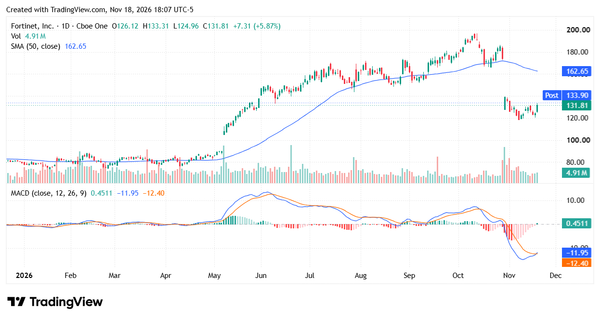
Fortinet (NASDAQ: FTNT) shows how quickly sentiment can turn. After its Oct. 28 report, shares fell about 25% in after-hours trading. Product revenue growth slowed to 37% from 52% in the prior quarter.
Yet the broader numbers were strong. Revenue rose 20% to $2.08 billion, and billings climbed 29% to $2.34 billion. Fortinet raised its full-year billings guidance for the third time this year. Non-GAAP operating margin reached a third-quarter record of 38.2%.
Fortinet is also a cash machine. Free cash flow rose 52% to $864.8 million, a 41.6% margin. The board added $1.2 billion to its buyback authorization. Fortinet protects the network layer that outages expose. For long-term investors in cybersecurity stocks, the selloff looks more like an entry point than a warning.
Okta: Identity Is the New Perimeter
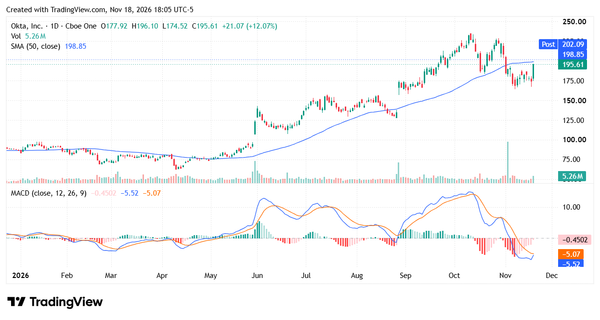
Okta (NASDAQ: OKTA) is the slowest grower in this group, but it may be the most underappreciated. Stolen credentials remain one of the easiest ways into a network. Uber recently said hackers stole driver data through compromised credentials at an AI vendor.
In its fiscal second quarter, Okta’s revenue grew 11% to $805 million. Current remaining performance obligations grew 14%, and management cited accelerating momentum. Free cash flow rose to $227 million, or 28% of revenue. GAAP net income nearly doubled to $116 million.
The next leg of growth is AI agents. Each one needs an identity and limits on what it can access. Okta is positioning itself as the neutral provider to manage them. It is expected to report fiscal third-quarter results in early December. Management has kept guidance prudent, setting a manageable bar.
Why Cybersecurity Stocks Belong in a Long-Term Portfolio
Last week’s outages weren’t cyberattacks. They didn’t need to be. They showed boards, regulators, and investors how much depends on systems staying online. That pressure lands on security budgets.
Cybersecurity stocks will stay volatile, especially with several earnings reports ahead. Valuations are high, and any slowdown will be punished. But demand isn’t tied to one quarter or one product cycle. For investors with a long horizon, these five companies are positions to own, not trade.
Today’s editorial pick for you
Viking’s Ocean Boom Is Starting To Expose The Cost Of Its Fleet Expansion
Posted On Nov 18, 2026 by Grayson Cavern
Viking Holdings (NYSE: VIK) is finding its strongest growth engine in Ocean, but Q3 earnings exposed the strain elsewhere in the business. Revenue climbed 9.2% to $2.18 billion, while Adjusted EBITDA fell 4.3% to $673.5 million and adjusted EPS slipped from $1.20 to $1.11. Viking’s capacity passenger cruise days increased 10.2% year over year, but actual passenger cruise days advanced just 4.9%, leaving a widening gap between available berths and occupied capacity.
Table of Contents
The figures point to a growing divide inside Viking. Ocean is delivering stronger margins and booking growth, while River struggles with disrupted itineraries and an expanding cost base. Meanwhile, the company is committing billions to new ships that must eventually justify the investment.
River Fleet Is Struggling To Fill The Extra Berths
Viking added capacity passenger cruise days 10.2% year over year, but actual passenger cruise days advanced just 4.9%, leaving a widening gap between available berths and occupied capacity. Occupancy consequently fell to 91.3%, weakening the contribution Viking gets from its expanding River fleet.
Low water levels across Europe compounded that problem, forcing Viking to modify itineraries and accommodate guests through a difficult operating season. Although every scheduled cruise operated, disruptions and cancellations cost the company an estimated $100 million in third-quarter revenue and approximately $100 million in Adjusted Gross Margin impact.
By mid-November, roughly 70% of River capacity passenger cruise days had been affected, and 20% of guests booked on those itineraries had cancelled. Management had yet to quantify the full Q4 impact.
Vessel operating expenses then climbed 17.6% to $461.4 million, while expenses per capacity passenger cruise day increased from $174 to $186. Viking is spending more to operate a larger fleet while disruptions make those additional berths harder to monetize… leaving River with less room to absorb further operating pressure.
Ocean Is Pulling Viking’s Earnings Away From The River
Ocean has become the stronger contributor to Viking Holdings’ earnings, generating $1.75 billion in Adjusted Gross Margin during the first nine months of 2026, up 16.6% year over year. River produced $1.40 billion, growing just 1.9%. The difference is widening, and the operating figures show why.
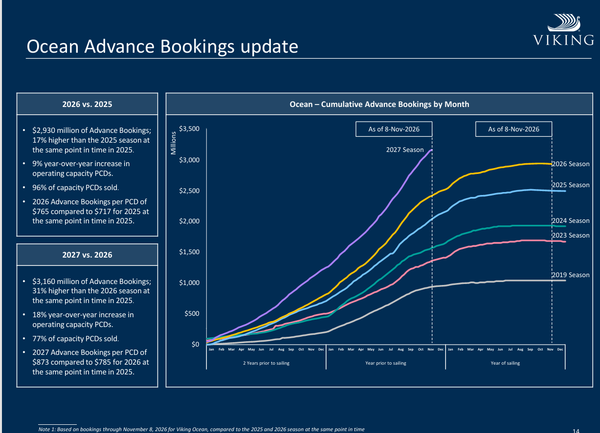
Ocean filled 96% of capacity and generated net yield of $624, up 5.5%. River’s net yield reached $599, increasing just 1.6%, while occupancy lagged Ocean by nearly five percentage points. Ocean is filling more of its ships and extracting more revenue from every passenger cruise day.
Management expects Ocean to account for approximately 70% of new-build capacity through 2036, directing expansion toward the segment with stronger occupancy, higher yields, and faster margin growth. I agree with that strategy, but the returns on future ships remain to be proven. Each new vessel brings operating expenses, depreciation and financing demands, and Ocean must preserve its pricing power as capacity expands.
Viking Is Paying Guests To Come Back, And River Will Feel It
Viking’s voucher program complicates the picture behind River’s forward bookings, with $165 million in cancellation vouchers issued to guests who abandoned disrupted sailings and approximately $265 million in goodwill vouchers issued to those who completed their journeys. Around 60% of the cancellation vouchers had been rebooked by November 8.
Approximately half of the goodwill vouchers had also been redeemed, with 60% of those redemptions going toward 2027 sailings. Viking includes these redemptions in advance bookings at net value, so the headline figures do not represent entirely fresh, full-price demand.
The program helps retain customers, but voucher use also reduces the value recognized when those guests return. River’s 2027 advance bookings stood at approximately $2.2 billion, broadly flat against the comparable period despite expected capacity growth of 13%. Ocean had secured approximately $3.2 billion, up 31%, against expected capacity growth of 18%. Ocean is growing booking value faster than its capacity, while River is preparing to bring more berths to market without comparable demand momentum.
River needs stronger demand from guests willing to pay for the experience. Repeat bookings protect customer relationships, but they do not erase the gap between capacity growth and booking performance.
The Fleet Expansion Is Eating Into Viking’s Cash Cushion
Viking generated $1.72 billion in operating cash flow during the first nine months, essentially matching the prior year, but investment in property, plant, equipment and intangible assets jumped to $1.32 billion from $869 million. After those investments, approximately $401 million remained, compared with roughly $854 million a year earlier.
The expansion program is consuming a much larger share of the cash generated by operations. Viking still has financial flexibility, with $4.1 billion in cash, $2.3 billion in net debt, and net leverage of 1.2 times at September 30. However, the $350 million spent on share repurchases during Q3 deserves scrutiny alongside the growing fleet commitments.
I would rather see Viking demonstrate stronger cash conversion from its expanding fleet before accelerating shareholder returns. The balance sheet can support the investment, but the ships must deliver earnings that justify the capital committed to them.
VIK Has Reclaimed Its Moving Averages, But $100 Stands In The Way
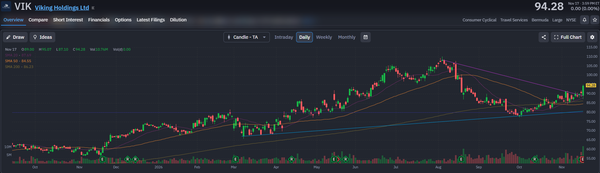
VIK stock closed at $94.28, above its 20-day moving average of $87.69, 50-day average of $84.55, and 200-day average of $86.23.. The recovery from October’s low near $78 has restored the short-term uptrend, although shares now face resistance between $95 and $100. A decisive move above $100 could open a path toward $105 to $108, near the descending trendline from August’s peak. Rejection at resistance could pull shares toward $90, with the moving-average cluster between $85 and $88 offering the next support zone.
I’m adding to my position here, but I want stronger cash generation before assigning the stock a richer multiple. As said, Ocean gives Viking a compelling growth engine, while River’s booking weakness and the rising cost of expansion leave plenty for management to prove.




Tidak ada komentar:
Posting Komentar