Editor's Note: Larry Benedict — the hedge fund legend who beat the S&P 500 by 18 times in 2025 and made his clients $95 million during the 2008 crisis — says Trump's installation of a new Federal Reserve chair is triggering the most significant shift in U.S. markets in nearly 20 years. He has already identified the one ticker he believes will be at the center of the money flows — and he's revealing it completely free. Click here to see the details or read more below…
Dear Reader,
You could have the chance to make big gains from the Federal Reserve’s next move…
But if you wait until its October 28 announcement, you could miss it.
Delta Takes a Profit Hit Even as Premium Travel Booms
Posted On Oct 09, 2026 by Ian Cooper
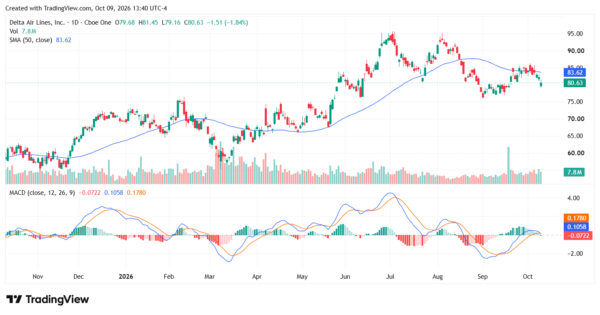
Delta Air Lines (NYSE: DAL) has a problem that higher ticket prices haven’t been able to solve: a soaring fuel bill. Travelers are still booking flights. Premium seats remain popular. And revenue continues to climb. But the airline is spending so much more on fuel that even those strengths aren’t enough to protect its earnings outlook.
Table of Contents
Just this morning, Delta lowered its full-year adjusted profit forecast to between $5.10 and $5.60 per share, down from the $6.50 to $7.50 it projected in July. It also reduced its free cash flow forecast to $2.5 billion, compared with expectations for as much as $4 billion.
Trump’s Federal Reserve announces its next interest-rate decision today!
Following past Fed announcements, Larry gave readers a chance to gain 89% in just 17 days. He believes today's decision and fresh projections will shift market expectations, triggering massive opportunities as billions move within minutes.
The encouraging part of Delta’s latest update is that customers haven’t stopped spending.
According to CEO Ed Bastian, demand remains healthy across business and leisure travel, different destinations, and all cabin categories. That matters because airlines facing sharply higher expenses have limited options. They can raise fares, adjust capacity, find savings, or accept lower profits.
Delta has been increasing ticket prices, and customers have continued to book. That suggests travel remains a priority for many consumers, even as getting from one place to another becomes more expensive. Businesses also appear willing to keep employees traveling.
Fuel Is Taking a Bigger Bite
Delta is dealing with an approximately $6 billion increase in fuel costs this year, according to Bastian. That is a substantial hurdle, even for a large airline. The figures help to explain the pressure. U.S. Gulf Coast jet fuel prices reached $4.34 per gallon on Thursday, compared with $2.19 a year earlier. In other words, prices have nearly doubled.
The surge associated with the Iran war has created a difficult situation across the airline industry. Carriers can charge more for seats, but fuel expenses can rise faster than those fare increases flow through their results.
Revenue Rose, but Earnings Fell
For the third quarter, Delta reported adjusted revenue of $17.59 billion, slightly below the $17.67 billion Wall Street expected. Adjusted earnings came in at $1.72 per share, compared with expectations for $1.75. Those were relatively small misses. The year-over-year decline in reported profit was more substantial. Net income fell 47% to $756 million, or $1.15 per share, from $1.42 billion, or $2.17 per share, a year earlier.
Meanwhile, adjusted revenue increased 16%, and total operating revenue climbed 21% to $20.19 billion. The takeaway is straightforward: Delta is bringing in more money, but keeping less of it as profit.
One encouraging development is the continued strength of Delta’s premium business. Third-quarter premium revenue increased 18% to $6.82 billion, edging past main cabin revenue of $6.8 billion, which grew 12%.
It also supports Delta’s emphasis on attracting customers who value additional comfort and service. However, premium demand doesn’t eliminate exposure to fuel prices. Those passengers may generate more revenue, but the aircraft still needs fuel regardless of where everyone is sitting.
Delta also has an unusual advantage through its refinery in Trainer, Pennsylvania. The facility helps offset some fuel pressure, although the reduced earnings outlook makes clear that it cannot fully insulate the business.
What Matters from Here
Delta expects fourth-quarter revenue to rise approximately 20% from a year earlier, suggesting that strong sales momentum could continue. The bigger test is whether those additional dollars translate into stronger profits.
Investors should watch fuel prices, booking trends, premium demand, and Delta’s ability to recover costs through fares. The lower cash flow forecast deserves attention, too, because it leaves less financial flexibility.
Delta’s customer demand remains encouraging, but the earnings reset shows the limits of pricing power. For the stock, a more convincing improvement would come when healthy bookings and revenue growth are accompanied by steadier costs and better profitability. Until then, full planes tell only part of the story.
Today’s editorial pick for you
Nike Leads Thursday’s Doomsday Q1 Earnings: Investors Wait For Sign Of Life
Posted On Sep 29, 2026 by Grayson Cavern
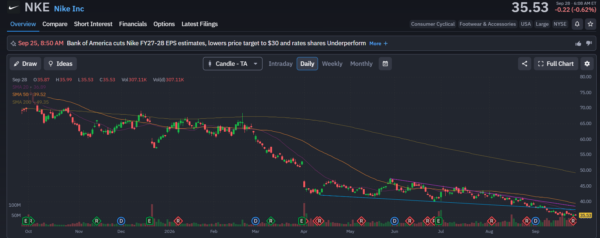
Nike (NYSE: NKE) goes into its Q1 earnings for fiscal year 2027 (FY2027) at $35.53, sitting just above its 52-week low of roughly $35.35. The chart is ugly, estimates are being cut again, and Bank of America Securities recently downgraded Nike to Underperform while cutting its price target from $47 to $30 and reducing its fiscal 2027 and 2028 EPS estimates by 11% and 12%, respectively.
Table of Contents
Wall Street is looking for roughly $11.34 billion in first-quarter revenue versus $11.72 billion a year ago, with EPS around $0.44 versus $0.49. Another weak quarter would hardly shock anyone. The unusual part would be seeing Nike’s economics improve while revenue deteriorates.
Nike finished fiscal 2026 with $46.4 billion in revenue, essentially flat reported and down 2% on a currency-neutral basis. NIKE Direct fell 9% currency-neutral, NIKE Brand Digital dropped 12%, Converse plunged 34%, and Greater China declined 17%.
North America gives the turnaround something to work with. Q4 revenue there increased 3%, footwear rose 4%, and wholesale grew 4% reported and 1% currency-neutral. North America EBIT jumped 91% to $2 billion.
Could the company be deliberately leaning into that split? Maybe. Management said it was tightening buys, reducing future sell-in, and managing inventory as it works through weaker demand, accepting lower near-term revenue in exchange for a healthier product mix and better margins. For Q1, management expects revenue to decline low-to-mid single digits, while gross-margin expansion should turn slightly positive and SG&A dollars remain roughly flat.
That is a strange setup for a stock sitting near its lows because the income statement can start looking better before demand does.
The 49.2% Margin Number Comes With An Asterisk
Nike’s Q4 gross margin was 49.2%, an enormous improvement on paper, but roughly 900 basis points of that increase came from the expected recovery of IEEPA tariffs. Q4 EPS reached $0.72, including a $0.52 tariff benefit. Strip that benefit out and the margin was roughly 40.2%, almost identical to the 40.3% recorded a year earlier.
I want to see that number move on Thursday. Nike has already shown it can print a spectacular headline margin when a $986 million tariff recovery runs through the quarter. Now the business has to expand the underlying margin without another one-off doing the work.
Management has actually pulled the timing forward, saying gross-margin expansion should begin in Q1 rather than Q2, while operating overhead dollars are expected to decline. That gives Nike a clean test because the revenue line is already expected to remain under pressure.
If margin improves while revenue falls, the cleanup is starting to show up where shareholders can actually measure it.
China Is Still The Hole In The Turnaround
Greater China fell 17% currency-neutral in Q4, with footwear down 17%, apparel down 15% and equipment down 21%. North America is doing enough to keep the story alive, but China is large enough to keep dragging on it.
That split is what makes Thursday worth trading around. Nike does not need every part of the business to turn at once. The pieces already improving have to become substantial enough to offset the ones still breaking apart.
With China still bleeding at a double-digit rate while Direct, Sportswear and Jordan remain under pressure, margin repair can start looking like financial housekeeping rather than a demand recovery. Nike needs North America and wholesale to keep getting better while the weaker businesses stop deteriorating.
The stock has already paid a heavy price for waiting.
$35.53 Is Where The Market Wants Proof
The chart leaves very little room for storytelling. Nike is below its $36.89 20-day SMA, $39.52 50-day SMA, and $49.35 200-day SMA, while pressing against the roughly $35.35 52-week low. The 20-day sits below the 50-day, the 50-day sits well below the 200-day, and the broader trend remains down.
The first reclaim I would watch is $36.89. Then comes $39.52. Getting back through both after earnings would at least show buyers are willing to fight for the fundamental improvement rather than sell every bounce.
The other side is cleaner. If revenue misses, underlying gross margin fails to improve, or management pushes the recovery timeline out again, $35.35 becomes the line I care about.
Thursday is therefore bigger than whether Nike can squeeze out a few extra cents of EPS. The stock needs evidence that the cleanup is improving the economics of the business while sales are still shrinking.



Tidak ada komentar:
Posting Komentar