 A Message From Base Camp Trading Hey Trader, Here’s a simple question for you... Would you rather buy 100 shares of a $50 stock for $5,000… Or control those same 100 shares for a fraction of the cost? That’s one of the biggest reasons traders love options. They give you leverage—the ability to participate in a stock’s movement without tying up thousands of dollars. And in The Beginner’s Guide to Options, we break down exactly how this works in plain English. You’ll also discover: ✓ Why options have become one of the most popular tools for generating income in today’s markets ✓ Real examples that show how options trades actually work ✓ A little-known strategy many traders use to reduce costs and improve profit potential It’s the kind of information that could save you weeks—or even months—of trial and error. But we’re making it free – click here. Just be sure to do it now… Time is running out for you to get this report for free. Click this link and download your copy while you still can. To your trading success, Dave Aquino
Lead Options Trader, Base Camp Trading
This Week's Exclusive News
Six Flags Launches FlexPay—Is There Any FUN Left in the Stock?Written by Chris Markoch. Publication Date: 9/28/2026. 
Key Points
- Activist investor JANA Partners is pressing Six Flags' board to explore a sale after weak second-quarter results and a 45% stock decline.
- Six Flags launched Flex Pay, a buy-now-pay-later financing option with up to 36% APR, shortly after missing Q2 2026 earnings and revenue expectations.
- Despite a heavy debt load near $4.9 billion against a $1.2 billion market cap, analysts still see roughly 85% upside to their consensus price target.
- Special Report: Your free copy is still here
Six Flags Entertainment (NYSE: FUN) has launched Flex Pay by Upgrade, a buy-now-pay-later (BNPL) solution that offers consumers a pay-over-time option for eligible online purchases of $49 or more, including season passes. Approved guests can activate their season passes immediately and begin visiting the parks while making fixed monthly payments. The initiative comes after the company announced disappointing Q2 2026 earnings in August. Six Flags posted earnings per share (EPS) of 14 cents, while analysts had expected EPS of 29 cents. Revenue also came in below expectations at $864.92 million, compared with the $929.31 million forecast.
In addition to missing expectations, both figures were lower year over year. Six Flags' net loss more than doubled to $202.6 million from $99.6 million a year earlier. That's troubling because the company's second and third quarters are typically its strongest, based on seasonal factors. It also raises questions about what consumer health could mean for the company's outlook. FUN is down 45% over the past 12 months. Now, an activist investor wants the board to consider selling the company. That leaves investors weighing a slow turnaround against the possibility of a buyout premium. Flex Pay Arrives at a Telling TimeThe theme park operator is announcing Flex Pay during the company's softer time of year. Many of its theme parks are about to close until next spring, so investors shouldn't read too much into Flex Pay's initial results. The timing stands out for another reason. Flex Pay went live on Sept. 7, the same day promotional pricing on 2027 season passes was set to expire. Six Flags appears to be using financing to keep pass sales moving after the discount window closed. Investors should understand what Flex Pay is. It isn't an in-house payment plan; it's a loan from Upgrade's lending partners. Approval depends on a credit check, and the APR ranges from 0% to 36%, depending on the borrower. That's a sharp contrast with the industry's biggest names. Universal and Disney (NYSE: DIS) both let annual passholders pay over time without interest, though Disney restricts its plan to Florida residents. Six Flags is marketing Flex Pay as a value tool, but budget-conscious families may feel differently if they have to pay interest on their purchases. Can Financing Fix a Demand Problem?A larger concern is why the company is struggling to attract consumers. Theme parks like Six Flags tend to be somewhat defensive. First, most guests can drive to the parks. Second, the parks generally offer good value. However, higher gas prices are causing some consumers to put off theme park trips, which come with their own on-site costs. That's where Flex Pay could make a difference. But is it too little, too late for investors? Six Flags May Go PrivateJANA Partners is leading a group of activist investors pressing Six Flags to explore a sale, which could include a take-private deal. On Sept. 22, JANA pushed the board to hire an investment bank to run that process, citing frustration with the company's second-quarter results. JANA isn't new to this story. The fund built a roughly 9% stake alongside co-investors last fall, worth around $200 million at the time. The group included Kansas City Chiefs tight end Travis Kelce, who later signed on as a Six Flags brand ambassador. JANA's original demands covered marketing, the park experience, technology, leadership changes and a review of a possible sale. The case for going private comes down to the balance sheet. Net debt stands at roughly $4.9 billion, while the company's market capitalization is about $1.2 billion. With debt near four times its equity value, a buyer's premium may look more attractive than waiting for a multiyear turnaround. There are reasons for investors to proceed with caution. The 2024 merger of Cedar Fair and Six Flags promised synergies that haven't materialized. History also offers a warning. Red Zone's 2005 takeover of Six Flags promised a brand revival but ended in bankruptcy in 2009. Investors Aren't ThrilledFlex Pay hasn't given Six Flags stock a lift. Shares fell about 26% in the month leading up to JANA's letter. The report then sparked a 5.4% after-hours pop. However, shares are still trading at five-year lows. A troubling sign for investors is that FUN continues to trend lower, even below its descending 50-day simple moving average (SMA). Retail investors will have to overcome short interest of around 21%. However, some factors are working in buyers' favor, including the stock's relative strength index (RSI) moving into oversold territory and a high percentage of institutional ownership. 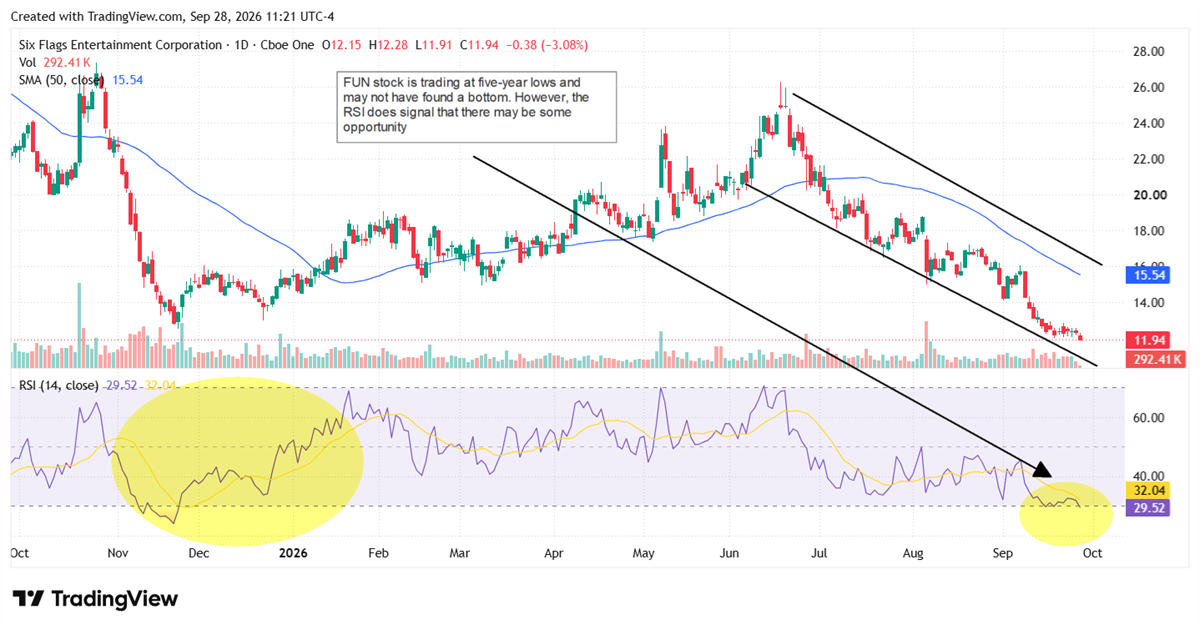
Analyst price targets have been moving lower since the company's disappointing Q2 earnings report in August. However, the consensus price target for FUN is $21.50, representing about 85% upside. The fundamentals still point to a long, expensive turnaround. But the possibility of a sale gives FUN a potential floor it didn't have a month ago. If the board hires bankers, the debate shifts from attendance to takeover value. Investors should watch two things. First, how FUN's board formally responds to JANA. Second, whether early season pass sales hold up in the next earnings report. Until the board acts, FUN remains a turnaround story with a takeover option attached—not a takeover story. . |


Tidak ada komentar:
Posting Komentar