McCormick Stock Falls After Q3 Beat as Unilever Deal Clouds Outlook
Posted On Oct 02, 2026 by Chris Markoch
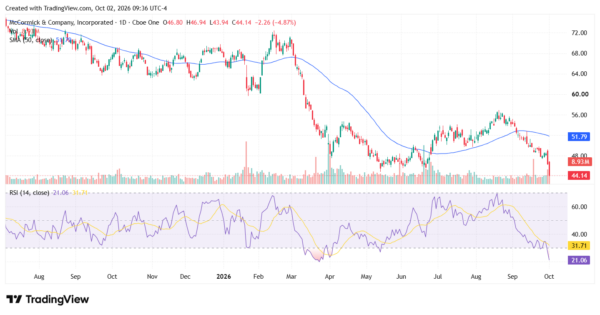
McCormick & Company (NYSE: MKC) stock is sliding after the company’s fiscal third-quarter earnings report. Shares fell more than 5.5% following the release, trading near $44. That marked a fresh 52-week low for the spice and flavor giant.
Table of Contents
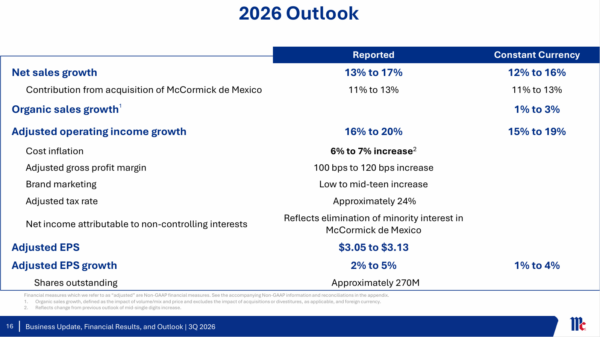
On paper, the quarter looked solid. McCormick beat Wall Street estimates on both revenue and adjusted earnings. Management also reaffirmed its full-year outlook.
But investors are looking past the headline beat. GAAP earnings fell sharply from a year ago. Special charges tied to the pending Unilever Foods combination did much of the damage. Management also warned of rising costs and more margin pressure heading into 2027.
That leaves McCormick stock in an uncomfortable spot. The core business is holding up. Yet the market is focused on what comes next. That includes a transformational merger that isn’t expected to close until mid-2027.
The fundamentals show a company still growing sales and expanding margins. The perception is that McCormick is entering a long, expensive transition with few near-term catalysts.
The stock was already down about 30% this year heading into the report. Now investors must decide whether this selloff creates value or signals more pain ahead.
McCormick reported net sales of $2.02 billion for the quarter ended Aug. 31. That was up 17.4% year-over-year and ahead of the $1.98 billion consensus. Most of that growth came from the McCormick de Mexico acquisition, which added roughly 14 points.
Organic sales growth was a more modest 1.9%. Pricing contributed 2.2%, while volume and mix slipped 0.3%. In other words, McCormick is still leaning on price to drive growth.
Margins were a bright spot. Gross margin expanded 190 basis points to 39.3%. Adjusted operating income jumped 22% to $358.5 million.
Adjusted earnings per share (EPS) came in at $0.86. That beat estimates of $0.76 and edged past last year’s $0.85. A higher tax rate of 22.6%, up from 16.1%, absorbed most of the operating gains.
The culprit was $141.5 million in special charges, or $0.50 per share. Those included transaction and integration costs for the Unilever deal. They also included an impairment tied to exiting a pepper sourcing project in Malaysia.
Why the Unilever Deal Is Weighing on Sentiment
McCormick announced its plan to combine with Unilever’s Foods business in March. The deal would create a flavor-focused company with about $20 billion in annual revenue. Unilever (NYSE: UL) will receive $15.7 billion in cash. McCormick shareholders would own 35% of the combined company.
Management says the deal is on track. Regulatory filings have been submitted on schedule. The future leadership team and operating model are in place. McCormick still expects significant EPS accretion after closing.
The problem is timing. Deal costs hit the income statement now. The benefits don’t arrive until after a mid-2027 close. Until then, GAAP earnings will likely stay noisy.
Financing is another worry. McCormick expects net leverage of up to 4.0x at closing. Interest rates have risen since the deal was announced. That raises questions about how much accretion survives higher borrowing costs.
On the call, the CFO said the company can still deliver its accretion and deleveraging targets. The plan includes mixing euro and dollar debt, balancing fixed and floating rates and staggering maturities. Management aims to cut leverage to 3.0x within two years of closing.
Analysts also flagged that Unilever Foods has grown more slowly than expected since the announcement. McCormick can’t control that business until the deal closes. That adds another layer of uncertainty.
Rising Costs and a Cautious Tone on 2027
The deal isn’t the only overhang. McCormick raised its full-year cost inflation forecast to 6% to 7%. It previously expected a mid-single-digit increase.
Management now expects gross margins to compress year-over-year in the fourth quarter. Higher commodity and freight costs are the main drivers. A packaging supply issue could also trim total volume growth by up to one point.
The U.S. consumer business remains soft. Consumer organic sales in the Americas were flat. Price gains offset lower volumes as shoppers stayed value-conscious.
Perhaps most important, management said it expects more headwinds for margins and EPS in 2027. A formal outlook is coming in January. That kind of early warning tends to cap enthusiasm for a defensive stock.
There were positives, too. EMEA consumer volumes grew for the 11th straight quarter. Year-to-date operating cash flow rose to about $600 million from $420 million. Leverage stood at roughly 2.9x, giving McCormick some cushion ahead of the deal.
What the MKC Chart Is Saying
The technical picture reflects the sour mood. MKC is trading well below its 50-day simple moving average near $51.79. The stock has also broken below its prior 52-week low.
The 14-day relative strength index (RSI) sits near 21. That’s deeply oversold territory. The last comparable reading came in late March.
That episode offers a useful lesson. The stock bounced in April, but the rally faded within weeks. A stronger recovery didn’t arrive until summer. Oversold conditions can spark relief rallies. They don’t guarantee a lasting bottom.
Is McCormick Stock a Buy After the Selloff?
McCormick delivered a solid quarter. Adjusted earnings beat estimates, margins expanded, and the full-year outlook held. The GAAP decline was largely driven by deal costs, not a collapse in the core business.
Still, investors aren’t wrong to be cautious. Inflation is rising, the consumer is stretched, and 2027 already looks tougher. The Unilever deal adds financing risk and integration complexity on top of that.
For long-term investors, the selloff may offer a better entry point into a durable consumer staples franchise. But patience will be required. The next real catalyst may not come until January’s 2027 outlook.
Until then, perception may continue to outweigh fundamentals for McCormick stock.
Today’s editorial pick for you
Nike’s Reset Is Getting More Expensive Before the Turnaround Arrives
Posted On Oct 02, 2026 by Grayson Cavern
When we last looked at Nike Inc. (NYSE: NKE) in this piece, the risk was that investors could get ahead of a turnaround that might take two or three years to show up in the financials. At roughly $41, the stock already had room to fall toward $28 if sales stayed weak, margins failed to recover, and the market ran out of patience.
Table of Contents
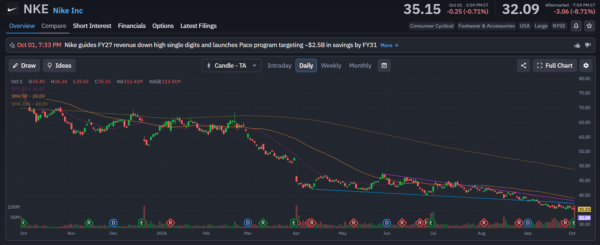
Nike has now handed us a tougher version of that setup in Q1 FY2027 as revenue fell 5% on a currency-neutral basis, and management expects FY27 revenue to decline by high single digits. All of which led to the stock closing at $35.15 before dropping to $32.09 after hours.
Now the company did deliver a 60-basis-point gross-margin improvement to 42.8%, with diluted EPS of $0.48, down 2%. But that margin progress came alongside lower sales, and the new outlook points to a longer reset than the market may have been willing to price in.
Today I'm seeing the same rare fingerprints on a different company – Billions in operating income. Rapid revenue and dividend growth. A valuation of roughly eight times profits.
But here's what makes this setup almost ridiculous: This company is helping supply the energy behind America's AI expansion, yet its entire market value remains below $8 billion.
I call stocks like this "unicorns" because they almost never appear.
Out of 23,281 stocks, this was the only one that passed my complete screen.
Nike’s Strongest Business Still Can’t Carry The Reset
Nike’s performance portfolio grew at a high-single-digit rate in Q1, led by double-digit growth in Running, Global Football, Tennis and Golf. Running continued to gain share, while Global Football benefited from World Cup demand. Management also said performance would have grown at a low-double-digit rate excluding the Greater China reset.
That isn’t too bad, as Nike still has products consumers are buying, and its performance business is producing growth. But the problem is that management said performance is not yet large enough to offset the pressure in Sportswear, Jordan Brand and Greater China. Those businesses, including Men’s, Women’s and Kids, represented a high-single-digit drag on consolidated Nike in Q1.
Sportswear, which accounted for just under half of quarterly revenue, declined by low double digits. Nike deliberately cut Dunk revenue by nearly 50%, creating an estimated $200 million headwind, while older, higher-volume footwear also sold below expectations and weighed on future wholesale orders. The company is trying to clear excess inventory and bring more product differentiation back to the category.
Jordan is getting a similar reset. It represented 13% of global business, with revenue down mid-teens, as Nike plans to reduce the volume and frequency of selected retro launches. China is under even heavier pressure: revenue fell 26%, with wholesale down 31% and Direct down 18% on a currency-neutral basis.
This is a deliberate pullback in some areas, but the numbers show that Nike is also dealing with product weakness and soft demand. The Dunk reduction explains part of Sportswear’s decline; it does not explain the entire category. And China’s digital cleanup is expected to take multiple seasons, with management warning that revenue and profitability will be affected in the near term.
The Margin Recovery Has A Long Runway
Nike’s Q1 gross margin improved mainly because warehousing and logistics costs came down. Supply-chain cost management and favorable currency movements helped, while increased discounts and channel mix worked against the improvement. Meanwhile, selling and administrative expense fell 3% to $3.9 billion, but demand-creation spending rose 5% to $1.3 billion as Nike invested more in sports marketing.
That is a useful combination for now: Nike is trimming overhead while still spending to build demand. But the margin gain is modest beside the sales problem, and the company is preparing investors for a heavier earnings reset.
Its new Pace program is expected to generate approximately $2.5 billion in cumulative savings through FY31, against about $1 billion in pre-tax implementation charges, plus roughly $300 million of severance costs recognized in FY26. Another $300 million of Pace-related charges is expected in FY27. Most of the savings are expected in FY29 and FY30, with the program fully realized into FY31.
That timeline deserves scrutiny because Nike is now asking investors to absorb a high-single-digit revenue decline in FY27 while waiting several years for most of the savings to arrive. The company expects adjusted FY27 EPS of $1.15 to $1.35, excluding approximately $0.15 of Pace restructuring expenses.
The Stock Has Already Started Repricing The Wait
The balance sheet gives Nike room to execute. Cash and short-term investments stood at $8.4 billion, inventory was $7.8 billion, down 3%, and the company returned approximately $610 million through dividends during the quarter.
But the stock is trading below its key moving averages: $36.49 for the 20-day, $39.09 for the 50-day, and $48.89 for the 200-day. At $32.09 after hours, NKE is also pressing toward the lower end of its recent trading range.
The market is being asked to value a turnaround whose strongest growth engine is still too small, whose major lifestyle franchises need a reset, and whose cost savings arrive mostly years from now.
But as an answer to my last article on Nike – yes, the business has pockets of genuine momentum, but management’s own FY2027 outlook says the reset will keep weighing on sales and EBIT. I want to see the stock stabilize first, then see evidence that the product cleanup is translating into better orders and full-price demand. Put another way, I’m staying on the sidelines until the sales trend gives the chart a reason to turn.




Tidak ada komentar:
Posting Komentar