| OddsRoll |
Signal Brief · June 1, 2026 |
|
|
● Live · Kalshi
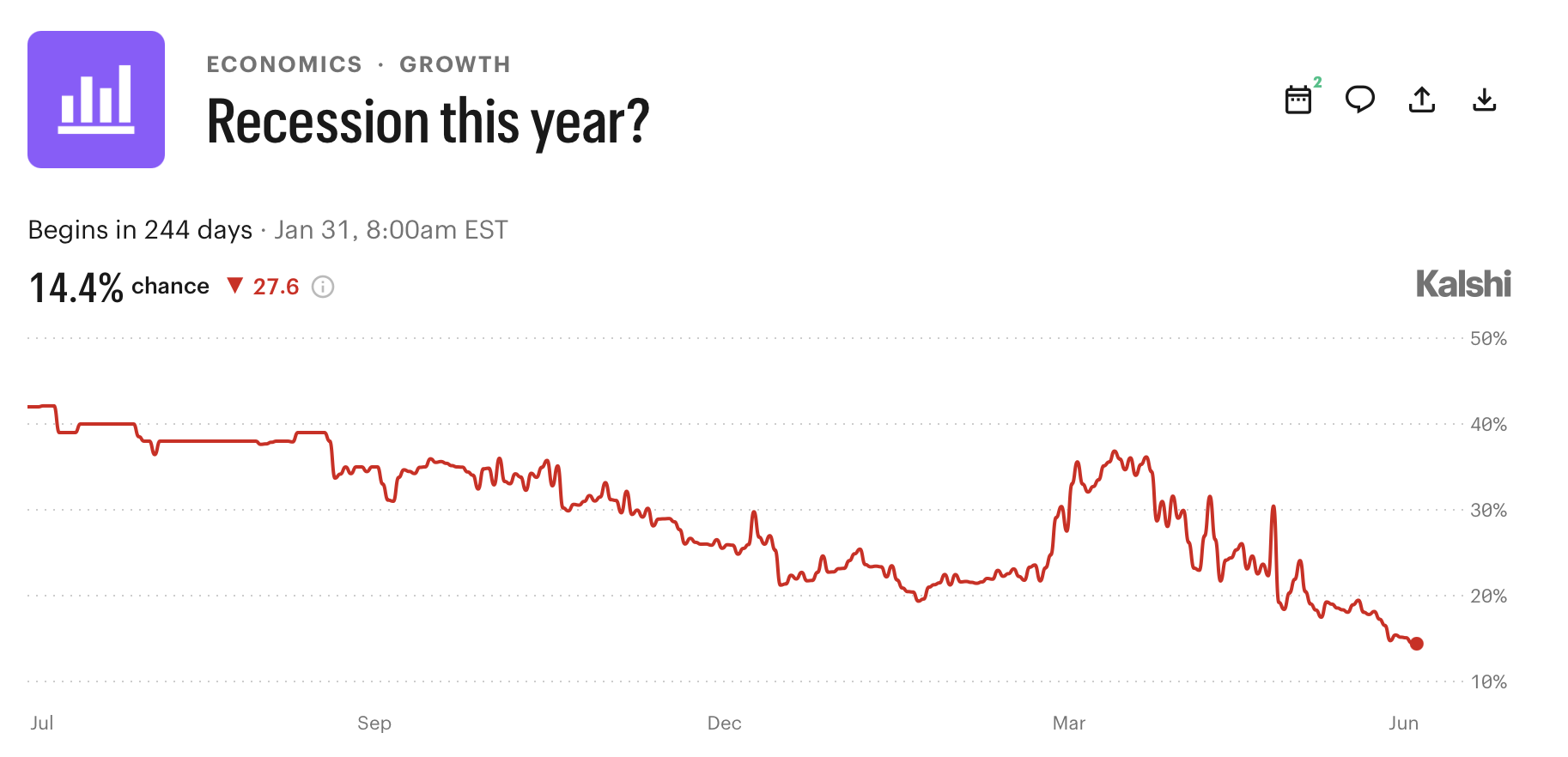
Recession at an all-time low.
Stagflation at an all-time high.
That is not good news.
Two contracts on the same platform. Same economy. Opposite records. If you have a mortgage, a car payment, or a grocery bill, this is the scenario that hurts most. And the market just priced it.
|
| |
| Kalshi · U.S. Recession in 2026 |
↗ View live market |
|
|
Two contracts sit on the same platform right now. Both are at records. Both are looking at the same economy. And they are moving in opposite directions.
Here is what the prediction market is pricing this morning:
| 17% |
Recession in 2026. The lowest level all year. Down from 39% in March. The market says the economy does not shrink. |
|
| 40% |
Stagflation by December. The highest level ever. Up from 11% three months ago. The market says inflation does not stop. |
|
| 21% |
Soft landing. The scenario Wall Street has been selling for two years. Now at its lowest level in the contract’s history. |
|
| 57% |
Zero rate cuts in 2026. More likely than not. The Fed stays frozen all year. |
|
Read those four numbers together. The economy keeps growing. Inflation keeps rising. The Fed does nothing. And the soft landing everyone promised is at 21%.
That is not a recovery. It is a trap. And the prediction market just priced it at record levels on both sides. That reads as a SILENT GAP.
| Signal: SILENT GAP — Recession at 17%. Stagflation at 40%. Both at records. The market is pricing a hot economy with rising prices and a frozen Fed. That is the worst outcome for anyone waiting for relief. |
Recession
17%
all-time low
|
Stagflation
40%
all-time high
|
Soft Landing
21%
all-time low
|
Zero Cuts
57%
no relief in 2026
|
|
| |
|
Partner Information
The Fed is trapped.
They can’t raise rates because it would crash the economy. Trump’s already dealing with job losses and a rough economic start to 2026.
But they can’t cut rates either. Inflation just spiked 0.6% in March alone.
This is the exact scenario that breaks central banking.
But there’s a third option. One the Fed won’t talk about publicly, but insiders are already positioning for.
The U.S. government still carries 8,133 tonnes of gold on its books at $42.22 per ounce. A price frozen since 1973.
With gold now above $5,000, that creates a $750 billion accounting gap.
Trump has the legal authority to close that gap with a single executive order.
If he revalues those reserves to current market prices, it would likely send gold to levels we’ve never seen before.
$7,000? $10,000? $15,000?
The smart money isn’t waiting to see what the Fed does. They’re positioning now, before the announcement hits.
That’s why I want you to read a free intelligence report I’ve compiled called The Great Gold Reset.
|
|
| |
|
A recession means the economy shrinks. GDP goes negative for two quarters. People lose jobs. Companies cut spending. It is painful but it is also the scenario that forces the Fed to act. When the economy contracts, the Fed cuts rates. Mortgages get cheaper. Credit loosens. The system resets.
Stagflation means the opposite problem. The economy does not shrink, but prices keep rising. GDP stays positive while inflation accelerates. The Fed cannot cut because inflation is too high. It cannot hike because growth is too fragile. It does nothing. And you sit in the middle paying more for everything while the tools that are supposed to help you stay locked in a drawer.
Here is the journey that got both contracts to record levels:
In March, recession odds hit 39%. Oil had spiked. The war with Iran was escalating. Traders priced a real chance the economy would crack.
Then it didn’t. Q1 GDP came in at 2.0%. The labor market held. Consumer spending stayed resilient. Recession odds fell from 39% to 28% to 17%. The economy refused to break.
But inflation did not stop. CPI went from 2.4% in January to 3.3% in March to 3.8% in April. The contract for May CPI prices 93% above 4.1%. Oil stayed above $4 a gallon at the pump through most of May. Shelter reaccelerated. Food kept climbing. Real wages fell 0.5% in April.
OddsRoll’s read: the economy did not crash. And that is exactly why you are stuck. A recession would have given the Fed permission to cut. Instead, GDP stayed positive, inflation kept climbing, and the Fed froze. The prediction market is pricing both sides of that trap simultaneously. Recession down. Stagflation up. The worst combination for anyone who was counting on relief.
|
| |
| 03 WHAT IT MAY ACTUALLY MEAN |
|
|
OddsRoll Deep Read
What is being priced quietly is not whether the economy is strong or weak. It is that the economy is strong AND broken at the same time. The GDP number says growth. Your grocery receipt says otherwise. Both are true. The contracts are reading both.
Here is why this combination is worse than a recession for your wallet. If the economy contracted, the Fed would cut rates. Your mortgage rate drops from 6.5% to 5%. Your car loan reprices. Credit card rates ease. The housing market unfreezes. That is the painful-but-functional cycle that has worked for 80 years.
Now look at what the contract is pricing instead. GDP stays positive. Unemployment holds near 4.3%. The Fed has no excuse to cut. Rates stay at 3.50–3.75%. Your mortgage stays at 6.5%. But inflation runs at 4.2%. Your paycheck shrinks 0.5% in real terms. Gas stays above $4. Food keeps climbing.
Stay with me. Think about what this means for your daily life. You are employed. Your 401k looks fine. The S&P is at record highs. But every trip to the grocery store costs more than the last. Every tank of gas eats a bigger share of your paycheck. And the rate cut that was supposed to help you buy a house, refinance your mortgage, or ease your credit card payment is not coming. The economy is too strong for the Fed to justify it.
If you have been reading OddsRoll, you have watched every piece of this trap assemble in real time. On May 14, we told you the strait might open but your gas price would not drop. On May 26, we showed you stagflation at 40%. On May 28, we showed you the CPI contract pricing 4.2%. Today the recession contract completes the picture. The economy will not rescue you from the inflation the economy created.
|
| The signal: The market is pricing two records at once: lowest recession risk and highest stagflation risk. Together they describe an economy that is too strong to rescue and too broken to fix. |
|
| |
| 04 WHAT THE CROWD MAY BE MISSING |
|
Most coverage this morning frames low recession odds as good news. The economy is resilient. Jobs are holding. Growth continues. That framing misses the four reasons why low recession odds and high stagflation odds are not two separate stories. They are the same story.
| → |
The strong economy is what keeps the Fed frozen. If GDP were negative, the Fed would cut. It is not. Q1 came in at 2.0%. Consumer spending held. Employment is near full. The part the crowd may be missing: a strong economy sounds good until you realize it is the reason the Fed will not lower your mortgage rate. Strength is what traps the Fed. Weakness is what frees it. |
| → |
The inflation is no longer just oil. Your readers know the staircase: 2.4% to 3.3% to 3.8% to an expected 4.2%. But the deeper read is that shelter rose 0.6% in one month. Food rose 0.7%. Airfares rose 2.8%. Even if the Iran deal brings oil down, the inflation that has spread into shelter, food, and services does not reverse because oil falls. It is sticky. It stays. And it stays while the economy stays strong. That combination is what the stagflation contract is pricing. |
| → |
The jobs report drops Friday. The May employment numbers come out June 6. If the number is strong, it confirms the trap. Recession odds stay low. The Fed stays frozen. Your rate cut stays in the drawer. If the number is weak, recession odds spike and everything reprices. Either way, the contract moves. This Friday is the next data point. Watch it. |
| → |
The 1970s comparison is getting louder. Raymond James’ chief economist has compared the current setup to the stagflationary decade. Oil shock from the Middle East. Inflation accelerating. The Fed trapped. The last time both the recession contract AND the stagflation contract moved to these extremes simultaneously was never. This has not happened in the contract’s history. The prediction market is in uncharted territory. So is your wallet. |
|
OddsRoll Take
Every OddsRoll edition this month was building toward this number. The strait. The oil price. The CPI staircase. The Fed trap. The stagflation contract. Each one was a piece. Today’s recession contract is the frame that holds them together.
17% recession means the economy does not break. 40% stagflation means inflation does not stop. Together they describe a scenario where the Fed has no reason to help you and no ability to stop what is hurting you. Your mortgage stays at 6.5%. Your paycheck keeps shrinking. Your grocery bill keeps climbing. And the economy is technically fine.
This is the end of OddsRoll’s May arc. We started with one contract on one strait. We end with two contracts on one economy. The signal is the same as it was on May 14: the headline looks like progress. The contract reads the math underneath. The math says the trap is closing.
|
|
| |
|
Prediction markets can reveal movement before consensus forms. OddsRoll helps you see what the crowd may understand only later.
|
|
|
|


Tidak ada komentar:
Posting Komentar