
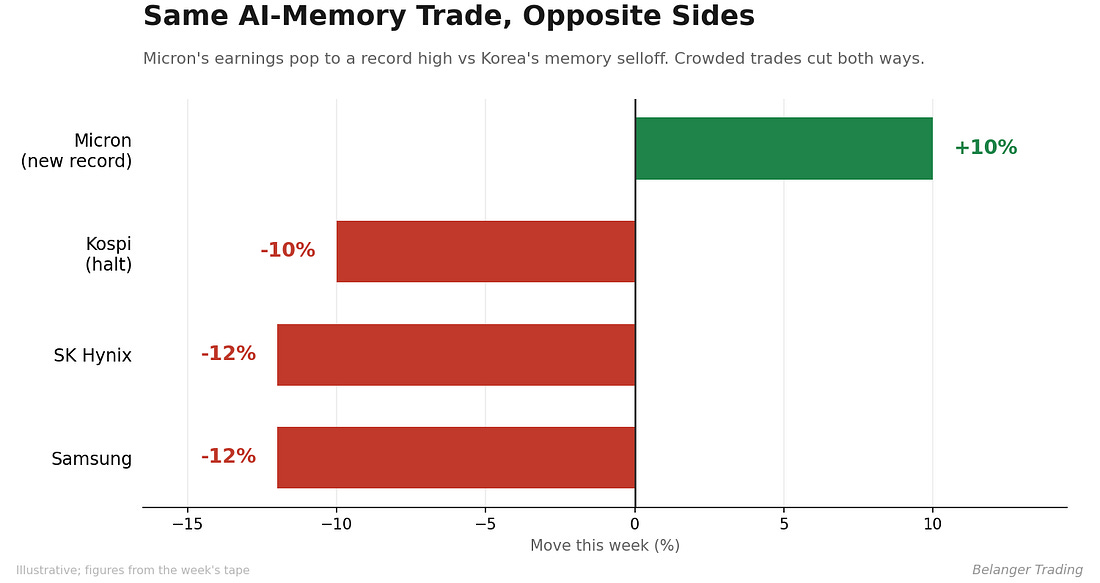
Korea got smoked overnight. SK Hynix sank. Samsung got whacked. The KOSPI cracked enough to trigger trading halts. And now the same AI-memory trade that made Micron the stock everyone had to own is suddenly showing its other side. That is the tell this morning. Micron’s quarter was not the problem. The company just printed one of the cleanest AI-memory reports Wall Street has seen this cycle. Revenue, earnings, guidance, and customer commitments all pointed the same direction. AI memory demand is no longer just a story. But Korea is the reminder that a real story can still turn into a crowded trade. South Korea’s stock market has been one of the hottest AI trades in the world this year, powered by the same memory-chip boom that just sent Micron higher. SK Hynix, Samsung, high-bandwidth memory, AI data centers — the whole thing became a giant proxy for the AI buildout. Then the tape cracked. That does not mean the AI trade is over. It means the trade is crowded. And crowded trades cut both ways.
When you are on the right side, a 95% run feels like genius. Nobody worries about downside when they are counting the dollars. The move becomes the proof. The chart becomes the story. Then one bad tape reminds everyone what risk actually feels like. That is the point today. Not that Micron is broken. Not that AI memory demand disappeared. Not that the AI trade is over. The point is that hot money creates fragile tape. When a theme becomes this obvious, the downside gets sharper because everyone is standing in the same place. Korea Is the FoilThe Korea trade matters because it is tied to the same story. Samsung and SK Hynix sit inside the global memory supply chain. When investors want AI memory exposure, Korea becomes one of the obvious places to go. That is what makes the selloff useful. It is not proof that AI demand disappeared overnight. It is proof that positioning matters. A theme can be real and still get hit. A stock can have a great story and still be over-owned. A market can be right about the long-term direction and still be wrong about how much good news is already priced in. That is exactly what happened with Nvidia this year. Nvidia did not stop being a great company. The stock just stopped being the easy trade. The story became obvious. The beats got harder to beat. Competition started to matter. Expectations caught up. Micron is not Nvidia. Korea is not Micron. But the warning is the same. When the whole market agrees on the trade, the next move is not only about the business. It is about positioning, liquidity, expectations, and who is left to buy. The Micron LessonMicron’s quarter was excellent. The demand picture is strong. The AI memory shortage is showing up in hard numbers, not just conference-call language. But memory is still memory. These businesses boom because supply gets tight. Then profits attract more supply. Then customers start pushing back. Then the cycle changes. That does not mean the trade is over today. It means the market has moved from asking: “Is AI memory demand real?” to asking: “How much good news is already priced in?” That is a different question. And it is the question that matters after a run like this. The Real Question Is ExposureAfter a move like this, I would not start with, “Should we buy Micron?” The better question is: “What exposure do we actually want?” Because this is going to be a bumpy trade. If the story is still working, you may want exposure. But after a vertical move, the structure matters more. A $1,200 stock is not a casual position for most smaller accounts. That is where options belong in the conversation. Not as free money. Not as safe income. As defined exposure. If you want stock-like exposure, a deep in-the-money call can reduce the capital tied up versus owning 100 shares. If you want excessive upside, an out-of-the-money call defines the risk. And if you want bullish exposure without tying up six figures in cash, a short put spread may make more sense than a cash-secured put. That is enough for a free note. The point is not to hand out the full trade sheet. The point is to ask the right question: How much exposure do you actually want after this move? What to Watch1. Does Korea stabilize or keep leading lower? 2. Do buyers start pushing back on memory costs? 3. Does good news stop working? From the Trade Desk is Belanger Trading’s daily market commentary on what matters on Wall Street right now, and why we’re watching it. Josh Belanger's results are not typical and are not a guarantee of your success. Josh is an experienced investor and your results will vary depending on education, work experience, and background. Josh does not personally participate in every investment alert he provides. Due to sensitivity of financial information, we do not know or track the typical results of our students. Josh’ strategies may not always be accurate, and his investments may not always be profitable. They could result in a loss of an entire investment. We cannot guarantee that you will make money or that you will be successful if you employ his trading strategies specifically or generally. Consequently, your results may significantly vary from his. We do not give investment, tax, or other professional advice. Reference to specific securities should not be construed as a recommendation to buy, sell or hold that security. Specific securities are mentioned for informational purposes only. All investments involve risk, and the past performance of a security, industry, sector, market, financial product, investment strategy, or individual’s investment does not guarantee future results or returns. Investors are fully responsible for any investment decisions they make. Such decisions should be based solely on an evaluation of their financial circumstances, investment objectives, risk tolerance, and liquidity needs.
|




Tidak ada komentar:
Posting Komentar