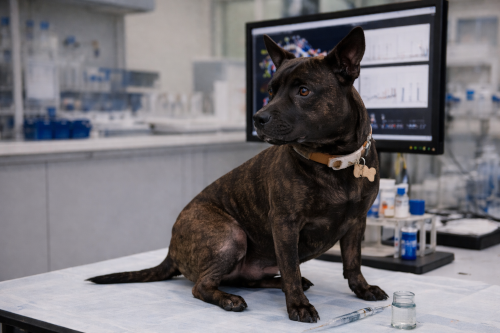
 Practical Investment Analysis for the New Energy EconomyThe $3,000 Dog Vaccine That Big Pharma CravesWe all need a feel-good story today. Headlines and social media are splattered with war, violence, and chaos — anything and everything that'll draw eyeballs to the view-whoring attention grabbing that has become our news cycle. Blood, death, destruction… there's seemingly no end to it. But you know what? Today is going to be different. Rather than revisiting some gruesome crisis plaguing our lives, what do you say we take a detour with one of the best stories I've come across in a very, very long time? Our story begins with an 8-pound Staffordshire Bull Terrier-Shar Pei mix in Australia named Rosie.
Rosie's owner, Paul Conyngham, wasn't a biologist, nor was he a veterinarian — and definitely was not a doctor. He was a data scientist in Sydney. And when his rescue dog Rosie was diagnosed with terminal mast cell cancer in 2024, the conventional treatments all failed. Surgery couldn't stop the tumors from spreading, and although chemotherapy slowed things down, it didn't actually shrink anything. So, it was with a heavy heart that he was told Rosie had maybe a few months left to live. So Conyngham did what a data scientist probably would — opened ChatGPT and started doing research. He paid $3,000 to have Rosie's tumor DNA sequenced at the University of New South Wales. Then he used AlphaFold — which is Google DeepMind's protein structure prediction tool — to figure out which mutations were actually driving her cancer. Working with both ChatGPT and Grok, he designed an mRNA vaccine that specifically targeted those mutations. The UNSW RNA Institute manufactured the vaccine in under two months, and by January 2026, the tennis ball-sized tumor on Rosie's leg had shrunk by 75%. They called it the first personalized cancer vaccine ever designed for a dog. So here's the $174 billion question: if a machine learning engineer with zero biology training can pull this off in a couple of months, why the hell aren't we doing this for humans? It's simple — we are! Holy Grail Discovered:
Forget everything you know! This "untapped powerhouse" can meet "global electricity demand 140 times over" with FREE, ENDLESS POWER, eclipsing oil, solar, and nuclear! The $174 Billion Race to Rebuild Drug Discovery With AI The short answer is that AI absolutely can design drugs. However, the problem is that regulation moves at the speed of molasses compared to technology. What Paul accomplished with Rosie in under two months is exactly what major pharmaceutical companies are betting billions will revolutionize human medicine. We know the technology works — we just saw it work. But getting it approved for humans? That's a completely different beast. And you can bet that Big Pharma is betting big on AI drug discovery. Who can blame them? We're talking about a global drug discovery market that is projected to grow as high as $174 billion by 2035. Last January, NVIDIA and Eli Lilly announced they're throwing $1 billion over five years at a co-innovation lab focused on AI-driven drug discovery. Lilly's AI supercomputer is the most powerful in the entire pharmaceutical industry, and they're using it to train biomedical foundation models that can identify and validate new molecules. Pfizer has deployed AI across every function in the company — discovery, legal, manufacturing, even marketing. They added over 1,200 graphics processing units to their data centers specifically to support these AI advances, and are dishing out $11 billion on R&D this year. Meanwhile, AstraZeneca is reporting that AI has accelerated their target drug design and validation by more than 50% in early discovery stages — effectively cutting their timelines in half! But here's the thing: the real impact isn't some miracle cure appearing out of nowhere overnight. You see, what AI is actually delivering is operational efficiency at a scale we've never seen before. It's analyzing massive amounts of complex biological data, predicting how molecules will interact with each other, and helping researchers prioritize which therapeutic targets are actually worth pursuing. How? Well, AI can screen billions of compounds against disease targets in a fraction of the time that traditional methods require. Then, it'll design novel drug candidates with properties that are already optimized before they ever hit a lab. And yet, we still have a massive gap between AI designing drugs and the red tape that is bogging everything down. One of the reasons why Rosie's treatment worked so quickly is because veterinary experimental treatments face way lighter regulatory scrutiny than anything involving humans. In other words, there's no veterinary equivalent of the FDA's Phase I, II, and III clinical trial requirements for compassionate use cases like this. So when a pharmaceutical company flat-out refused to supply an immunotherapy drug that Paul had initially identified for compassionate use, he just pivoted to the mRNA approach instead. The entire process from tumor sequencing to actually administering the vaccine took months, not years. For humans? It's a completely different story. Moderna and Merck have jointly developed a personalized melanoma vaccine that showed a 49% reduction in cancer recurrence or death over five years when it's combined with Merck's blockbuster drug Keytruda. In fact, they've got Phase III trials underway right now, with interim results potentially coming later this year. But do you want to guess what the expected price tag will be to get approved? Around $200,000 per patient. Think about that for a second... The same basic technology that shrunk Rosie's tumor for $3,000 in sequencing costs is going to cost hundreds of thousands of dollars when it's finally approved for human use. It's not because the science is any different — it's because the regulatory pathway demands years of trials, mountains of documentation, and endless approval processes. The FDA finalized new AI guidance in 2026 that requires sponsors to develop credibility assessment plans for high-risk AI applications. The EU's AI Act has high-risk provisions that take effect on August 2, 2026, and they could potentially classify drug development AI as high-risk. The real obstacle here isn't whether we have the capability to do this — we clearly do. No, dear reader, the obstacle is getting permission to actually use it. Trump's Bold Move to Kill the IRS — $21,307 Payouts IncomingTrump just launched a $1 trillion National Fund to replace taxes with direct payouts. Everyday Americans could claim up to $21,307 — but only if they act before the first checks go out. Big Pharma's AI Bet That Changes Everything Look, the pharmaceutical industry isn't sitting around waiting for perfect regulatory clarity before they invest in this stuff. Every major player is integrating AI into their drug discovery platforms right now, and they're treating it like core infrastructure — not some experimental side project that might pay off someday. Takeda just dropped $1.7 billion on a deal with Iambic Therapeutics a month ago, and Merck developed something called KERMT, which is an AI model that helps predict molecular properties and optimize which candidates are worth pursuing. The pattern across the industry has been pretty consistent— build AI capabilities internally while simultaneously partnering with specialized AI-native biotech firms that have already figured this stuff out. You've got companies like Exscientia, Insilico Medicine, Schrödinger, and Atomwise that are providing the computational infrastructure. Big Pharma brings the capital, the clinical expertise, the regulatory experience, and the manufacturing scale to actually turn these discoveries into drugs people can use. The good news is that we are still in the early innings of this ballgame, folks. And the first wave of AI-discovered drugs that are entering late-stage clinical trials will ultimately determine whether computational design actually improves clinical outcomes or just makes the existing process faster. Either outcome has real commercial value, but only the former would represent truly transformational change in how we develop medicines. Of course, our investment thesis here doesn't require AI to suddenly cure diseases that were previously incurable. However, what we do need to see is AI meaningfully reducing the $2.6 billion average cost and the10-15 year timeline that it currently takes to bring a new drug to market. If AI really can cut discovery timelines by 50% the way AstraZeneca is reporting in their early-stage work, those productivity gains compound across every single program in a company's pipeline. That's not just incremental improvement — that's a complete restructuring of how pharmaceutical R&D economics work. Rosie's story isn't really about a miracle cure for cancer… that part is just a wonderful, feel-good bonus to the grander story taking place. Until next time,
Keith Kohl A true insider in the technology and energy markets, Keith's research has helped everyday investors capitalize from the rapid adoption of new technology trends and energy transitions. Keith connects with hundreds of thousands of readers as the Managing Editor of Energy & Capital, as well as the investment director of Angel Publishing's Energy Investor and Technology and Opportunity. For nearly two decades, Keith has been providing in-depth coverage of the hottest investment trends before they go mainstream — from the shale oil and gas boom in the United States to the red-hot EV revolution currently underway. Keith and his readers have banked hundreds of winning trades on the 5G rollout and on key advancements in robotics and AI technology. Keith's keen trading acumen and investment research also extend all the way into the complex biotech sector, where he and his readers take advantage of the newest and most groundbreaking medical therapies being developed by nearly 1,000 biotech companies. His network includes hundreds of experts, from M.D.s and Ph.D.s to lab scientists grinding out the latest medical technology and treatments. You can join his vast investment community and target the most profitable biotech stocks in Keith's Topline Trader advisory newsletter.
|

 Check us out on YouTube!


Tidak ada komentar:
Posting Komentar