| Dear Reader,
You don't have to work on Wall Street to make money in the stock market.
My millionaire students come from all walks of life.
Mariana and Jack Schwartz started right after high school graduation.
Kyle Williams was waiting tables.
Jack Kellogg parked cars as a valet.
Anyone can turn a profit in the market.
So what exactly are the keys to success? What do my millionaire trading students all have in common?
After teaching thousands of students over the last decade, I've narrowed it down to three key elements that every one of my student success stories has in common.
Master these three items and you'll quickly discover more reliable and consistently profitable outcomes. 1. Manage Your Losses Trading is an exercise in risk management.
As a trader, I'm responsible for minimizing my potential losses and maximizing my possible gains.
Over the years, I found that most traders lose money not because they can't win but because they lose poorly.
That's why I always advocate and practice cutting my losers quickly.
Heck, if a trade doesn't start winning for me quickly, I'll drop it.
Take the trade I had in TBH Holdings Inc. (PETZ).
While I managed to turn a profit, I quickly released my position when the stock failed to continue its rally. 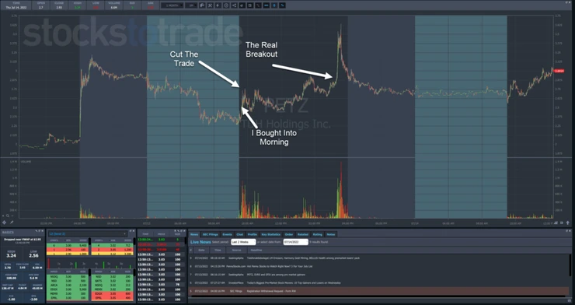 If you look through my trade history, you'll see dozens of trades where I only make $30 or $40.
These are positions I entered that failed to provide the required move.
Rather than hold and hope, I cut and run.
Now, what you'll notice with these trades is that on many, I still manage to turn a small profit.
That comes with practice and patience.
You see, the first step towards profitability is removing those big losses that offset my gains.
The second step is to optimize your trades, getting better entries and exits.
Over time, this turned from small losses to small gains, which add up. | $650 Billion Isn't Enough. Microsoft, Google, Meta, and Amazon are spending $650 billion this year on AI infrastructure.
And it's still not enough.
A critical bottleneck is threatening the entire buildout.
Which is why every Fortune 500 company on Earth is scrambling to secure the same scarce resource.
But two financial legends — one who advised President Reagan, the other a former Wall Street hedge fund manager — say they've found three tiny companies positioned at the center of this crisis.
And they believe this convergence will create more fortunes in 12 months than in the last 12 years.
They call it "Computranium."
Click here to see why Big Tech is scrambling to get their hands on "Computranium." | 2. Adjust to the Market Markets can and do change.
As I tell my students, some markets are for learning and some are for earning.
The meme stock craze and bubbles built in 2021 created some of the best trades I've seen in my lifetime.
2022 was much slower. Slow doesn't mean there aren't trades, or that you can't be profitable.
Fast forward to this year — there's major volatility (and opportunity).
Throughout the year, the conditions can rapidly change.
While small stocks trade more independently from the broader markets, general risk appetites driven by the Fed and other factors all still play into the environment.
Put simply, if markets are crashing, small stocks will struggle just as much to rally for more than a day or two. 3. Focus on Fewer, Better Setups I earned most of my first $1 million with just one pattern.
Many traders I know only take 2-3 trades a week.
And there are some that trade once a week at most.
You don't need a lot of trades to become successful.
Early on, I tell my students to work on just one setup that they feel comfortable with and get really good at that before expanding.
Folks who have never found consistent success need to build their confidence and a baseline to work from.
Otherwise, they'll fear losing on every trade, which is a recipe for moving stops and a host of other bad habits.
Here's some quick math to prove my point.
If you win 65% of your trades and risk $1 to make $3, starting with $1,000 and risking 5% of your account on each trade, you will hit $1 million in 90 trades.
At one trade per week, that's a little under 2 years.
Not bad…
Where are you at in your trading career? I'd love to hear from you! Send me a message at SykesDaily@BanyanHill.com.
Cheers, 
Tim Sykes
Editor, Tim Sykes Daily
|




Tidak ada komentar:
Posting Komentar