Editor's Note: Please see the following from Dr. David Eifrig, a former Goldman Sachs Vice President and professional trader. He has just released an urgent investigative exposé on the $7.2 Trillion "Mar-a-Lago Trade" -- an idea Bloomberg has said may cause "a dire shift of fortunes for America."
Why Palantir Investors Aren't Panicking While the Rest of AI Sells Off
Author: Chris Markoch. Article Posted: 7/25/2026.
Key Points
CEO Alex Karp's forecast of $15 billion to $18 billion in free cash flow within two years is central to the debate over Palantir's valuation.
Palantir's Q1 2026 adjusted free cash flow and EPS both grew roughly 150% year over year, far outpacing the 20% to 30% growth bears typically assume.
Palantir reports Q2 2026 earnings on Aug. 3, and the stock trades well below its 200-day moving average despite recent stabilization after a sharp 2026 decline.
One narrative says this is simply Palantir growing into its valuation. Even after the 2026 slide, PLTR still trades at more than 100x forward earnings and has a trailing price-to-sales (P/S) ratio of about 65x.
However, while inflation readings and the conflict in the Middle East are causing volatility across the AI sector, Palantir has been less affected. That could be due to its focus on government agencies. The company’s government and critical-infrastructure client base positions it to maintain growth even during economic downturns.
The question on many investors’ minds is what comes next. Palantir reports its Q2 2026 earnings on Aug. 3. If history is any guide, it will be a strong report. But over the last couple of earnings reports, “strong” hasn’t been enough to push the stock price higher.
Palantir’s consistently impressive results are the unstoppable force pushing against a stock price that doesn’t want to move higher. Another strong report could change that equation.
Why Wall Street Keeps Undervaluing Palantir Stock
Palantir bears often rely on conservative discounted cash flow (DCF) models, which typically assume 20% to 30% annual growth in free cash flow and earnings per share (EPS). That may be standard for a maturing software company, but bulls argue it is far below the growth Palantir just reported.
Q1 2026 adjusted free cash flow reached $925 million, up 150% year over year. Adjusted EPS came in at 33 cents, also up roughly 150%. Those growth rates are five to seven times higher than what conservative models assume.
Traditional valuation models exist for a reason: They protect against overpaying for hype. But they also assume mean reversion, and Palantir hasn’t reverted yet.
A 20% to 30% growth assumption produces a modest fair-value estimate. Skeptics such as Michael Burry have used that logic to argue Palantir trades far above what its cash flows justify.
The problem is the actual numbers. Fiscal year (FY) 2025 free cash flow was $2.27 billion. Karp’s two-year target of $15 billion to $18 billion implies a gain of roughly 560% to 690% over that period.
That’s not a modest beat over conservative assumptions. It’s an entirely different growth universe. If Karp is even directionally right, every DCF model built on 20% to 30% growth significantly understates fair value.
Palantir’s Free Cash Flow Growth Supports the Bull Case
That history matters in the current situation. Karp isn’t a CEO known for making wild promises that evaporate. His $15 billion to $18 billion free cash flow target deserves scrutiny, not dismissal.
Q1 2026 results support that trajectory. Full-year 2026 revenue guidance now sits at $7.65 billion to $7.66 billion, implying 71% growth. U.S. commercial revenue guidance calls for at least 120% growth.
Full-year adjusted free cash flow guidance was raised to $4.2 billion to $4.4 billion. That’s already well above what a 20% to 30% growth model would project for this year alone.
Palantir Stock Tests Key Support Before Earnings
Technically, Palantir looks like a stock in a downtrend. Shares trade in the $120s, well below the 200-day moving average near $154. The stock peaked above $200 last November, then slid through a rough first half of 2026. It has since stabilized, but the July 22 drop shows that PLTR continues to face selling pressure.
That range-bound action reflects the valuation split perfectly. Bulls see a company outgrowing every conservative valuation model. Bears see a stock priced for perfection that hasn’t delivered it yet.
Will Palantir Earnings Finally Settle the Valuation Debate?
This isn’t really a story about whether Palantir is expensive. By traditional metrics, it clearly is. The forward P/S multiple sits near 40x, and skeptics aren’t wrong to flag that.
The real question is which growth assumption to trust. A 20% to 30% model produces one fair value. Actual results running at 150%+ produce something very different.
Karp’s $15 billion to $18 billion free cash flow target is the single number that could resolve this argument either way. If Palantir is even close to that path in two years, today’s valuation debate looks premature.
If it isn’t, the bears’ conservative models were right all along. Either way, free cash flow will be one of the key metrics worth tracking every quarter between now and then.
This ad is sent on behalf of Stansberry Research, 1125 N Charles St, Baltimore, MD 21201. If you would like to optout from receiving offers from Stansberry Research please click here.
*Please read the offering circular and related risks at invest.modemobile.com.
*Mode cumulative revenue includes full year revenue of businesses acquired in 2025.
Mode Mobile recently received their ticker reservation with Nasdaq ($MODE), indicating an intent to IPO in the next 24 months. An intent to IPO is no guarantee that an actual IPO will occur.
The Deloitte rankings are based on submitted applications and public company database research, with winners selected based on their fiscal-year revenue growth percentage over a three-year period.
Exclusive Headlines
Apple Q3: Sold Out, Squeezed and Flattered
Apple posted its best demand in years and the stock fell about 6%. That is the whole point. Demand has stopped being Apple's problem. iPhone and Mac accelerated. Greater China grew more than 20%. Every region grew double digits. But Apple cannot make enough product to fill orders, and memory prices are climbing into margins.
Apple earned $2.02 versus $1.57 a year ago. Revenue rose 16.4% to $109.42 billion. Take out the tariff refund and EPS was roughly $1.91 against $1.89 consensus. The beat shrinks to two cents. Gross margin was 50.1% reported. Refunds contributed about two points. Underlying margin was near 48.1%, down from about 49.3% in March.
iPhone revenue rose 21.7% to $54.25 billion. Mac jumped 28.7% to $10.35 billion. Greater China rose 22.4% to $18.82 billion. Only iPad fell, down 5.9% against a hard A16 comparison. Active devices passed 2.5 billion.
Guidance disappointed. Apple expects September revenue up 9% to 11%, implying about $112.7 billion versus consensus near $114.9 billion. Currency costs 2.5 points. Supply limits will worsen significantly across iPhone, Mac, and iPad. Cook said Apple's own forecast was the cause, not supplier failure.
Two problems get merged constantly. Leading-edge chip node capacity caps revenue. Memory pricing caps gross profit. Ex-refund margin ran near 49.3% in March, 48.1% in June, and September guidance implies about 46.5% once the refund benefit is stripped. That is 280 basis points of underlying decline in two quarters.
Apple has already raised Mac and iPad prices. Services grew 12.1% to $30.74 billion, trailing estimates.
This was Cook's final earnings call. John Ternus takes over with node supply, memory costs, pricing, and App Store rules all unsettled. The June quarter proves a stronger franchise. It does not yet prove better earnings.
Inside Coca-Cola's 5% Volume Quarter: A Tournament, Six Extra Days and a Weaker Dollar
Coca-Cola finally gave investors the mix they had asked for. Volume grew 5%. Price stayed positive. Margins widened. Guidance went up. The stock rose as much as 7%, its best day since June 2009, and set a record high.
Management argued against its own headline. On a two-year basis, volume grew 2%, close to Coca-Cola's recent trend. Three temporary factors helped: an easy comparison, kind weather, and the FIFA World Cup running through the quarter. The first half also carried six extra reporting days that the fourth quarter gives back.
The volume was not free. Asia Pacific grew volume 8% but organic revenue only 2% with price/mix down 9%. EMEA grew volume 4% and organic revenue 3% while comparable currency-neutral operating income fell 5%. Latin America's 16% revenue growth was mostly currency. North America was the clean result: volume up 3%, price/mix up 4%, operating income up 12%.
Currency flattered group margin. Comparable operating income grew 9% but 6% currency-neutral. Roughly three points came from the dollar. The operational raise was the currency-neutral range, moved to 7% to 8% from 6% to 7%.
The peer contrast is the strongest evidence. PepsiCo's North American beverage volumes fell 4%. Coca-Cola's rose 3% with price/mix up 4%. That gap looks like pack architecture and distribution. Trademark Coca-Cola grew 5%, the best quarterly volume growth in 17 years outside the pandemic rebound. Zero Sugar grew 16% in every geographic segment.
Three things make H2 harder. A July 17 ransomware attack briefly halted fairlife production. Aluminum and PET costs have risen more than expected on Iran conflict energy prices. First-half organic revenue grew 8% but full-year guidance is about 5%, implying a slower H2.
Coca-Cola no longer needs price increases to carry organic revenue. Whether a 5% volume quarter repeats without the tournament, weather, and easy comparison is the next test.
Disclosure: This message includes sponsored content or affiliate links. Cryptohiiv may receive compensation from partners featured.
Below is an important message from one of our highly valued sponsors. Please read it carefully as they have some special information to share with you.
Dear reader,
If you’re feeling betrayed by the Republican Party…
Because this could have a major impact on your wealth in the coming months and years.
Regards,
Aaron Gentzler
VP or Research, Paradigm Press
Today’s editorial pick for you
Boeing Still Losing Money, But Recovery Continues
Posted On Jul 28, 2026 by Ian Cooper
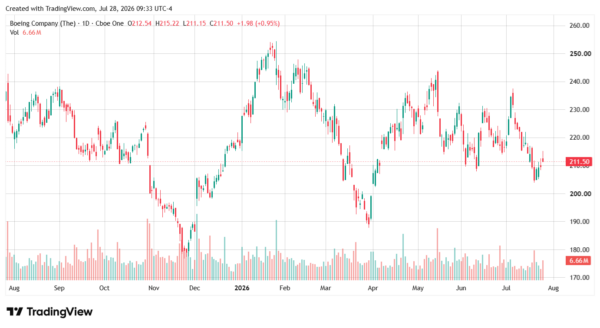
Boeing’s (NYSE: BA)latest earnings report shows the company is making progress even though it is still losing money. For the second quarter of 2026, Boeing reported a loss of $428 million, or 67 cents per share.
Table of Contents
The company lost more money than many analysts expected. However, there was also good news. BA’s revenue increased to $24.6 billion, up about 8% from the same time last year. The increase came mainly from delivering more airplanes to customers.
Gold has dipped more than 15% this year. And right now, as you read this sentence, that dip could already be the bottom. Meanwhile, the institutions that print the world's money are dumping their own paper to grab gold at a record pace.
What do they know that the average American doesn't?
One of the biggest reasons Boeing lost money was a $280 million charge connected to its Air Force One project. The company is building two new aircraft for the U.S., but the program has faced years of delays and rising costs. The company said the extra money will help complete the work and meet certification requirements. They still expect to deliver the first new Air Force One aircraft in 2028.
Even with that setback, Boeing’s commercial airplane business continued to improve. During the quarter, the company delivered 171 airplanes, compared with 150 during the same period last year. Delivering more aircraft means Boeing can collect payments from airline customers, which helps improve its financial results.
The company’s commercial airplane division also lost less money than it did a year ago. That shows BA is becoming more efficient as production increases.
Cash Flow and Debt Show Positive Progress
Another positive sign was Boeing’s cash flow. The company generated $631 million in free cash flow during the quarter. Last year, BA was spending more cash than it was bringing in. This year, it generated extra cash, which is an important step toward a stronger financial future.
The company also made progress reducing its debt. At the end of the quarter, the company had about $20 billion in cash and investments while lowering its total debt by more than $1 billion.
Helping, CEO Kelly Ortberg said the company remains focused on improving safety, product quality, and production. He admitted some projects are still difficult, but he believes the company is moving in the right direction.
Production Continues to Increase
The company is also increasing production of its popular 737 Max aircraft. Boeing recently opened another assembly line to help build more planes and is working toward producing 47 aircraft each month. Higher production should allow the company to deliver more airplanes and earn more revenue.
Boeing also shared updates on two other aircraft programs. The company said flight testing has been completed for the 737-7 and 737-10, and it expects both models to receive government certification sometime in 2026. Deliveries to airlines are expected to begin in 2027. Another aircraft, the 777X, is also moving closer to entering service. Boeing expects to begin delivering that long-range jet to customers in 2027.
Investors Focus on the Recovery
Although BA missed Wall Street’s earnings expectations, many investors focused on the company’s overall progress instead of the quarterly loss. The company is delivering more airplanes, bringing in more cash, and slowly improving its finances.
Boeing has faced many challenges over the past several years, including the 737 Max crisis, the pandemic, supply chain problems, labor issues, and expensive government contracts. Those problems have not completely disappeared, but the company appears to be making progress.
The defense business remains a challenge because projects like Air Force One continue to cost more than expected. However, Boeing’s commercial airplane business is becoming stronger, which is helping balance those losses.
Looking Ahead
Overall, Boeing’s latest earnings report shows a company that is still in recovery. It is not back to full strength yet, but it is moving in the right direction. By building and delivering more airplanes, improving cash flow, and reducing debt, BA is taking important steps toward becoming profitable again.
Today’s editorial pick for you
Walmart Stock Looks Expensive, But Catalysts Justify a Buy
Posted On Jul 28, 2026 by Chris Markoch
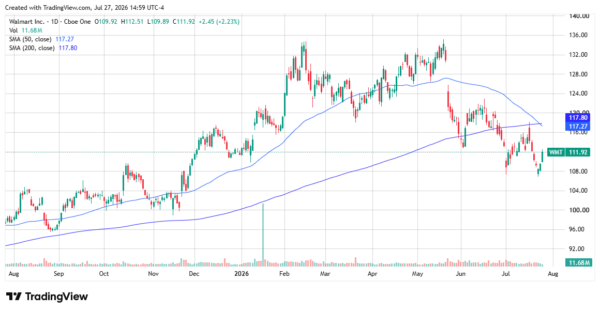
Walmart (NASDAQ: WMT) stock trades at a premium most retailers can only dream of. Shares command roughly 39 times trailing earnings and about 38 times forward estimates, well above the retailer’s historical range and far pricier than most consumer staples peers. That valuation alone gives investors pause, especially after Walmart’s stock retreated from its 52-week high near $137 to trade around $112 today.
Table of Contents
But a rich multiple isn’t automatically a reason to sell. Walmart is building real competitive advantages that could justify paying up. Walmart+ membership income jumped 45.6% in the U.S. segment last quarter, a sign the loyalty program is gaining serious traction against Amazon Prime. The company’s “dark store” fulfillment network is delivering to nearly 36% of store-fulfilled orders in under three hours, with some markets seeing delivery windows compressed to under 30 minutes.
Q1 FY27 results showed the underlying business remains healthy. Total revenue climbed 7.3% to $177.8 billion. Adjusted EPS rose 8.2% to 66 cents. Global eCommerce sales grew 26%, now representing 23% of total net sales.
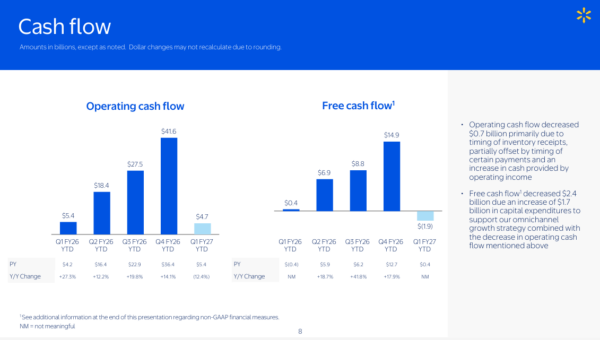
Yet one number stands out as a genuine concern: free cash flow turned negative $1.9 billion for the quarter, a $2.4 billion swing from the prior year. That gets at the heart of evaluating WMT stock right now. That is, are expanding growth engines enough to offset deteriorating near-term cash generation?
Walmart+ And Dark Stores Are Reshaping The Growth Story
Walmart’s investment thesis increasingly hinges on services, not just merchandise. Walmart+ delivered record first-quarter net adds, and membership fee revenue climbed at a double-digit pace. That recurring, high-margin income stream mirrors what makes Amazon Prime so valuable to its parent company.
The dark store strategy compounds that advantage. By converting portions of existing stores into micro-fulfillment hubs, Walmart is using its 4,600-plus U.S. footprint as a logistics network Amazon (NASDAQ: AMZN) can’t easily replicate. Store-fulfilled delivery grew approximately 45% last quarter. Expedited deliveries under three hours made up roughly 36% of those orders.
This matters because speed drives frequency. Faster delivery windows encourage customers to treat Walmart as a daily-use app rather than an occasional destination. Advertising revenue is also benefiting, with Walmart Connect up 44% as more digital engagement creates monetizable ad inventory. Together, these pieces support a bull case for durable margin expansion, even if the stock already prices in some of that optimism.
Strong Comp Sales Show Momentum Across Every Segment
Walmart’s core retail engine hasn’t skipped a beat. U.S. comp sales rose 4.1%, driven by accelerated transactions and broad-based share gains across income tiers. Sam’s Club posted even stronger comp growth of 5.9%, fueled by 6.2% transaction growth.
International net sales climbed 10.1% in constant currency, with China posting 22.3% growth and Flipkart contributing to operating income gains. General merchandise saw its strongest share gains in five years.
That breadth matters. It’s not one segment carrying the company. Grocery, general merchandise, international, and membership income are all contributing, which reduces the risk that a single soft category could derail guidance. Management’s Q2 FY27 outlook calls for adjusted EPS of 72 cents to 74 cents, implying continued double-digit growth versus last year’s comparable quarter.
Technical Picture Reflects The Valuation Debate
WMT’s chart tells the same story as its fundamentals: a name searching for direction. Shares surged from around $104 in November to a peak near $137 by April, then reversed sharply, falling below both the 50-day ($117.27) and 200-day ($117.80) moving averages.
The stock now sits around $112, roughly 5% below its 200-day average. That’s a bearish signal technically, though today’s 2.2% bounce suggests buyers are stepping in near current levels. A close back above the 50-day average would signal the correction may be ending. Until then, the technical setup favors caution.
Priced For Perfection, But Perfection May Be Coming
Walmart isn’t cheap by any conventional measure. At 38 times forward earnings, the stock demands flawless execution. The negative free cash flow quarter adds a legitimate reason for skepticism, driven largely by a $1.7 billion jump in capital expenditures supporting the omnichannel buildout.
But that capex is buying something valuable: a delivery network and membership ecosystem that could widen Walmart’s moat for years. Investors willing to look past one messy cash flow quarter may find a company still executing well ahead of a valuation that already assumes it will.
For those comfortable paying up for quality, Walmart’s catalysts heading into earnings make a compelling case that expensive doesn’t have to mean overvalued.