Iran war hits two-week mark Iran vows to keep blocking the Strait of Hormuz Trump says the US military will be hitting Iran 'very hard' over the next week The Iran war is causing the largest disruption to oil markets in history, IEA says Oil prices hold on to gains for the week US eases sanctions on Russian oil at sea German Chancellor Merz: "We believe it is wrong to ease sanctions against Russia for whatever reason" Adobe falls after news of CEO's exit offset results Apple devices like the $599 MacBook Neo to directly challenge budget-friendly Windows laptops and Chromebooks The Sub-$1 Pre-IPO AI Stock That Could Make People "Superhuman"* (ad)
| | What a wild week! | It's time to buckle up. Brent crude crossed $100 again this week. | Dow, S&P, and Nasdaq closed at their lowest levels since November. And a war in the Middle East is rewriting the rules for global trade, energy markets, and your portfolio. | We're 14 days into a conflict nobody fully priced in. Here's your complete rundown and what it means for where your money sits right now. | | | | | Iran's New Voice |  | Mojtaba Khamenei (Getty Images) |
| Key points: | Mojtaba Khamenei declared Hormuz must stay closed "indefinitely" on Mar 12 Khamenei vows to continue attacks on Gulf Arab countries Trump: "Will be hitting Iran very hard over the next week"
| Iran is on day 14 of a war with the US and Israel and this week, the son of the slain Ayatollah stepped forward to speak. | Mojtaba Khamenei broke his silence on March 12, calling the Strait of Hormuz a "lever of pressure" and declaring it must stay shut. That one statement sent oil back above $100 a barrel after markets had briefly calmed on Trump's signals that the operation was "mostly complete." | Since Operation Epic Fury launched, over 1,300 Iranians and 7 US soldiers have been killed. Around 3.2 million Iranians have been displaced. And yet the new leadership is digging in. | Why it matters for investors: Leadership transitions mid-conflict historically add volatility premium to energy and defense names. The market believed the war was almost over. It may not be. | Do you think the Iran conflict will be resolved within 30 days? | |
| |
| | |
| | | | | Trump's "Ace Card" For Iran | Right now, as the conflict with Iran intensifies, there's one company quietly protecting every branch of the U.S. military.
Army. Navy. Air Force. Marines.
That company is Elon Musk's SpaceX.
But here's what most Americans don't realize… SpaceX isn't just a defense asset. It's about to become the biggest investment opportunity of the decade .
Elon is quietly planning to take SpaceX public — potentially just days from now — in what could be the largest IPO in stock market history. Elon himself has implied early investors could see 80X returns over the long term.
And you don't need to be an insider or accredited investor to get in. I've found a simple way for practically anyone to position themselves before this IPO hits — with as little as $100.
Click here and I'll show you exactly how. | *ad |
| |
| | |
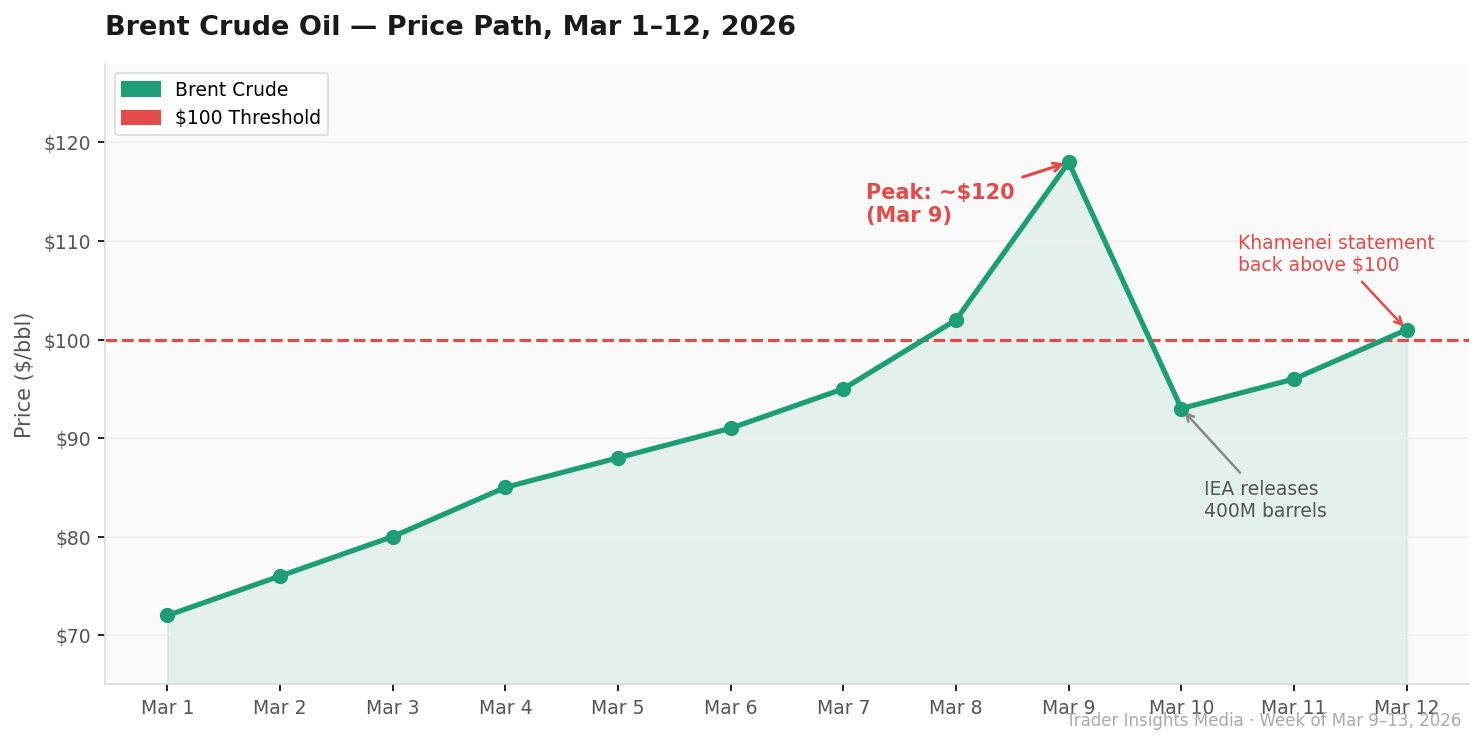
| | | | | | Oil Market Disruption | | Key points: | Brent spiked to nearly $120, pulled back to $93, then climbed back above $100 IEA announced a record 400M barrel reserve release to stabilize supply US average gas prices at $3.54/gal (+50¢ since Feb 28); diesel at $4.72
| This was one of the most volatile weeks for oil in years. | Brent crude spiked to nearly $120 a barrel on March 9, then dropped to around $93 after Trump's peace signals, only to climb back above $100 after Khamenei's defiant statement. In roughly 72 hours, oil swung nearly $30. | The IEA announced a record 400-million-barrel reserve release to cool things down. Qatar's energy minister warned that continued closure of the Strait "will bring down economies of the world." US gas prices are now at $3.54 per gallon, up 50 cents since February 28. Diesel has hit $4.72 per gallon. | Here's the thing, energy stocks like $XOM ( ▲ 1.29% ) and $CVX ( ▲ 2.7% ) are hitting 52-week highs while the broader market bleeds. That divergence is worth watching closely. |
| |
| | |
| | | | | | The Strait of Hormuz Goes Dark | 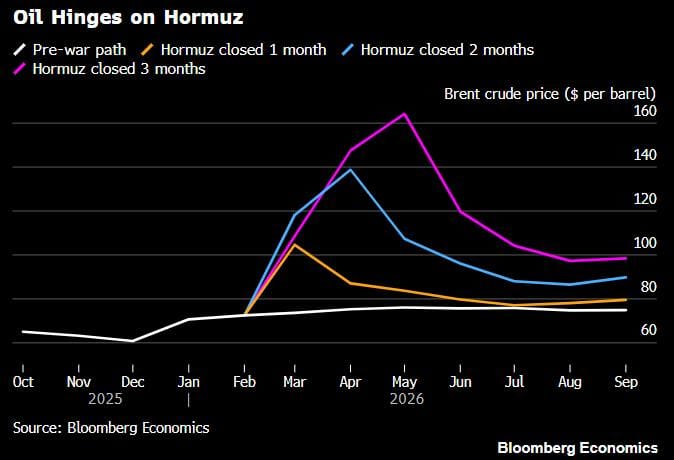 | Bloomberg Economics |
| Key points: | IRGC struck at least 3 vessels; drones hit near Dubai International Airport IEA calls this the "largest supply disruption" in history US Navy not yet ready to escort tankers through the strait
| The Strait of Hormuz, the narrow passage that moves roughly 20% of the world's oil, is effectively closed. | The IRGC struck at least three vessels this week. Among them: the Thailand-flagged Mayuree Naree, with three crew members trapped in the engine room. Drones also hit near Dubai International Airport, wounding four people. The IRGC claimed its 37th wave of attacks on March 11. | The IEA called this the "largest supply disruption" in history. Tanker traffic through the strait is near zero. And the US Navy isn't ready to escort ships yet, per Energy Secretary Chris Wright. | That last point matters more than you might think. Until safe passage is guaranteed, or Iran backs down, the oil price floor just moves higher. | Which sector is best positioned during the Hormuz closure? | |
| |
| | |
| | | | | | Markets: November Lows Are Back | | Key points: | Dow -1.56%, S&P -1.52%, Nasdaq -1.78% on Mar 12, lowest closes since November Oracle the outlier: Q3 revenue $17.19B (up 22% YoY), cloud revenue up 44% Fed expected to hold rates; PCE report incoming but already pre-conflict data
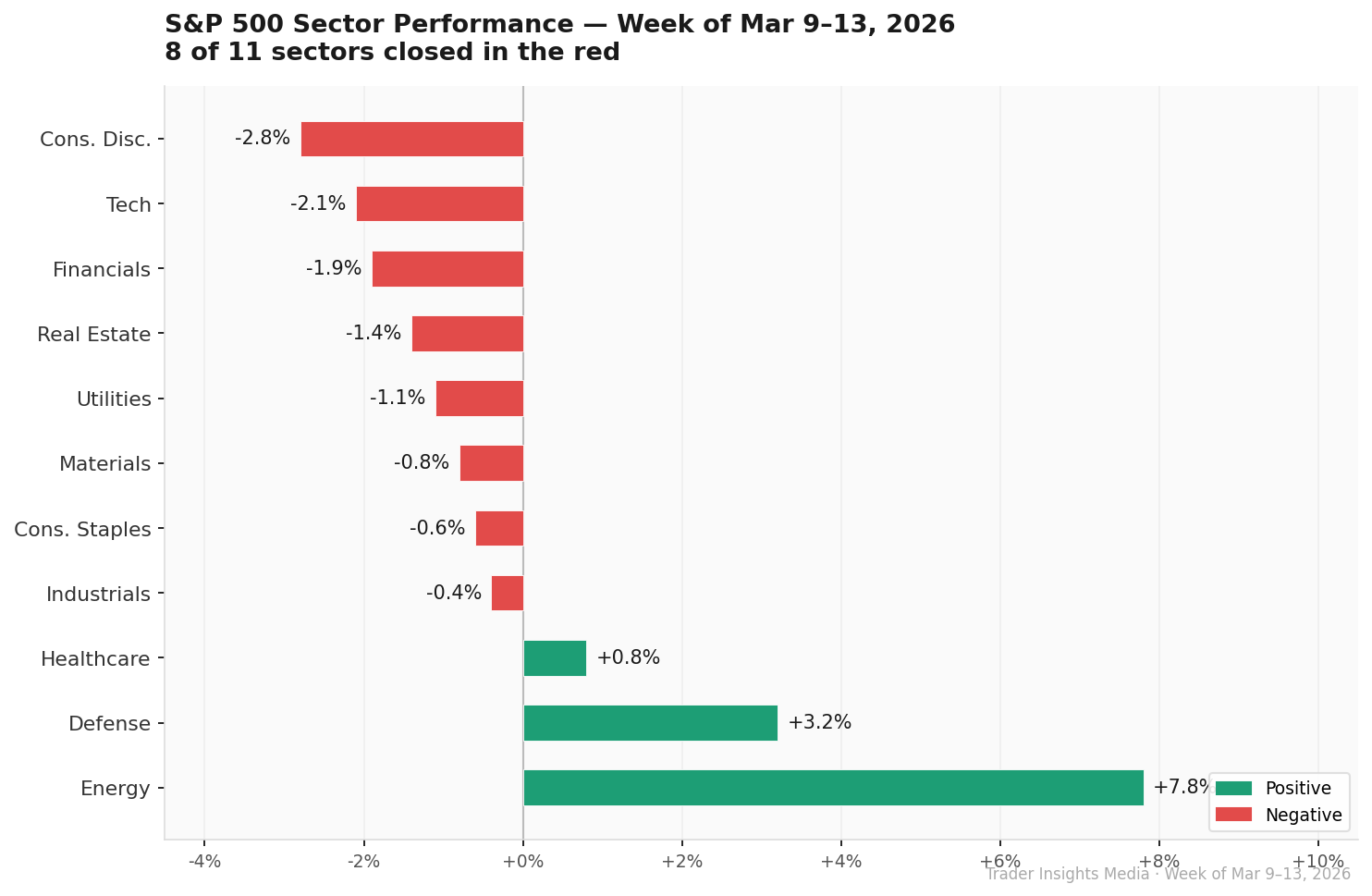
| Wall Street had a brutal Thursday. | The Dow fell 1.56%, the S&P 500 dropped 1.52%, and the Nasdaq declined 1.78%, all closing at their lowest levels since November. 8 of 11 S&P sectors ended in the red. The week felt like a slow bleed with a sharp selloff to close it out. | The one bright spot: Oracle. The company reported Q3 revenue of $17.19 billion, up 22% YoY, with cloud revenue up 44%. $ORCL surged nearly 10% post-earnings. | Markets are now waiting on the PCE inflation report, the Fed's preferred gauge. Problem: that data predates the Iran conflict's full economic impact, so it won't tell you much about where inflation goes from here. The Fed is expected to hold rates steady. But a prolonged oil shock complicates everything. |
| |
| | |
| | | | | This Company Just Rang the NYSE Opening Bell — the clock is ticking | Two weeks ago, a company rang the opening bell at the New York Stock Exchange. | It wasn't an IPO. | It was the launch of a multi-billion-dollar expansion of America's only operating advanced nuclear fuel facility. | The government committed $900 million. | Three federal deadlines are about to force billions more through this single chokepoint. | I believe this is the last window before institutional money reprices the stock. | Click here for the name, ticker, and the 3 steps I'd take before June 30th. | *ad |
| |
| | |
| | | | | | | Private Credit Meltdown | | Key points: | Morgan Stanley honored only ~46% of Q1 redemption requests; shares fell 3.6% JPMorgan Chase is reducing its exposure to the private credit industry Deutsche Bank disclosed ~$30B in private credit exposure; shares fell 5.6% Blackstone, KKR, Apollo, Blue Owl all down above 1%
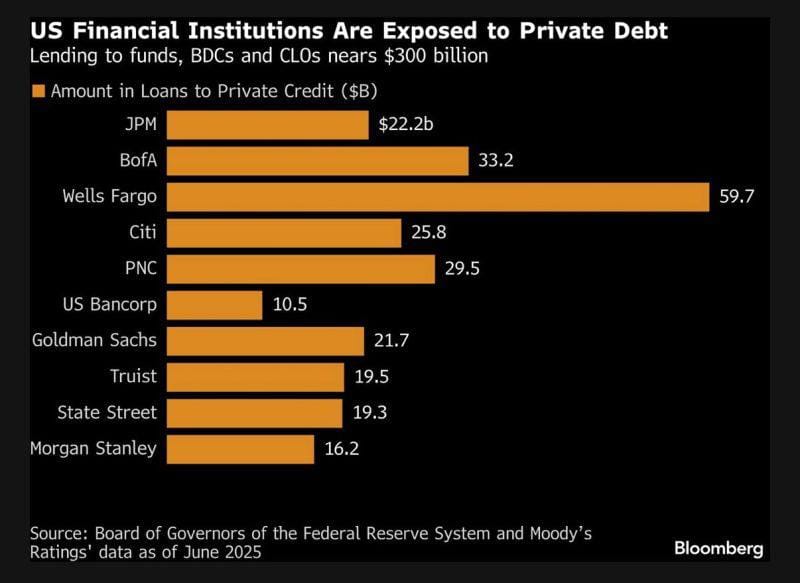
| This one flew under the radar. But it shouldn't. | Morgan Stanley's North Haven Private Income Fund got hit with redemption requests totaling 10.9% of shares in Q1. They only honored 5%, about $169 million, or roughly 46 cents on every dollar requested. MS shares tumbled 3.6%. | Same day, Deutsche Bank disclosed roughly $30 billion in private credit exposure in its annual report. DB shares fell 5.6%. Blackstone, Blue Owl, KKR, and Apollo each dropped over 1%. | Earlier this week, JPMorgan Chase is reducing its exposure to the private credit industry by marking down the value of loans held by the bank as collateral, according to a person with knowledge of the moves. | Private credit was the trade of the last decade. High yields during low rates. No public market volatility to stomach. It looked clean. But rising redemption requests, rising rates, and a geopolitical shock are now all hitting at once. That's when "illiquid" stops being a feature and starts being a problem. | Watch this space carefully. It could be early innings of something bigger. |
| |
| | |
| | | | | | The AI Disruption Is Now Internal | | Key points: | Atlassian cuts 1,600 jobs (10% of staff); TEAM down 84% from 2021 peak and 53% YTD Amazon's 13-hour AWS outage traced to an AI coding tool gone wrong Junior engineers at Amazon now require senior approval for AI-assisted deployments
| Here's an irony for the ages: the companies building AI tools are now being disrupted by them. | Atlassian announced it's cutting 10% of its workforce, about 1,600 jobs, to redirect capital toward AI investments and enterprise sales. The stock is already down over 53% this year and 84% from its 2021 peak. CEO Mike Cannon-Brookes was direct: the restructuring frees money for AI and enterprise growth. | Meanwhile, Amazon held an emergency engineering meeting after a 13-hour AWS outage was traced back to an AI coding tool that deleted and recreated cloud environments. Junior engineers at Amazon now need senior sign-off before deploying any AI-assisted code. | The lesson here is real: AI can cut costs, accelerate development, and now, apparently, take down a cloud platform for 13 hours if left unsupervised. |
| |
| | |
| Bottom Line | Think of this week as a pressure cooker that never got a chance to cool down. | A war in the Middle East is shutting off roughly 20% of the world's oil supply. Brent crude swung from $72 to nearly $120 and settled back above $100, all in two weeks. Gas prices followed. Your wallet noticed. | Wall Street didn't take it well. The Dow, S&P, and Nasdaq all hit their lowest closes since November. 8 of 11 sectors finished in the red. | Meanwhile, Morgan Stanley quietly capped fund withdrawals, a sign that private credit, one of the hottest trades of the past decade, is starting to crack. | And tech? Atlassian cut 10% of its staff for AI. An AI tool knocked Amazon's cloud offline for 13 hours. | Energy and defense held up. Almost everything else didn't. | Stay focused. This isn't over.
| | Disclaimer: This analysis is for educational purposes only and should not be considered investment advice. Always do your own research before making investment decisions.
Items marked with an asterisk (*) are promotional and help support this newsletter at no cost to readers. | |
|





Tidak ada komentar:
Posting Komentar