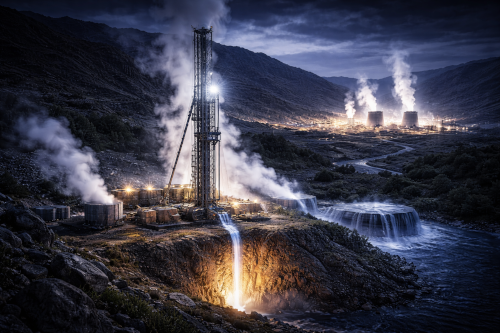
 Practical Investment Analysis for the New Energy Economy171 Million Reasons Why Trump Is Getting Power HungryOf all places in the U.S., it's not Boise, Idaho that most people would think of when it comes to geothermal energy. Yet, the city was running geothermal heat like a public utility before most American cities had finished arguing about electricity. Over 130 years ago, east Boise had a geothermal district heating system that was sending hot water through pipes to warm buildings like it was the most ordinary thing in the world. Believe me, there was no venture capital pitch deck, nor was there some activist-driven "energy transition" panel that made it happen — just a town that looked at the ground and decided to use what was already there. That's the part most people don't recognize, dear reader. The U.S. hasn't been waiting around for geothermal energy to be invented… we've just been eager for it to become scalable. Why? Well, because district heat is a local issue. However, electricity is different. Electricity builds empires. More importantly, power demands repeatable projects, predictable performance, and the kind of engineering that can be copied from one location to the next without hopes and dreams. And that's where next-gen geothermal and EGS come in. You see, EGS is effectively the industrial answer to the old geographic limitation — you don't need a perfect natural hydrothermal setup if you can engineer the reservoir, manage the flow, and pull dependable heat out of hot, dry rock. For decades, that idea was promising: small pilot projects, published scientific papers, and big claims that were followed by small megawatts. Today, that tone is finally changing, and now it's coming with things like federal funding, power purchase agreements, and projects that look suspiciously like an oilfield playbook repurposed for power. In fact, our Department of Energy pledged $171.5 million to support next-gen geothermal field tests, and confirmed drilling for both next-gen and conventional hydrothermal resources. And once Washington starts paying for field proof, you can bet the rest of the market will start shifting their gaze.
Trump's Tariff Windfall is Turning Into Cash Checks — Did You Claim Yours? Nearly $400 billion a year is now flowing into Washington from foreign imports. A portion of that money is already being redirected into "Tariff Rebate Checks," paying qualifying Americans up to $8,276 every quarter. The next payout window is approaching fast. Trump's New Power Rush Let's not mince words here — the bottleneck for geothermal in the U.S. has never been about heat. Rather, the bottleneck has been making the enormous leap from rare, location-specific systems to something buildable on schedule. When we talked a little about Fervo Energy's Cape Generating Station being under construction in Utah, we saw a flagship geothermal project coming to fruition. We're talking commercial scale, not just some pilot demonstration hoping to drum up a little media excitement. A power plant. So, the $171 million that the DOE is pushing is aimed at the exact two things the geothermal industry has needed for years: field-scale proof and drilling that confirms the resource with the kind of rigor utilities demand. Meanwhile, the demand-side story is getting blunt. You know as well as I do that data centers want power that shows up at 2 a.m. in August, not just at noon when the sun is bright in the sky. It's why Ormat recently inked its geothermal power purchase agreement for up to 150 MW NV Energy to support Google's data center operations, with projects expected online between 2028 and 2030. You can call that corporate sustainability if you like, but to us it reads like a procurement department quietly admitting that stable 24/7 baseload power trumps everything. However, we're also seeing a new technology layer to this dynamic, where next-gen geothermal starts to look less like an alternative energy moonshot, and more like advanced drilling connecting to grid planners. Even MIT has been framing next-generation geothermal as a real promise with real obstacles, highlighting millimeter-wave drilling work associated with Quaise Energy as one of the high-profile innovations aimed at going deeper, faster, and into tougher rock. New models are emerging that treat geothermal not only as generation, but as a system that can pair heat extraction with pressure-based energy storage concepts. Are we finally seeing a convergence in geothermal energy? After all, the EIA is documenting a shift from small experiments to a named, commercial-scale EGS project under construction in Utah. Utilities and big buyers are signing longer-dated contracts that effectively treat geothermal as a reliability product, not a novelty. And here's something else most people don't realize — next-gen drilling and reservoir engineering are emerging as the tools that make geothermal less location-bound and more repeatable. That alone will accelerate development in the years and decades ahead. How to Get a Six-Figure Payday From China's China's recent export ban on gallium, antimony, and germanium has sent shock waves through global markets, threatening to cripple U.S. national security. These critical metals are the backbone of America's defense infrastructure, essential for producing missiles, satellites, and fighter jets. Without them, the U.S. military is paralyzed. That's why the U.S. government is turning to a tiny American mining company to secure a reliable domestic supply of these vital materials. Look, Boise's 1892 system is a reminder that geothermal's best feature is also its least marketable one. It's boring. The heat doesn't care about election years or fuel shipping lanes (which I'll add is an interesting feature given the fact that marine traffic in the Strait of Hormuz has all but come to a standstill today). And it certainly doesn't give a damn if a pipeline is late… or explodes. Nope, geothermal energy just just sits there, quietly waiting for someone to tap it correctly. Granted, when a technology moves from being a mere curiosity to having real potential, the opportunity usually shows up before the headlines lead the market there. People see a wind farm, or maybe a field of solar panels locked side-by-side stretching across hundreds of acres. What they don't see (not at first, at least) is the industrial machine that forms around something like EGS: permitting pathways, drilling supply chains, offtake agreements, and the gradual standardization that turns bespoke projects into a build program. Think about it… The DOE didn't announce its $171.5 million field-test and drilling push because it wanted another round of inspirational geothermal speeches. That investment was made because the U.S. is staring down the road at an insatiable appetite for electricity. If you want a simple way to think about it, it's like the difference between a clever prototype and a factory line. Of course, as this development of next-gen geothermal projects accelerate, there'll always be those hidden gems lying in wait, flying under Wall Street's radar and just waiting to be plucked at the right time. Perhaps it's time you beat Wall Street to the punch. If you're ready, take a moment and check this one out for yourself. Until next time,
Keith Kohl A true insider in the technology and energy markets, Keith's research has helped everyday investors capitalize from the rapid adoption of new technology trends and energy transitions. Keith connects with hundreds of thousands of readers as the Managing Editor of Energy & Capital, as well as the investment director of Angel Publishing's Energy Investor and Technology and Opportunity. For nearly two decades, Keith has been providing in-depth coverage of the hottest investment trends before they go mainstream — from the shale oil and gas boom in the United States to the red-hot EV revolution currently underway. Keith and his readers have banked hundreds of winning trades on the 5G rollout and on key advancements in robotics and AI technology. Keith's keen trading acumen and investment research also extend all the way into the complex biotech sector, where he and his readers take advantage of the newest and most groundbreaking medical therapies being developed by nearly 1,000 biotech companies. His network includes hundreds of experts, from M.D.s and Ph.D.s to lab scientists grinding out the latest medical technology and treatments. You can join his vast investment community and target the most profitable biotech stocks in Keith's Topline Trader advisory newsletter.
|

 Check us out on YouTube!


Tidak ada komentar:
Posting Komentar