March 13, 2026
The 3 Kings of the Moon
Dear Subscriber,
 |
| By Michael A. Robinson |
Not long ago, I told you about Jared Isaacman — the billionaire entrepreneur and civilian astronaut now overseeing NASA’s return to the Moon.
At just 42, he’s the youngest person ever to lead the agency.
More to the point, he led the first all-civilian orbital mission and is the first private citizen to perform a spacewalk.
That matters.
Because in just a few weeks, America begins its long-awaited return to the Moon.
And Isaacman won’t be alone in shaping what happens next.
In fact, I see him as one of what I call the Three Kings of the Moon.
The other two? Jeff Bezos and Elon Musk.
Each has his own plans — not just for a space empire but starting with our return to the lunar surface and the infrastructure that follows.
Here’s the key for investors:
Instead of betting on which king wins — NASA, SpaceX or Blue Origin — we can own a company that works with all three.
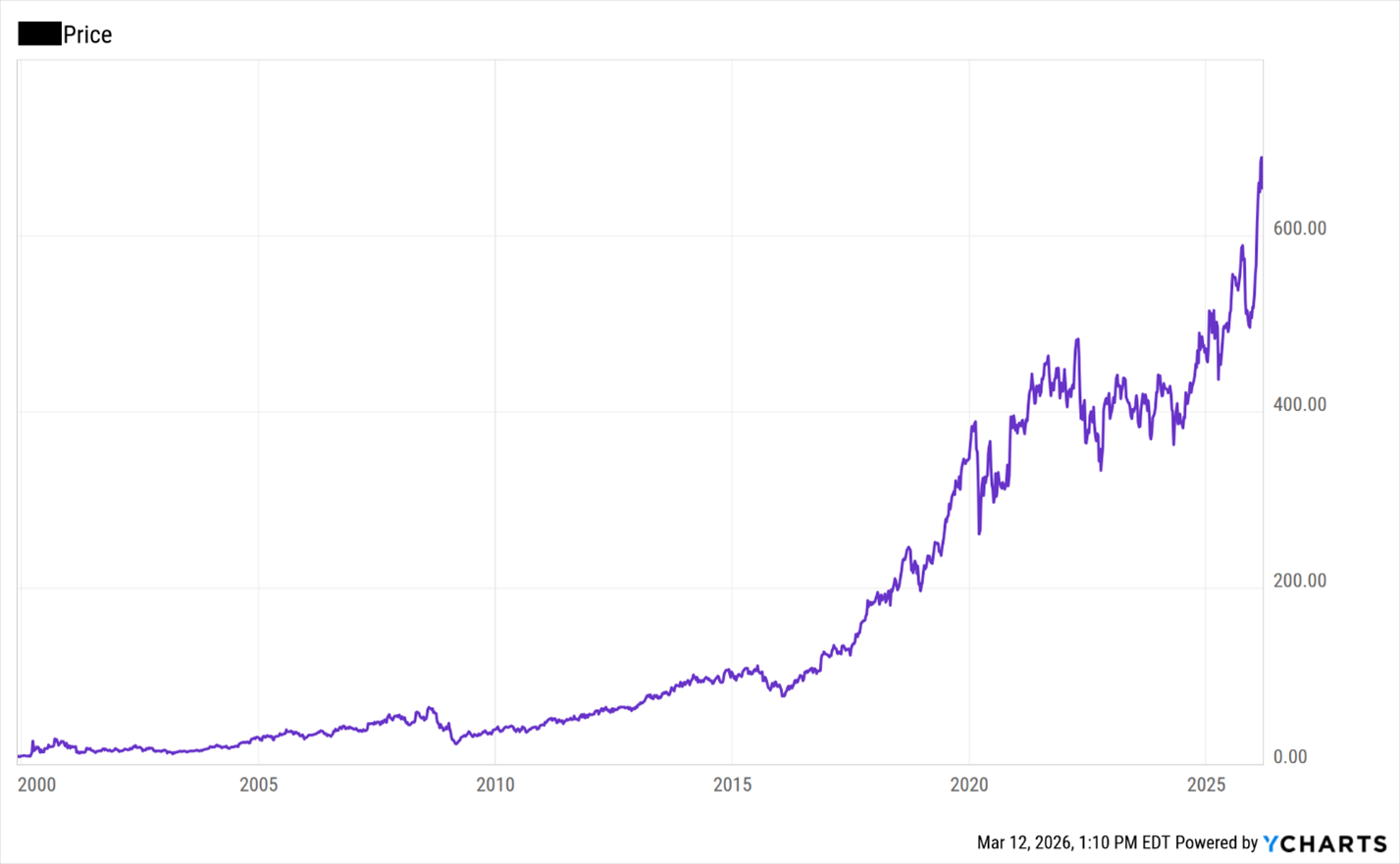
This is a firm that has grown sales 10x over 25 years — and just tripled its earnings growth …
Introducing Project Artemis
One of the key driving forces in space right now is NASA’s Project Artemis.
This multistage national initiative represents a decades-long commitment to put people back on the Moon — and eventually establish sustainable lunar bases, launch facilities and mining operations.
Why? Resources.
The Moon contains rare earth metals as well as helium-3, which some estimates value at $1.5 quadrillion.
The space economy is expanding rapidly to make all this possible.
That’s why space is currently a $613 billion industry expected to exceed $1.8 trillion by 2035.
Projects as complex as Artemis require not just vision, but execution.
Fortunately, the United States has both the talent and private-sector innovation to make it happen.
Private companies now drive much of the innovation in space exploration.
And Isaacman comes from this new generation of space pioneers. He’s uniquely positioned to coordinate both private and public sectors as Artemis moves forward.
It also helps that the current administration is strongly supportive of Artemis and wants Americans back on the Moon within the next two years.
And Isaacman has two of the richest men in the world — both major players in space — effectively working alongside him.
Musk vs. Bezos
These are the other two Kings of the Moon.
The first is Elon Musk, who runs SpaceX.
For years Musk focused primarily on colonizing Mars, viewing the Moon as a distraction. But recently his thinking has shifted.
Now he sees the Moon as a critical stepping stone for building the infrastructure needed to eventually reach Mars.
Building and supplying a lunar base is far less daunting than attempting the same feat on Mars.
It also positions SpaceX to play a central role in Artemis rather than watching from the sidelines.
SpaceX now sees Artemis as a gateway to NASA’s larger long-term space vision.
The second king is Jeff Bezos, founder of Blue Origin.
Bezos has been focused on the Moon since the earliest days of his space venture.
Blue Origin had a slower start than SpaceX.
Bezos has always emphasized a deliberate engineering philosophy — moving carefully and getting things right rather than moving fast and iterating constantly.
That philosophy is why he responded to Musk’s shift with a picture of a turtle:
While its rockets are still evolving, Blue Origin is already deeply involved across the space economy.
Its engines power other launch vehicles. And the company is developing a lunar lander and other equipment for Artemis and government missions.
Together, these three kings are shaping America’s efforts to extend human activity beyond Earth.
A Storied Supply Firm
Knowing all this, the next question becomes: What company is best positioned to benefit from all three space kings?
After examining the options, the clearest winner is Teledyne (TDY).
Teledyne often flies under the radar because it specializes in highly engineered equipment for specialized industries. But its technology is essential to many of those sectors.
The Artemis program and the broader space race play directly into Teledyne’s strengths.
And the Three Kings — along with many others — will rely heavily on its technology.
Much of Teledyne’s growth over the past decade has come through acquisitions.
When it identifies promising sectors, the company acquires strong performers and integrates them.
Over the past five years it has averaged nearly two acquisitions annually and already has one in the books for 2026.
As space and defense spending accelerate, companies like Teledyne provide critical technologies — including radiation-hardened electronics, communications subsystems, avionics and advanced test equipment.
That’s one reason sales have surged nearly tenfold since 2000 to more than $6 billion today.
Selling to the Three Kings and Beyond
Nearly every major aerospace name works with Teledyne in some way — including Artemis, satellites and other national space initiatives.
It supplies sensors and extreme-environment electronics to SpaceX and recently deployed hardware on a SpaceX smallsat mission.
For Blue Origin, Teledyne supports key systems tied to NASA’s next lunar lander, where Blue Origin serves as prime contractor.
And at NASA, Teledyne is a prime contractor supporting the Artemis Moon rocket through work on the Space Launch System alongside Aerojet Rocketdyne, Boeing (BA) and Northrop Grumman ( NOC).
This is only a small sample of the work Teledyne is already performing — with more likely ahead.
We’re entering a major expansion in space exploration, and the Three Kings will be central to that growth.
But the smartest way to play this boom may be through Teledyne.
Earnings growth has been steady in recent years. And the company’s latest results show that its strategy to expand margins and capture new opportunities is working.
Profits per share have nearly tripled.
That puts Teledyne in a strong position no matter which king ultimately leads the race to the Moon.
And it gives investors a way to participate in the profits as America becomes the undisputed leader of the New Space Race.
You can see that Teledyne earned a high rating from Weiss Ratings:
But to see why, you’ll need access to the many tools, indices and data that only Weiss Ratings Plus Members have.
I use these tools when researching any idea I have. I recommend everyone else start doing the same if they haven’t already.
To see what I’m talking about, watch this to the end.
Best,
Michael A. Robinson







Tidak ada komentar:
Posting Komentar