January 22, 2026
Forget Greenland. AI Stole the Show in Davos
Dear Subscriber,
 |
| By Dawn Pennington |
While Main Street waited to hear what President Trump and other world leaders would say about tariffs, Greenland and NATO …
Wall Street had its eyes on something else.
I’m talking about the World Economic Forum Annual Meeting that’s about to wrap up in Davos-Klosters, Switzerland.
Investors are interested in all those important topics above.
But the big money that moves markets every day was more concerned wtih what’s changed at this year’s Davos meeting …
AI dominated the list of events.
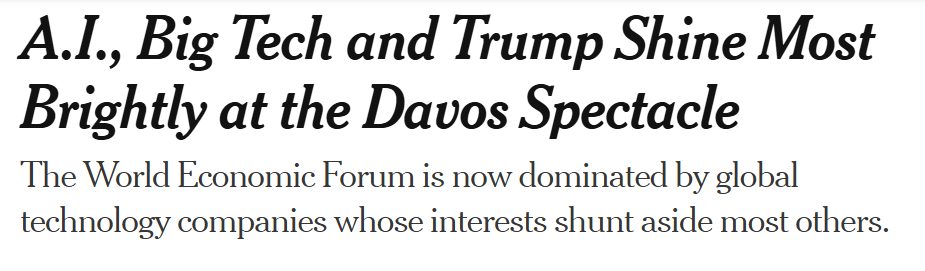
And as the above New York Times article notes, it was the biggest people magnet, too …
“The high-minded panel discussions about climate change, caring for refugees and the future of healthcare were there to be heard in lesser venues.
“But the action was dominated by technology giants and their euphoria over the lucrative potential of the moment.”
These weren’t just any tech giants dominating the action.
They were American tech giants — Microsoft (MSFT), Nvidia ( NVDA) and Palantir (PLTR) , to name a few.
The reason? America’s culture of innovation.
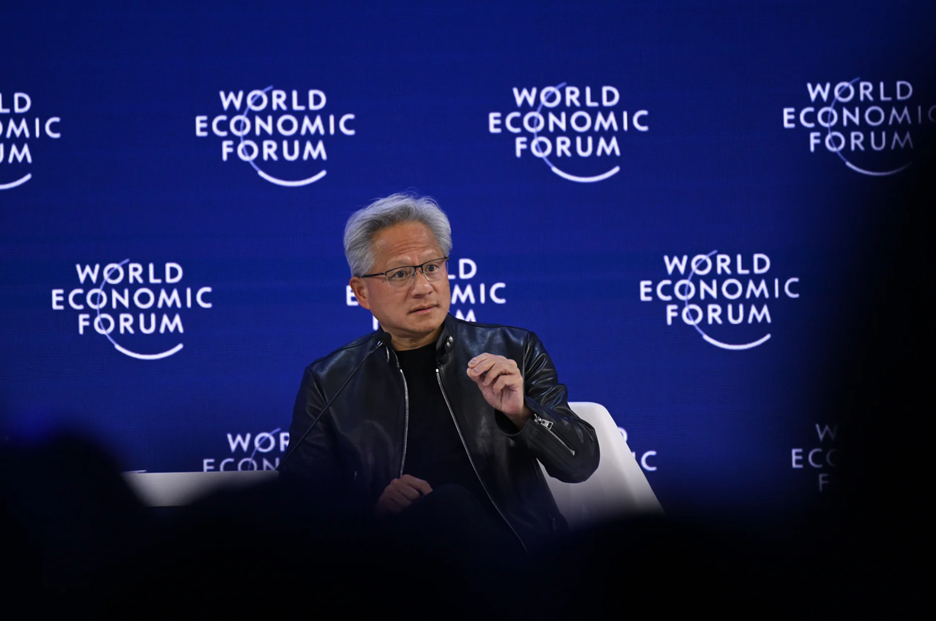
Nvidia CEO Jensen Huang at Davos.
Source: Quartz.
It’s no surprise that America has been the top investment market for over a decade.
Today, America boasts eight tech companies with valuations of more than $1 trillion.
It’s hard to believe, but it wasn’t until 2018 that Apple became the first company to cross the $1 trillion mark.
It’s clear: America’s innovation was second to none.
But now, there is a second player in the global AI race: China.
A New ‘AI Arms Race’
An ostensibly communist country, China has embraced capitalist reforms when in the country’s best interest.
And they’ve been developing AI programs of their own.
If they manage to become the first country to achieve AGI, artificial generalized intelligence, it could pose a massive geopolitical threat.
All told, China and the U.S. have distinct approaches to AI development that reflect their different political systems, economic structures and strategic priorities.
Let’s take a look at each and see who’s coming out ahead right now …
How the U.S. & China Stack Up in the AI Race
China's AI development is heavily state-directed through initiatives like the "New Generation Artificial Intelligence Development Plan" (2017), which set explicit goals for AI leadership by 2030.
Under this initiative, the government works with universities, research labs and companies, with significant state funding and centralized planning.
There are no rockstar CEOs like Nvidia’s Jensen Huang or ChatGPT founder Sam Altman.
The U.S. relies more on private sector innovation.
That said, the government does provide research funding, particularly through DARPA, NSF and the DoD.
Under President Trump, this government spending on AI is increasingly focused on maintaining technological leadership and increased domestic manufacturing capabilities.
But the system is still geared toward a capitalist model.
That’s why there’s intense competition and the rise of several AI systems such as ChatGPT and Gemini.
Chinese AI companies benefit from access to massive datasets from a large population with fewer privacy restrictions than in the West.
This gives advantages in training certain AI systems.
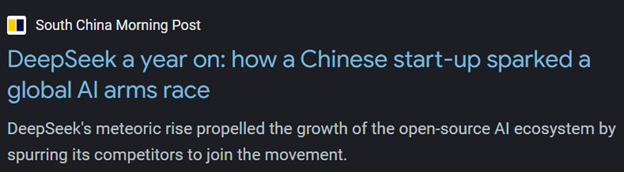
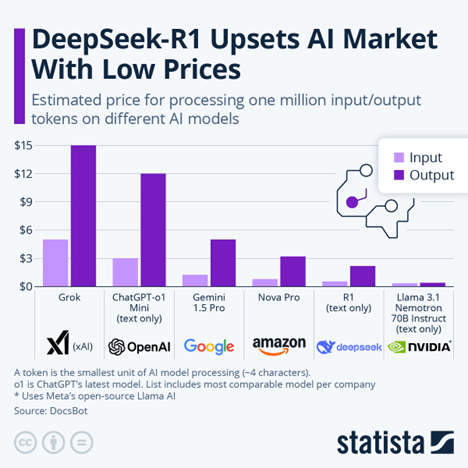
We saw that nearly a year ago when China announced the development of its DeepSeek AI.
In contrast, U.S. companies face stricter privacy regulations and more public scrutiny around data collection.
Regulations that President Trump aims to see loosened with his latest tech-focused Executive Order: “Ensuring a National Policy Framework for Artificial Intelligence.”
His 23rd tech EO of this term calls for the U.S. to fortify its status as a global AI superpower, to “win the AI race, as we must.”
China emphasizes AI for surveillance, social management, smart cities and manufacturing efficiency.
These are applications that align with state goals for social stability and economic modernization.
In the U.S., we call what China’s doing as part of a surveillance state.
In contrast, the U.S. private sector focuses more on consumer applications, enterprise software, autonomous vehicles and healthcare.
Plus, the military also invests heavily in AI for defense applications.
The Competition for the Next Leap Forward
The U.S. has imposed export controls on advanced AI chips to China.
This has created a significant constraint on Chinese AI development, particularly for training large models.
China is investing heavily in domestic chip production to reduce this dependency. Though it currently lags in cutting-edge semiconductor manufacturing.
As seen with DeepSeek, these restrictions could simply cause China to leapfrog on innovation …
Which could result in it coming up with better AI tools that use less-sophisticated hardware.
On the research front, the U.S. maintains advantages in foundational AI research.
Here, leading universities and research labs (like OpenAI, DeepMind, Anthropic) push theoretical boundaries.
China, meanwhile, excels at rapid implementation and scaling of AI applications.
Though it's also investing heavily in basic research to close gaps.
How to Play This New ‘AI Arms Race’
In short, both countries view AI as crucial for economic competitiveness, national security and global influence.
Healthy competition is good for any marketplace.
But if China pulls ahead in the race for AI supremacy, it could use that power to slow the progress of others.
Not only can the U.S. not afford that … we don’t plan to let that happen.
As Sean Brodrick revealed in this brand-new video, the U.S. has a clear edge — and likely will for some time.
Sean breaks down how, based on the historical patterns, today’s AI boom is still alive and well …
And how some of the best opportunities are ahead.
To your health and wealth,
Dawn Pennington
Editorial Director




Tidak ada komentar:
Posting Komentar