January 23, 2026
3x the Market with 'Freed' Robots
Dear Subscriber,
 |
| By Michael A. Robinson |
For years, robots were basically locked behind cages.
Bolted to factory floors.
Useful — but a little on the limited side.
Of course, in recent years they’ve gotten more mobile.
Now, Elon Musk wants to turn that idea on its head. He’s building robots that look, act and work like humans.
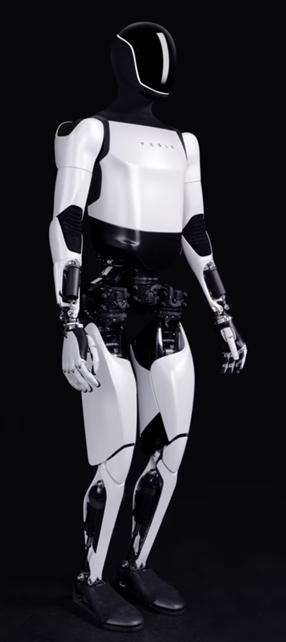
Inside Tesla’s (TSLA) labs, nearly six-foot-tall humanoid robots roam hallways, sort objects, fold laundry and practice basic industrial tasks.
Musk has told investors these machines — called Optimus — could one day generate “infinite” revenue and become the biggest product Tesla has ever built.
He says the bots could have long-term sales of more than $10 trillion.
It’s like I keep saying. Robots have become a vital part of our tech-centric economy.
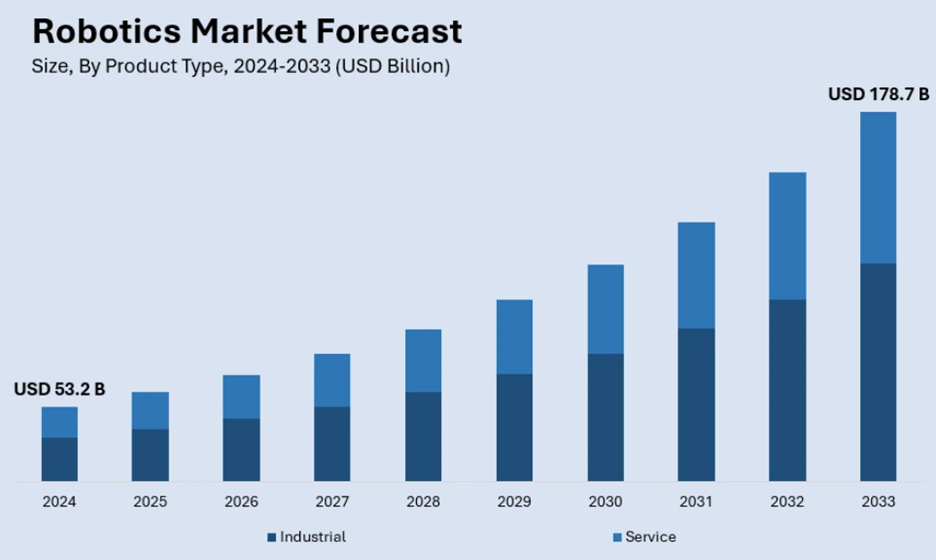
Now you know why the pre-Musk sector is on pace to have a value of $178.7 billion by 2033.
Which brings me to a lesser-known robotics leader quietly positioned to profit from this shift.
Last year, its stock beat the market by 3x.
Let me show you why there’s still a lot of upside ahead …
The Robot Economy Is Arriving
Now then, if machines can finally move freely, see and adapt inside environments built for humans, the implications stretch into logistics, manufacturing, warehouses and health care just to name a few.
Tesla’s humanoid robots are still early. Many are trained with human guidance.
Some are remotely operated. And skeptics question whether walking, human-shaped machines are the most efficient answer for factory work.
But that debate misses the point.
Musk isn’t chasing novelty. He’s responding to the same structural pressure confronting every manufacturer on the planet: Labor is scarce, expensive and increasingly unreliable.
Factories, warehouses and logistics hubs were built for humans.
Retrofitting them with fixed automation only goes so far.
What companies actually need are machines that can move freely.
They should be able to understand their surroundings and perform useful work without constant reprogramming.
That’s why robotics spending is accelerating across sectors.
Analysts project that advanced robotics and automation could generate massive sales and profits.
According to recent industry forecasts, the robotics market was valued at roughly $53.2 billion in 2024.
Research and Markets projects that by 2033 the sector will grow to $178.7 billion.
Warehousing, manufacturing, e-commerce fulfillment and industrial logistics are already in the early stages of this shift.
Tesla is aiming for a fully autonomous, humanoid future.
The AI-powered robotics segment — machines that see, sense and make decisions — is on track to increase from around $12.8 billion in 2023 to nearly $125 billion by 2030.
Grand View Research says the yearly growth rate is a blistering 38.5%.
No wonder Musk sees so many dollar signs.
Musk’s sales likely won’t come for several years. But other players have an early mover advantage in the robotics sector.
They’re taking a more practical course with robots that can solve real-world problems right now.
Which brings us back to that stock that crushed the market last year — and the quiet robotics leader behind it.
The Quiet Winner in Robotics
That leader is Teradyne (TER).
Based in Massachusetts, Teradyne doesn’t make consumer gadgets or promise futuristic breakthroughs.
Instead, it builds the machines that modern manufacturing depends on.
Founded by two MIT classmates in the 1960s, Teradyne pioneered automated testing at a time when electronics were still inspected by hand.
Its systems transformed quality control in semiconductors — a role that remains vital as chips grow more complex and more essential to everything from data centers to electric vehicles.
But today, Teradyne’s most important growth engine is robotics.
Through its Mobile Industrial Robots (MiR) and Universal Robots units, the firm has become a global leader in practical automation.
MiR focuses on autonomous mobile robots designed for logistics and material handling.
These machines move pallets, tow carts and transport materials through warehouses and factories without human drivers.
Some models can move more than 2,600 pounds, navigating dynamic environments safely and efficiently.
For companies facing labor shortages, these robots aren’t luxuries — they’re solutions.
Universal Robots addresses a different need: collaboration.
Its “cobots” are designed to work alongside humans rather than behind cages.
They handle tasks like assembly, palletizing, machine tending, inspection and finishing — jobs that demand precision but flexibility as well.
More than 75,000 of these robots are already deployed worldwide by companies such as Ford (F), L’Oréal ( LRLCY), Stellantis (STLA), Autodesk (ADSK) and Sanofi ( SNY).
Crucially, Teradyne’s robots are getting smarter.
The company has integrated artificial intelligence — including accelerated computing from Nvidia (NVDA) — to improve vision, planning and decision-making.
Some systems now plan movements 50 to 80 times faster than earlier generations.
This allows robots to operate effectively in complex, real-world settings.
This is the key distinction.
While Tesla pursues humanoid robots that may redefine automation someday, Teradyne sells robotics infrastructure businesses can deploy today.
It’s a classic picks-and-shovels play on a massive technological shift.
And the market has noticed.
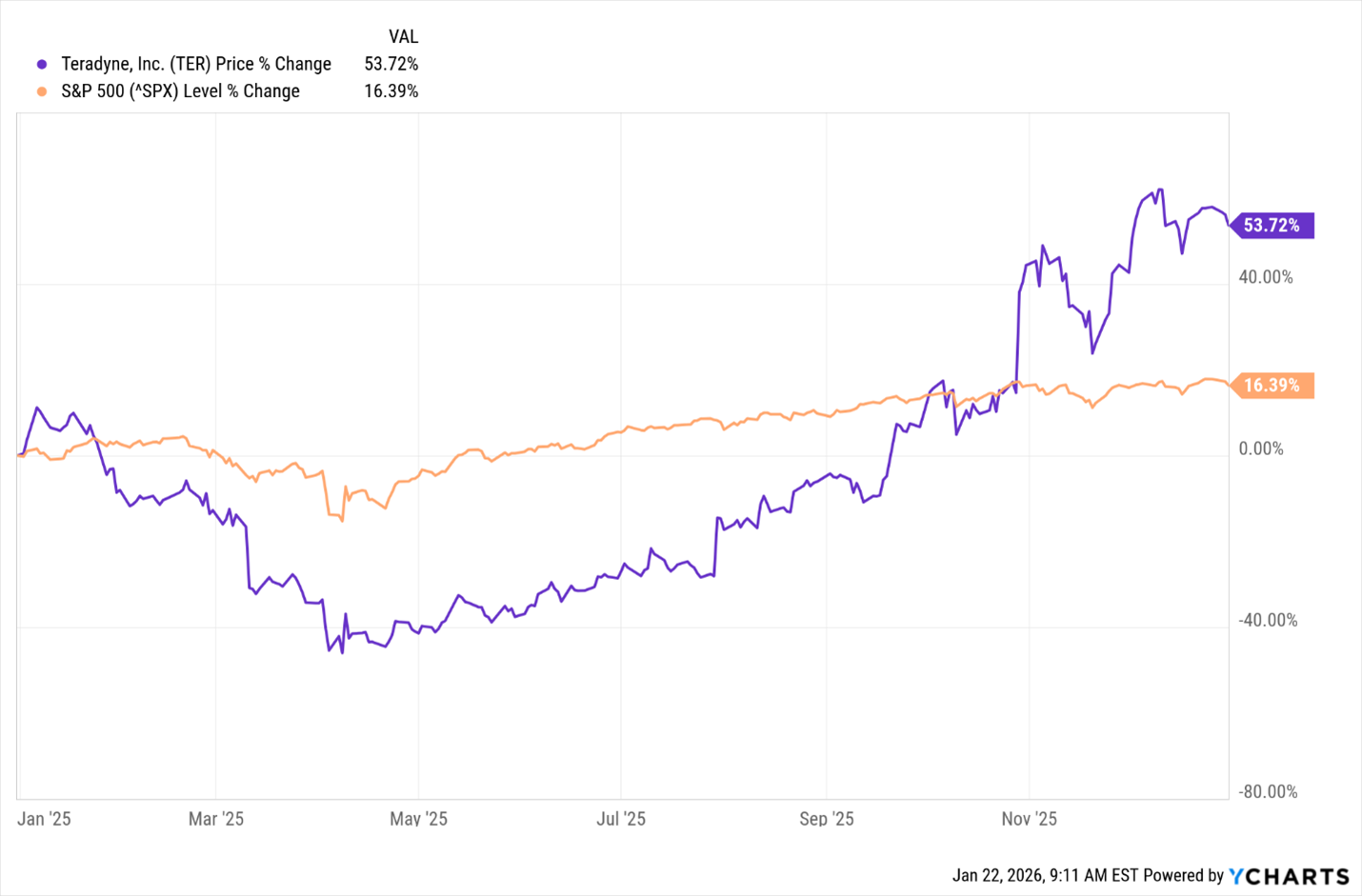
Last year, TER gained 54%, while the S&P 500 rose just 16.4% — meaning Teradyne beat the market by more than 3x.
As you can see, it did even better compared to the overall market after its April bottom.
And as companies across the economy keep adding robots to their “labor force,” this is a stock you can count on for the long haul.
Best,
Michael A. Robinson
P.S. This is all part of the “Fifth Tech Supercycle” in the past 150 years.
For what all that entails … and exactly which stocks are set to soar … watch this to the end.




Tidak ada komentar:
Posting Komentar