Bloomberg calls it "a dire shift of fortunes for America" and The Wall Street Journal calls it a "New World Order." Now, Dr. David Eifrig – a 40-year market veteran who traded through Black Monday and has recommended more than a dozen triple-digit winners – warns that you must make one of the most important financial decisions of your lifetime today.
🧮 BONUS: The Two Numbers Wednesday's Fed Vote Couldn't Move 📌
The 10-year closed. A dividend paid. Neither one waited to see how this week's argument turned out.
Tonight's Numbers
4.67% — where the 10-year Treasury was trading Friday morning, the benchmark every new bond-ladder rung gets priced against.
$1.50 — JPMorgan Chase's declared quarterly dividend per share, paid today to shareholders on the books.
3.3% — the trailing yield on the Schwab U.S. Dividend Equity ETF, a common stand-in for a diversified income sleeve.
Two numbers from today are worth more than everything that happened this week. The 10-year Treasury was trading near 4.67% Friday morning, little changed from Thursday's close. JPMorgan Chase paid its declared quarterly dividend of $1.50 per share to shareholders on the books. Neither number cares that three Fed officials dissented Wednesday, or that Apple and Amazon told opposite earnings stories Thursday night. They were set weeks ago, and they landed exactly on schedule.
That's the case for treating this week's noise the way a portfolio built for income should: as weather, not climate. A retirement account doesn't need to reposition every time a committee splits or a mega-cap misses a guidance number. What it needs is a structure that keeps paying out regardless of which headline wins the week — a bond ladder with rungs coming due on a schedule you control, and dividend payers that keep the checks coming whether their stock closed up or down on any given Thursday. Buffett has made a career of saying, in one form or another, that time in a good business beats trying to time the news around it.
Position sizing is where this actually gets decided, not in the reading of any single week's headlines. A holding sized so that a 6% overnight move in one stock — the kind Apple just had — barely moves your total return is a holding sized correctly. One that keeps you up at night was probably too large before Thursday's earnings call, not because of it. The same test applies to the income side: a bond ladder should be built so that where the 10-year sits on any given Friday, whether 4.50% or 4.90%, changes the reinvestment rate on your next rung, not your sleep.
There's a real question sitting underneath this week's noise, and it's worth naming rather than trading around: Amazon just raised its 2026 capital spending plan to roughly $220 billion, up from about $200 billion, largely to fund AI and cloud buildout. Spending at that scale, from companies this size, tends to show up eventually in the bond market as issuance — and issuance is one of the quieter forces that can nudge long-term rates, the same rates a bond ladder is priced against. It's not a today problem. It's a multi-quarter one, worth watching rather than reacting to.
Friday, August 7 brings the July jobs report, and it will likely get read as the market's verdict on which side of Wednesday's Fed split was right. It's worth watching. It's not worth restructuring an income sleeve around in advance, since nobody — including the three officials who dissented — knows what it will say yet.
Income Watch
Declared: JPMorgan Chase paid its declared quarterly dividend of $1.50 per share today, a payment scheduled well before this week's Fed drama began.
Ex-dates ahead: Quiet stretch ahead for widely-held income names — the next one on the calendar is Chevron, ex-dividend August 19.
Yield check: The 10-year Treasury was trading near 4.67% Friday morning, little changed from Thursday's close. The Schwab U.S. Dividend Equity ETF (SCHD), a common income-sleeve holding, carries a trailing yield near 3.3%.
Tomorrow's Calendar
ISM Manufacturing PMI, Monday Aug 3, 10:00 AM ET — the first hard data read since Wednesday's split Fed vote. July Jobs Report, Friday Aug 7, 8:30 AM ET — the number the three dissenting officials will likely point to next. Next FOMC Meeting, Sept 15–16 — the committee's next chance to act on this week's disagreement.
Are you leaning on dividends like JPMorgan's for income, or letting them quietly compound? Drop me a reply — I read every note.
— Randy Cole, Editor
This email may contain paid advertisements and affiliate links. Guardian Financial Publishing may receive compensation if you click a link or make a purchase.
The Money Memo is a publication of Guardian Financial Publishing (D/B/A) Stable Financial Publishing | Privacy Policy | Terms | Disclaimer
Your American First, America Always account is active and this message was delivered as part of your current subscription. If you did not request this email or believe it was sent in error, please reply directly so our team can review your account status. Account Status and Subscription Details Your subscription is confirmed and your delivery preferences are current. You are receiving content based on the schedule and format you selected when you registered. If you need to modify your delivery window, update your email frequency, or temporarily pause communications, reply to this message and our team will process your request within one business day. Your most recent account activity has been logged and no irregular access was detected. If you did not recently sign in or modify your account preferences, please reply to this email immediately so we can investigate and secure your account. We recommend reviewing your login history regularly and changing your password if anything looks unusual. As an active subscriber, your current access includes policy briefings, legislative tracking updates, economic commentary, and periodic special reports. These are delivered on the schedule you selected during enrollment. A copy of your original registration confirmation is available upon request by replying to this message. Billing and Transaction History If you have questions about a recent charge, your next renewal date, or your current membership tier, reply to this email and a member of our billing team will pull up your account details. We maintain complete records of all transactions associated with your subscription and can provide a full billing statement upon request. For members with active paid subscriptions, billing occurs on the renewal date established at the time of your original purchase. If you need to update the payment method associated with your account, please contact our team directly by replying to this email rather than clicking links in forwarded messages. We handle all payment updates manually to safeguard against unauthorized modifications. If you believe a charge was made in error, please notify us within 30 days of the transaction date. Refund requests are reviewed on a case-by-case basis and are typically processed within five to seven business days. You will receive a confirmation email once any billing adjustment has been applied to your account. Please be aware that we will never request full payment card numbers, bank account information, or login credentials via email. Any message asking for this type of information should be treated as fraudulent and reported to our team immediately by replying to this email. Managing Your Communication Preferences We recognize that every subscriber manages their inbox differently and we respect your time. You have full control over the types of messages you receive from us. Available delivery options include daily briefings, weekly digests, breaking alerts on major policy developments only, or a temporary hold on all communications. To adjust your preferences, reply to this email with your request. Our team processes preference updates manually to ensure accuracy and prevent errors. Most changes take effect within 24 to 48 hours. If you previously submitted a preference change and it has not been reflected in your deliveries, please reply again referencing your earlier request and we will prioritize resolution. If you wish to unsubscribe entirely, you may do so using the link included at the bottom of this email. The process is simple and your request will be honored without delay. We do not use deceptive practices to prevent unsubscription and we respect every subscriber's choice. Privacy and Data Handling The personal information you provided during registration, including your name and email address, is stored securely and accessed only by authorized members of our team. We do not sell, rent, license, or disclose subscriber information to third parties for marketing or advertising purposes. Our data handling procedures are reviewed on a regular basis to ensure compliance with applicable laws and regulations. We employ industry-standard protocols for both data storage and transmission. Subscriber records are retained only for the duration necessary to fulfill your subscription obligations and satisfy any applicable legal requirements. If you would like to request a copy of the personal data we maintain on file for your account, or if you would like to request deletion of that data, please reply to this email with your request. We will process it and confirm completion within ten business days. Our privacy practices may be updated from time to time. When changes occur, subscribers will be notified via email with a clear summary of what has been revised. Continued use of our services following notification constitutes acceptance of the updated terms. Account Security The security of your account is a priority. All subscriber information is transmitted using encryption and stored on systems that are actively monitored for unauthorized access attempts. We encourage all subscribers to use strong, unique passwords and to exercise caution when responding to unsolicited messages that request personal details. If you receive a suspicious email that appears to come from American First, America Always, please forward it to our team for review. We will examine the message and confirm whether it is legitimate. Do not click links or open attachments in messages you are uncertain about until you have verified their authenticity with us. For added protection, we recommend reviewing your account settings on a regular basis to verify that your contact details and communication preferences are accurate. If you discover any discrepancies or information that appears incorrect, reply to this email and our support team will assist you in resolving the issue. Contacting Our Team Our support team is available Monday through Friday during standard business hours. We strive to respond to all subscriber inquiries within one business day. For urgent matters related to account security or unauthorized access, we prioritize expedited response times. To contact our team, reply directly to this email. Please include your full name and the email address linked to your subscription so we can locate your account records efficiently. If you are writing on behalf of another subscriber, please include written authorization from the account holder. We genuinely value feedback from our subscribers regarding our content, communication frequency, and the overall subscriber experience. Every reply is reviewed by a member of our team and your input directly informs how we refine and improve our service. Content and Editorial Disclaimer The information delivered through American First, America Always is provided for educational and informational purposes. The views expressed represent the analysis and commentary of our editorial team at the time of publication. Political, economic, and legislative conditions are subject to rapid change and readers are encouraged to verify information independently and consult with qualified professionals where appropriate. Our editorial staff makes every reasonable effort to ensure accuracy and fairness in the information we publish. However, we cannot guarantee that all details remain current following delivery. If you identify an error or inaccuracy in any of our content, please notify us by replying to this email and we will issue a correction as quickly as possible. Thank you for being an active member of the American First, America Always community. We value your trust, your time, and your engagement. If there is anything we can do to improve your experience as a subscriber, please do not hesitate to reach out by replying to this message.
Editor’s Note: Jeff Brown and Marc Chaikin, two investment legends who picked Nvidia 10 years ago, are predicting that by the end of this month, Elon Musk’s new AI breakthrough will collide with a strange market pattern with a flawless 100% track record of massive market gains. Click here to see the details or read more below because the last time this happened everyday folks had a chance to turn $10,000 into as much as $350,000 in just about 12 months.
Dear Reader,
Take a look at Elon Musk’s new patent below…
Because it protects a new invention that could rewrite the future of wealth forever.
I’m talking about a radical new form of AI I call “M.A.G.I.”
One so revolutionary that Elon called it an “infinite money glitch.”
Click here to see the details because he believes this is a once-in-a-generation opportunity to create wealth on a scale most people can’t even comprehend.
What’s the upside potential here?
I know this is going to sound crazy…
But Elon is projecting growth of over 7,000,000%.
Let that sink in.
That’s enough to turn $100 into more than $7 million.
This sounds absolutely insane.
But then again… everything Elon has ever done sounded insane at first.
Self-driving cars.
Reusable rockets that land themselves.
Brain chips that let paralyzed people control computers with their minds.
Crazy ideas.
But he turned them into trillion-dollar realities.
So here’s the real question…
Will you watch Elon build another empire from the sidelines…
Or will you finally position yourself to potentially become one of the winners in his next trillion-dollar revolution?
Click here to get the details because I believe Elon will flip the switch on this new invention by the end of this month.
We have so much to look forward to,
Jeff Brown
Founder & CEO, Brownstone Research
Bonus News from MarketBeat Media
AMD and Cerebras Create A New Blueprint For Hardware
Author: Jeffrey Neal Johnson. First Published: 7/24/2026.
Key Points
AMD and Cerebras Systems have combined Helios rack-scale systems with the Wafer-Scale Engine to separate AI prompt processing from token generation, boosting efficiency.
The joint architecture targets a fivefold increase in tokens per second per watt and 30% more inference tokens per dollar, appealing to power-constrained data centers.
Despite Cerebras shares falling amid margin warnings and insider selling, analysts attribute this to growth-driven capacity expansion rather than weakening demand or pricing power.
Artificial intelligence (AI) infrastructure is hitting a physical wall. As large language models grow exponentially, the legacy approach of throwing large, monolithic graphics processing units at the problem breaks down during the inference phase.
Marc Chaikin, founder of Chaikin Analytics, is flagging a little-known company that just secured a partnership with Nvidia - one he believes positions it ahead of Tesla in the autonomous vehicle race.
With a market-moving announcement expected on July 31st, Chaikin is urging investors to swap overpriced AI stocks for this under-the-radar name before markets open. He's also releasing a free Hotlist and Hitlist of buy and sell ideas for the second half of 2026.
Understanding how AI models generate text or code reveals why this partnership matters. Inference involves two very different workloads. First, the system must process the prompt and context window, which requires high computational throughput to digest thousands of words in real time. Second, the system generates the response token by token, a process that demands ultra-low latency and immense memory bandwidth.
Monolithic chips attempt to handle both tasks simultaneously, creating a bottleneck in which the processor wastes time waiting for memory to catch up. The technical combination unveiled at the Advancing AI 2026 event is designed to address this bottleneck.
AMD brings its Helios rack-scale systems to manage high-throughput prompt processing. Cerebras Systems integrates its Wafer-Scale Engine to handle rapid-fire token generation. Operating as a single disaggregated workflow, the two distinct computing engines handle the specific tasks they were designed to execute.
Expanding the Moat: How Hardware Efficiency Builds Margins
From a fundamental valuation perspective, hardware efficiency can translate directly into pricing power. Data center operators are currently constrained by power availability and cooling capacity, making energy efficiency one of the most critical metrics in cloud computing. The joint solution aims to achieve a fivefold increase in tokens per second per watt compared with standalone hardware.
AMD expects the Helios platform to deliver 30% more inference tokens per dollar than legacy monolithic racks. When cloud service providers can generate more output using the same energy footprint, their operating margins expand. That structural total-cost-of-ownership advantage provides both hardware manufacturers with a formidable economic moat as hyperscalers look to optimize capital expenditures.
Capturing the High-Rent District: Premium Latency Markets
High-volume workloads such as batch processing prioritize total token generation, but the next frontier of artificial intelligence demands instant reaction times. Applications such as autonomous agents, real-time customer service copilots and high-frequency coding assistants require ultra-low latency. If a cybersecurity protocol takes even two seconds to generate an inference response, the breach may already have occurred.
This latency-sensitive segment represents the highest-margin opportunity in the sector, and tier-one enterprise adoption is already accelerating. Cerebras Systems recently partnered with CrowdStrike to integrate wafer-scale inference into the Falcon AIDR platform, validating demand for real-time security processing. Concurrently, Microsoft Azure plans to deploy the Helios system across its data centers in the second half of 2026, offering broad distribution channels for the new architecture.
AMD also executed a notable capital-allocation maneuver by securing a $5 billion equity stake in Anthropic. Rather than simply investing cash for a financial return, the agreement locks in commitments to core graphics processing unit capacity for 2027. Securing captive demand from one of the leading foundational model developers derisks forward revenue projections and supports high utilization rates for the new disaggregated infrastructure.
Scaling Through the Noise
Despite these structural tailwinds, retail market sentiment often misprices short-term volatility. Shares of Cerebras Systems recently fell about 10% intraday to around $194, well below their post-IPO peak. First-quarter earnings revealed a net loss of 4 cents per share, which beat consensus estimates, alongside strong core revenue of $191.3 million. Management warned of a 10-to-15-percentage-point decline in cloud and service margins in the near term.
Analysts recognize that not all margin compression is created equal. Cerebras Systems is currently renting external, third-party compute capacity to fulfill a rapidly growing tier-one enterprise backlog. This temporary capital expenditure is a direct byproduct of demand outpacing current deployment capacity. Sacrificing near-term margins to secure dominant market share is a classic infrastructure growth playbook, not necessarily a signal of structural pricing weakness.
The accompanying bearish optics of insider selling require similar context. Liquidations by the chief operating officer and chief accounting officer occurred precisely as the May 2026 IPO lock-up period expired and during standard quarterly 10b5-1 programmatic selling windows.
Executive diversification following a major liquidity event is a routine corporate mechanism that is separate from underlying business conviction. Active securities litigation regarding post-IPO volatility represents standard plaintiff posturing and poses a limited threat to the underlying technology moat.
Completing the Build: Why Disaggregated Compute Wins
AMD presents a different fundamental profile, trading near $531 after an impressive 146% year-to-date run. While the valuation is steep, with a forward price-to-earnings ratio of 83.94, the underlying growth narrative supports the premium. First-quarter earnings per share reached $1.37, driven by 37.8% year-over-year revenue growth. Management has established a firm floor under AMD through an active $6 billion share buyback program initiated in May 2025.
The transition toward heterogeneous, specialized compute clusters is no longer a theoretical roadmap. The architecture is actively being deployed across major cloud providers. By separating distinct AI inference workloads into optimized hardware streams, this partnership rewrites the economics of data center scaling. Investors evaluating semiconductor exposure may want to monitor how aggressively hyperscalers adopt this disaggregated hardware approach as enterprise deployments accelerate through the end of 2026.
Boeing’s Factory Is Finally Producing The Cash Flow Investors Want
Posted On Jul 30, 2026 by Grayson Cavern
Turnarounds have a funny way of moving the goalposts. First, investors want proof the company can stop getting worse. Once that happens, they immediately start demanding evidence that things can get materially better.
Table of Contents
Last quarter, Boeing (NYSE: BA) graduated from proving it could build airplanes again. This quarter, it had to prove those airplanes could start repairing the business itself. I’d say it passed. Not because BA suddenly became a polished business overnight. It didn’t. In its Q2 earnings report, the company still reported a core loss of $0.76 per share, weighed down by a $280 million charge tied to the Air Force One programme. If that’s all you looked at, you’d probably come away thinking this was another mixed quarter.
Look a little deeper, and you’ll discover that revenue climbed 17% to $24.56 billion. Operating cash flow reached $4.1 billion, free cash flow improved to $3.4 billion, and commercial deliveries rose to 171 aircraft. BA also walked away with a record backlog of more than $619 billion, giving it years of production already spoken for. This means that the conversation is changing. For the last few years, every Boeing quarter began and ended with the factory floor. This one nudged my attention to the cash those factories are finally beginning to produce.
Marc Chaikin just revealed a powerful strategy — "Sell This, Buy That" — to rid yourself of overpriced AI stocks before a July 31st announcement reshuffles winners and losers.
His "upgrade to Tesla" is a little-known company that just inked a groundbreaking Nvidia partnership — miles ahead of Tesla in the autonomous vehicle race. Plus a Hotlist and Hitlist.
One reason BA didn’t receive a standing ovation after earnings is that investors are buying the next few years more than this quarter.
On that front, the company gave them plenty to work with. Boeing ended the quarter with a record backlog exceeding $619 billion, including more than 6,200 commercial aircraft. That’s not just a large number to drop into an earnings release. It’s years of contracted demand sitting in the queue, giving management unusual visibility into future production.
Of course, a backlog has never been Boeing’s problem. Turning orders into delivered aircraft – and delivered aircraft into profitable cash flow – has been.
That’s why I paid closer attention to management’s comments around production. The 737 programme continues to move toward a monthly production rate of 38 aircraft, while the 787 programme remains on track to reach seven per month later this year. Those aren’t flashy milestones, but they determine how quickly the company converts that backlog into revenue and, more importantly, cash.
To me, that’s the bigger takeaway. Demand no longer needs defending. Execution still does.
Boeing’s Chart Is Waiting For Management To Blink First
Boeing’s fundamentals have improved faster than its stock. That’s not unusual. Markets tend to demand repetition before handing out higher valuations.
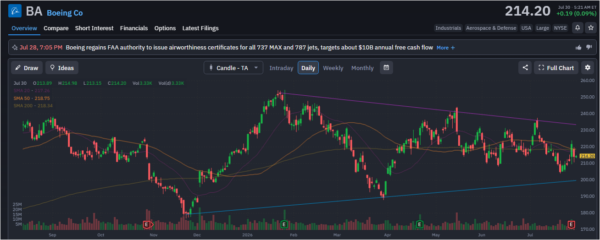
Since February, BA has failed three separate attempts to break above its long-term descending trendline, most recently after this quarter’s earnings. At the same time, buyers have continued defending a rising trendline that’s been intact since the April low, creating a tightening range that neither side has been able to break.
Shares are now trading just below the 20-day, 50-day, and 200-day moving averages, which have compressed into a narrow band around 217-219. Instead of providing support, they’ve become a ceiling that the company has struggled to reclaim.
To me, that’s a market waiting for evidence rather than doubting the story. The easy part of Boeing’s rerating came when investors realised the company wasn’t falling apart. The next leg probably won’t begin until management strings together enough quarters of improving cash flow and execution to force that resistance out of the way.
My Scorecard For Boeing Just Changed
A few quarters ago, I was judging Boeing by a simple standard: Can it build airplanes consistently again?
I don’t think that’s the right question anymore. The company has shown it can steadily increase production, rebuild its order book and generate meaningful cash even with legacy programme charges still weighing on results. That’s enough for me to move the goalposts.
From here, I want to see something different. I want operating improvements to become routine rather than newsworthy. I want Commercial Airplanes to produce healthier margins as production rates increase. Most importantly, I want Boeing to prove this quarter wasn’t an isolated step forward but the beginning of a repeatable financial profile.
That’s a much higher bar than simply celebrating every additional aircraft that leaves the factory. And for long-term investors, I think that’s good news.
Companies don’t earn premium valuations because they solve yesterday’s problems. They earn them by making investors stop worrying about those problems altogether. Boeing isn’t there yet, but it’s closer than it’s been in years. The business is finally generating the kind of cash that gives management options instead of excuses.
I remain bullish on BA because the operational turnaround is becoming a financial one, and if management keeps executing, I think the stock still has room to catch up with the business.
Today’s editorial pick for you
A High-Risk Gamble on ARM Stock Could Lead to Big Gains for Options Traders
Posted On Jul 31, 2026 by Joshua Enomoto
Straight out of the gates, it must be acknowledged thatARM Holdings (NASDAQ: ARM) is a high-risk affair. Although I am bullish on ARM stock, the basis for this speculative proposition is based on a very limited sample size of data. Quite frankly, you should only engage this semiconductor and software design company with funds you can afford to lose.
Table of Contents
But then, the cautionary stance raises an obvious question: why am I excited about ARM stock? It comes down to the quantitative profile of the tech ticker. Based on trends witnessed from similar circumstances, ARM may be due for a strong comeback over the next several weeks. However, the problem is that the inductive analysis undergirding my bull thesis is not extensively backed by empirical data — considering that shares started trading only since September 2023.
What does that mean for those willing to stick their necks out? Obviously, it’s much easier to have confidence in inductive analyses when a particular pattern has been observed frequently and consistently. In the case of ARM stock, we just don’t have enough trading history. Therefore, any statistical implications must be taken with a massive grain of salt.
Nevertheless, if the future resembles the past, ARM stock could see an impressive performance around the Sep. 18 expiration date. And since the smart money is rather pensive about the semiconductor company, going contrarian could lead to outsized rewards.
Nearly half of the world's biggest money allocators are scrambling to reposition for what they expect to be the most volatile market in years.
Larry Benedict isn't scrambling. He's seen this before.
He says the Warsh Shock is setting up the most predictable wealth-building window he's seen n 20 years… and there's one ticker right at the center of it.
Disclosing the Two Presuppositions Behind ARM Stock
I’ll be working with two key presuppositions in my analysis of ARM stock. First, I assume that future market outcomes are dependent variables. This philosophy aligns with the concept of Markov chains, where the future state of a system depends on the current state. Second, I believe that order flow imbalances trigger certain responses from market players, thus enabling a possible blueprint for what may happen next.
These concepts might sound confusing at first glance but they’re intuitive and are readily deployed in the financial media ecosystem. For example, practically every finance writer believes that market returns are dependent variables. If you look at common themes, you’ll discover titles such as “3 Best Stocks to Buy Now” or “5 Reasons Why This Tech Stock is Undervalued.”
Such motifs are impossible to cohesively generate unless the person making the claim assumes that a future outcome depends on a specific condition or catalyst that they have identified. Otherwise, if a writer believed that the future market returns were independent variables, they would write articles entitled, “3 Stocks Taking a Random Walk.”
Since the equities system doesn’t operate in a risk-free environment, you have an entire industry dedicated to deciphering what the true fair value of a public security should be. As such, variable dependency is a cornerstone assumption in finance.
Regarding order flow imbalances, this is another point that financial writers accept, whether they consciously realize it or not. Look at ARM stock, which is down more than 22% in the trailing month. There are contrarians who instinctively believe that the ticker has been beaten down too much and that it’s “due” for a bounce higher.
You can call it mean reversion, buying on the dip or whatever other term — people sense that crimson-stained shares of good companies can rip higher. The difference between my work and everyone else is that I seek to quantify these transitions.
Playing the Order Flow Game
What has really intrigued me about ARM stock is the negative balance of the security’s current order flow. In the last 10 weeks, ARM has printed four up weeks, leading to a downward slope (due to the balance of negative sessions outnumbering positive sessions). This 4-6-D quantitative sequence has materialized 17 times on a rolling basis since the ticker’s public debut and has historically led to above-average performances.
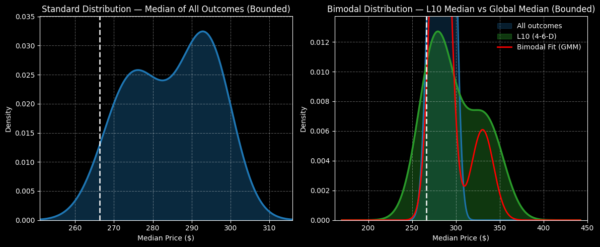
When the above signal flashes, traders can expect a forward 10-week distribution ranging between $200 and $400 (assuming a starting price of $266.33), with probability density peaking around $275. In contrast, a random 10-week hold would be expected to deliver a distribution ranging between $250 and $315, with peak probability density hitting around $292.
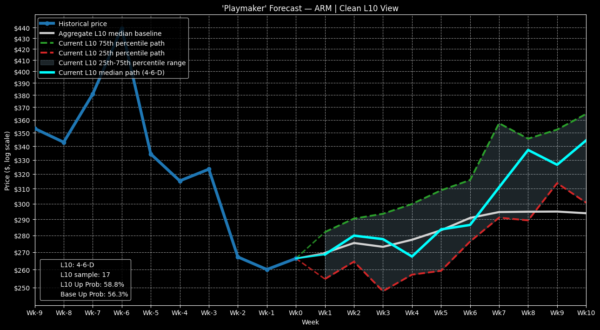
Granted, this is a strange dichotomy and part of it centers on the uneven nature of the signal’s expected performance versus the random baseline. Under 4-6-D conditions, ARM stock has tended to trade in almost lock-step with the random baseline over the next six weeks. But beginning in the seventh week onward, ARM’s median price tends to rise dramatically higher.
By week 8 following the flashing of the signal, the median endpoint of ARM stock is well over $330. What’s more, the 75th percentile pathway is around $347 while the 25th percentile pathway clocks in at $290 at the same time period.
However, this calculation doesn’t mean that you should rush out and buy Sep.18 call option spreads with a $330 strike. Well, you can if you so please, but the low sample size makes confidence in the trade a luxury that few can afford. That’s why I said it’s better to treat ARM stock as a gamble.
Another reason to be cautious is the volatility skew for the Sep. 18 options chain. To make a long story short, the volatility surface appears to show a prioritization toward downside protection, with implied volatility spiking for far out-the-money (OTM) puts, while IV is relatively muted for OTM calls. Basically, following ARM’s July 29 earnings disclosure, smart money sentiment appears protective.
Penciling a Highly Speculative Trade
Still, for those who are intrigued by the contrarian opportunity, the 300/310 bull call spread expiring Sep. 18 arguably seems the most reasonable when looking at the empirical data. Should ARM stock rise through the $310 strike at expiration, the maximum payout would clock in at over 132%. But the biggest highlight for me is the breakeven price of $304.30.
Right now, Wall Street assigns a probability of profit of only 35.8% that ARM stock will hit the threshold at expiration. However, this calculation comes from the Black-Scholes model, which assumes that market returns are independent variables. Stated differently, no matter what structurally occurs to ARM, the output is run through the parameters of the underlying formula, possibly creating an inaccurate picture.
Instead, as I mentioned earlier, I operate under the assumption that market returns are dependent variables. Essentially, this means that whatever has recently influenced ARM stock will likely play a role in how the market responds to the ticker.
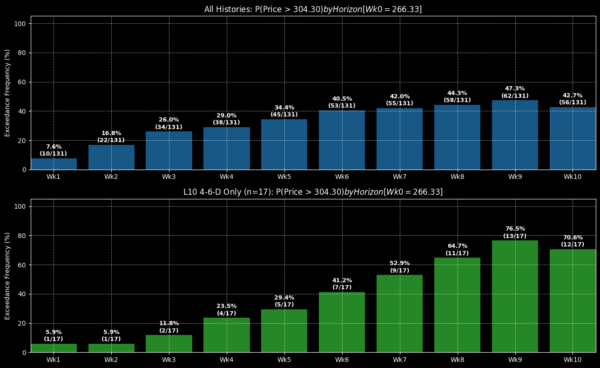
More to the point, of the 17 times that the 4-6-D signal has flashed, ARM stock has exceeded the equivalent of the breakeven price of $304.30 a total of 11 times on week 8 (Sep. 18). Again, while the sample size is extremely small, the observed probability of profit under my model is 64.7%.
It’s still a high-risk gamble, let’s not kid ourselves. But if variable dependency wins the day, there could be a mathematical incentive to buy ARM stock call options.