 In case you missed it... ...make sure you get your free "Simple Options Trading For Beginners" book before your link expires. 
I eventually plan to charge money for this training, so do yourself a favor and download it now... That way, no matter what it costs in the future, you'll have a free copy. Sound good? FREE: Simple Options Trading For Beginners << Get It Now Good Trading,
Bill Poulos p.s. Go here to save a copy of your "Simple Options Trading For Beginners" book while it's still free.
Special Report
If the Market Rally Stalls, This ETF Can Insulate PortfoliosReported by Jessica Mitacek. Published: 5/28/2026. 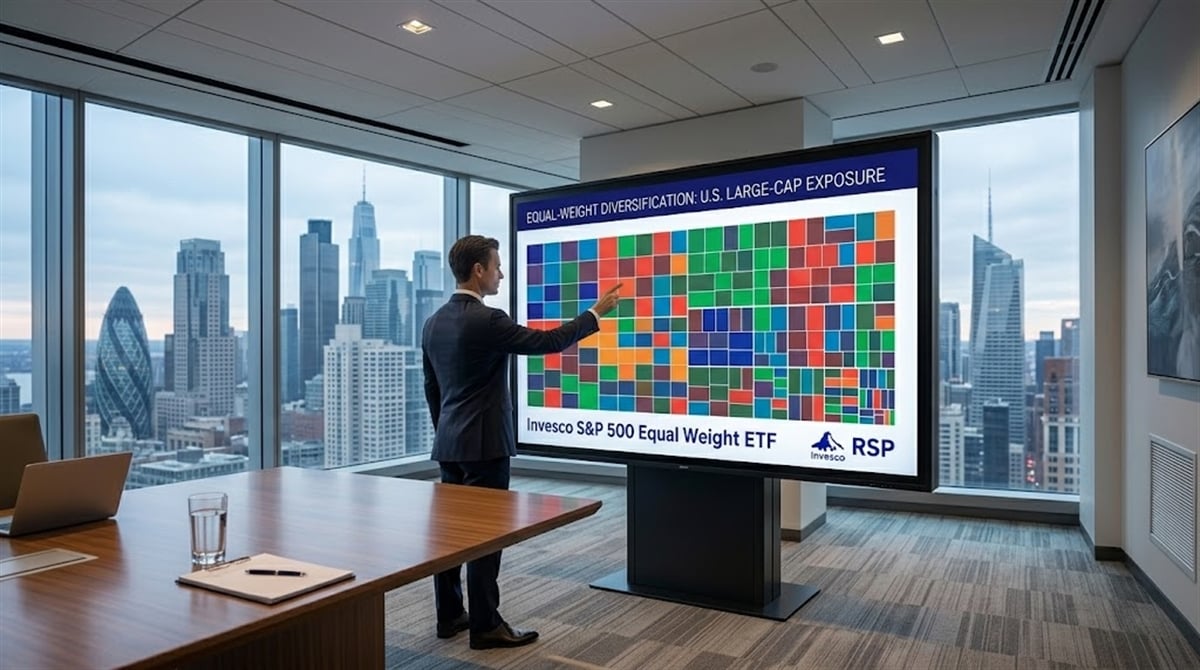
Key Points
- The Invesco S&P 500 Equal Weight ETF uses quarterly rebalancing to reduce concentration risk, limiting technology exposure to 19% versus nearly 38% for the SPY.
- RSP carries a beta of 0.92, making it nearly 9% less volatile than the broad market, and it lost less than SPY during the year's earlier selloff.
- Since 1990, the equal-weight index has outperformed the cap-weighted S&P 500 by an annual average of 1% to 1.05%, and RSP's dividend yield of 1.50% exceeds SPY's 0.98%.
- Special Report: Before SpaceX goes public, watch this tiny supplier closely
After losing nearly 8% in the first three months of the year, the S&P 500 Index has rallied on a renewed AI trade and increasingly bullish investor sentiment. Large- and mega-cap U.S. equities have seen a surge in inflows, helping push the benchmark index up more than 18% since the start of Q2. Despite the recent turnaround, uncertainty persists. Much of the rally is tied to mega-cap companies benefiting from the memory chip shortage, leaving investors wondering how long the S&P 500’s rally can last. Add in an expanding $1 trillion market cap club and looming initial public offerings (IPOs) from companies like SpaceX and OpenAI, and concentration risk is becoming an increasingly pressing threat to investors’ portfolios.
However, equal-weight exchange-traded funds (ETFs) tracking the major indices are having a moment—especially the Invesco S&P 500 Equal Weight ETF (NYSEARCA: RSP), which recently hit an all-time high. For conservative investors looking to avoid a potential pullback or stalled rally, here’s how RSP can help hedge against the S&P 500’s tech-heavy weightings and their inherent volatility. The Equal Opportunity Fund for All of the S&P 500 CompaniesGiven its current weightings, the S&P 500’s 10 largest companies account for around 40% of the index. For ETFs using the index as their benchmark, that means 40 cents out of every $1 invested goes to those stocks, with the remaining 60 cents spread across the other 493 stocks. And that’s before the rumored $1.75 billion SpaceX IPO adds another layer of concentration risk. By contrast, RSP uses quarterly rebalancing to maintain its equal-weight stance. That means a stock like Micron (NASDAQ: MU)—a more than $1 trillion market cap company with a nearly 840% one-year gain—receives the same treatment as little-known Corning (NYSE: GLW), a $164 billion market cap company with a nearly 280% one-year gain. Because of that quarterly rebalancing, the fund’s portfolio is more evenly—though not equally—balanced across the S&P 500’s 11 sectors. Technology, which accounts for approximately 35% of the index’s companies, still represents the largest allocation at more than 19% of the fund. For context, the market-cap weighted SPDR S&P 500 ETF Trust (NYSEARCA: SPY)allocates nearly 38% of its portfolio to technology. After technology, RSP’s top sector allocations are financials at 15.6%, industrials at 13.9%, healthcare at 10.9%, and consumer discretionary at 9.4%. Perhaps the clearest example of the Invesco S&P 500 Equal Weight ETF’s strategy is its industry breakdown. At 5.6%, utilities receive a larger position in RSP’s portfolio than semiconductors, oil, and gas—each of which have played enormous roles in the S&P 500’s Q2 rally and now look extended as a result. If the index’s current run stalls even briefly or experiences a pullback, which it is arguably overdue for, equal-weight alternatives are better suited to insulate investors’ portfolios from the fallout. Equal Weight Equals Lower VolatilityUpside potential is capped for equal-weight ETFs like RSP when compared with their market-cap-weighted counterparts. The SPY, for instance, has seen its shares gain about 10% so far this year, while RSP is up a little more than 8%—respectable, but still trailing. But gains are not the primary objective when investing in equal-weight funds—stability is. RSP’s equal-weight approach directly translates to lower volatility. The ETF currently carries a beta of 0.92, meaning it is nearly 9% less volatile than the broad market as measured by the S&P 500, whose beta serves as the benchmark at 1. By comparison, Micron’s beta currently stands at 1.91, indicating its stock is nearly twice as volatile as the overall market. That was on full display earlier this year when the SPY fell more than 9% from its then-year-to-date (YTD) high on Jan. 27 to its YTD low on March 30. Meanwhile, RSP was better equipped to endure the S&P 500’s selloff earlier this year, not reaching its then-YTD high until Feb. 27—a full month after the market-cap weighted SPY—and losing just over 8% before hitting its YTD low on March 30. Performance and Yield That Help You Sleep at NightIn the short term, the difference in gains and losses between RSP and market-cap-weighted funds may seem marginal. But over time, those differences can add up. According to Invesco, since 1990, the equal-weight index has outperformed the weighted S&P 500 by an annual average of 1% to 1.05% through the early 2020s. That translates to a gain of more than 32% while helping protect investors from downside risk over that multi-decade timeframe. Furthermore, the RSP’s dividend yields 1.50%, or $3.11 per share annually at the fund’s current share price. The SPY’s dividend yields just 0.98%, or $7.38 per share annually at the fund’s current share price. Based on 719 analyst ratings of the companies in the Invesco S&P 500 Equal Weight ETF’s holdings over the past year, the fund has a Moderate Buy rating, with more than 61% of shares held by institutional owners. . |


Tidak ada komentar:
Posting Komentar