 Greetings,
Every Monday afternoon, we send out a stock trade idea to some of MarketBeat's best and most valued subscribers.
We think you are one of those people...but you are not on our alert distribution list yet.
This once a week alert is sent out via SMS so that you can see it right away.
Last week's alert was very popular with our subscribers, you won't want to miss out on the next alert -- and it doesn't cost you a thing.
We're going to send out another trade idea on Monday around noon, and I want to make sure that you're able to see it.
Add your name to the distribution list here.
You'll thank me on Tuesday morning.
Matthew Paulson
MarketBeat
This Week's Exclusive Article
The Space Race Just Hit a Bottleneck—Who Benefits?Author: Ryan Hasson. Article Posted: 4/23/2026. 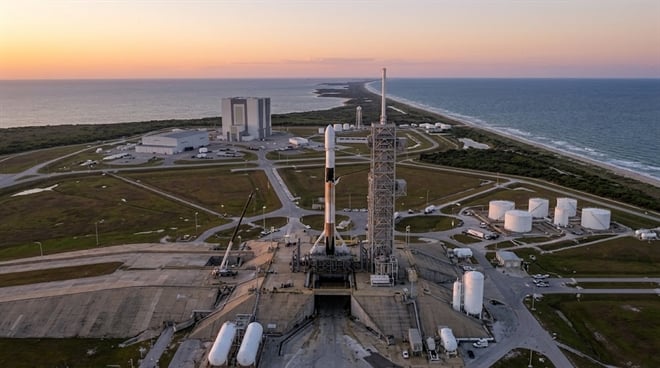
Key Points
- Blue Origin's grounding of New Glenn after an April 19 mishap tightens an already-constrained launch market, potentially benefiting RKLB, FLY, and LUNR.
- Rocket Lab stands to benefit most from the grounding of New Glenn, backed by a 100% mission success rate in 2025, $602 million in 2025 revenue, and a $1.85 billion backlog.
- Firefly Aerospace and Intuitive Machines also offer exposure to the space sector's growth, with Firefly returning to successful flight in March 2026 and Intuitive Machines holding a $943 million backlog.
- Special Report: Altucher: This is My Favorite FREE Starlink Pre-IPO Ticker
One of the space industry's fastest-growing constraints isn’t ambition, funding, or technology: it’s access to orbit. Reliable launch capacity is the bottleneck shaping competitive dynamics across the sector, and a high-profile mishap this past weekend made that clearer than ever. On April 19, Blue Origin's New Glenn rocket placed an AST SpaceMobile (NASDAQ: ASTS) BlueBird 7 satellite into a lower-than-planned orbit after one of the upper stage engines failed to produce sufficient thrust. The satellite, which would have been AST's eighth in orbit, was deemed unrecoverable and will be de-orbited. The FAA has classified the event as a mishap and grounded the New Glenn fleet pending an investigation. For Blue Origin, this is its first major mission failure, and it couldn't come at a worse time as the company works to establish New Glenn as a credible option for commercial, military, and NASA missions, including lunar landers tied to the Artemis program.
For the broader launch market, grounding New Glenn exacerbates an already acute bottleneck in launch capacity. Constellation operators, defense contractors, and government agencies all need reliable, repeatable access to orbit. Every provider that stumbles creates an opening for those with a proven track record. Here are three companies potentially positioned to benefit over the long run. Rocket Lab: The Proven OperatorRocket Lab (NASDAQ: RKLB) is one of the most compelling stories in the space launch market, and the Blue Origin mishap only reinforces that position. Electron, Rocket Lab's small-lift orbital rocket, has established itself as one of the most reliable vehicles in the small-launch segment. The company executed a record 21 missions in 2025, achieving a 100% mission success rate. Every time a competitor falters, Rocket Lab's consistent execution becomes more valuable to customers who cannot afford to have their satellites placed incorrectly. The fundamentals back up that positioning. Q4 2025 revenue came in at $180 million, up 36% year over year, and full-year 2025 revenue reached $602 million, an increase of almost 40%. The backlog stands at $1.85 billion, up 73% year over year, and includes an $816 million contract with the Space Development Agency to build 18 satellites for the Tracking Layer program. That backlog growth reflects customers locking in launch and satellite manufacturing capacity with a provider they trust. Looking ahead, the Neutron medium-lift rocket has filed for a launch permit and is targeting a debut window from July through December 2026. A successful Neutron debut would open a substantially larger addressable market for the company. Firefly Aerospace: The Alpha ReturnsFirefly Aerospace (NASDAQ: FLY) is a younger, more volatile story but one showing genuine momentum. After a difficult 2025 that included a mission anomaly, the Alpha rocket returned to flight in March 2026, successfully delivering a Lockheed Martin (NYSE: LMT) payload to orbit. That return to flight was a critical confidence signal for a company still building its reliability record. The stock is up almost 80% year to date, and analysts collectively assign it a Moderate Buy rating. Firefly's acquisition of SciTec broadens its capabilities into defense-focused space technology, and its partnership with Northrop Grumman on the Eclipse rocket program adds optionality across the small- and medium-lift segments. NASA's planned ramp-up in lunar cargo missions represents a significant long-term opportunity for a company building the kind of responsive launch infrastructure those missions will require. Intuitive Machines: The Lunar Infrastructure PlayIntuitive Machines (NASDAQ: LUNR) is a different kind of space company. It is not primarily a launch provider, but it is deeply embedded in the lunar infrastructure buildout that is driving the sector's most durable, long-term demand. The company is trading near 52-week highs, reflecting growing conviction in its positioning. Its backlog stands at $943 million, anchored by a $180.4 million NASA lunar mission contract. The Lanteris Space Systems acquisition, completed in early 2026, positions Intuitive Machines as a more vertically integrated national security and civil space services provider. However, analyst sentiment is mixed. Based on 13 analyst ratings, the stock carries a Hold consensus rating, and the $21.45 consensus price target implies downside risk from current levels. Some analysts differ: Roth raised its target from $25 to $35 and maintained a Buy rating on April 17, implying roughly 28% upside from the report date. . |



Tidak ada komentar:
Posting Komentar