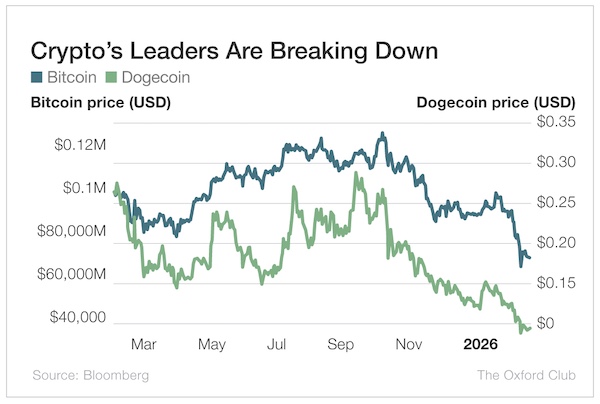
| Bitcoin's ledger is so transparent that it has become one of the most effective surveillance tools ever created. Chain-analysis firms, governments, and law enforcement agencies can track transactions with ruthless efficiency. Funds are frozen, flagged, and seized regularly. That's not "confiscation protection." It's exposure. Also, there is no practical way to determine whether the market price of Bitcoin is undervalued or overvalued. Bonds accrue interest. Stocks generate earnings and dividends. Real estate provides rental income. That means you can make an independent calculation of what they're worth and then check the market to see if they're undervalued. Nothing like that is possible with Bitcoin. It's all conjecture. Some will insist that Bitcoin is an inflation hedge. They call it "digital gold." They're half right. It's digital. Gold - an inflation hedge for thousands of years - is up 20% over the past four months. Bitcoin has slumped in half. At some point, belief becomes denial. Meanwhile, as Bitcoin struggles to justify its existence, other digital assets have quietly stepped into the roles it claimed but never fulfilled. If you want digital gold, for example, there are tokens that actually represent gold. Tether Gold and Paxos Gold don't rely on metaphors or narratives. Each token corresponds to a real, audited ounce of physical gold sitting in a vault. They offer stability because they're anchored to something tangible. That's why they've outperformed Bitcoin by more than 70 percentage points over the past four months. Bitcoin's current downturn has the classic signs of a bubble reaching its exhaustion phase. The run to six figures wasn't driven by new utility or widespread adoption. It was driven by hype and the hope of a friendlier political climate. Even institutional champions - the so-called "crypto treasury" companies - are now underwater, holding Bitcoin worth less than they paid for it. No doubt investors who chose to ignore Warren Buffett's warning that Bitcoin is "rat poison squared," also ignored his advice to invest in companies with durable moats that protect profit margins. There is no moat for crypto treasury companies. Anyone can do it. And there are now more than 200 of these money-losers. In short, Bitcoin faces insurmountable obstacles in gaining institutional adoption or serving as a legitimate medium of exchange. As I wrote about it several months ago: This is the greatest speculative bubble of the modern era, one that economic historians will be writing about for decades to come. Bitcoin has no credible uses. It has no valuation criteria. It is volatile, slow, costly, energy inefficient, and the industry is rife with deceit, fraud, and abuse. Those who are in it because they fear 'missing out' might want to strap themselves into one of those bomb disposal outfits like Jeremy Renner wore in "The Hurt Locker." One day - and it might be soon - they're going to need it. Good investing, Alex P.S. Dogecoin was created as a joke. But notice the high correlation between the movement of Dogecoin and Bitcoin. Two jokes? | 





Tidak ada komentar:
Posting Komentar