February 20, 2026
Small Robots, Big Profit Potential
Dear Subscriber,
 |
| By Michael A. Robinson |
As a boomer of a certain age, I remember the sci-fi classic “Fantastic Voyage” well.
It’s the 1966 film where scientists shrink down and pilot a submarine through the human body to perform surgery.
And for 60 years, the plot remained pure science fiction. The physics simply wouldn’t cooperate.
Not anymore.
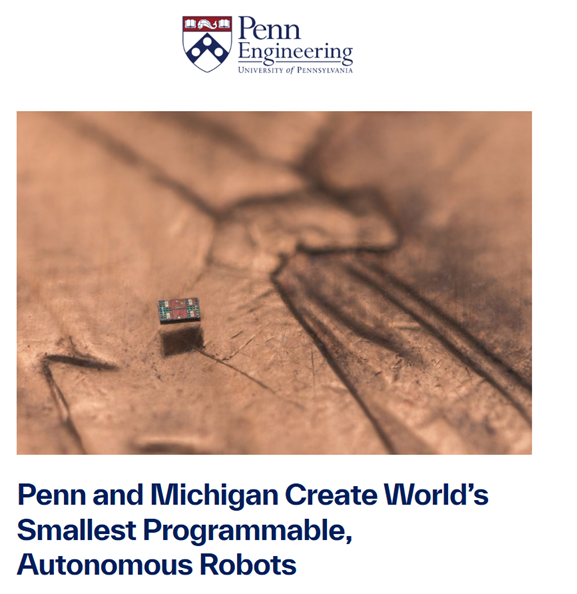
Researchers at the University of Pennsylvania just built fully autonomous robots smaller than a grain of sand.
These bots can swim through the human body on their own.
No remote control. No tether. No moving parts.
It sounds like a costly innovation. But because these bots are built with standard semiconductor manufacturing, they can be mass-produced for just pennies.
Add it up, and the message is clear: The age of the medical nanobot has arrived.
Today, I’ll reveal a way to invest in this new trend on its way to being worth $179 billion …
An investment that more than doubled the market’s return last year.
And there’s plenty more where that came from.
Big Potential in Small Robots
Interest in nanobots has surged in recent years, and for good reason.
These microscopic machines can interact with matter at extremely small scales, opening new possibilities in healthcare, technology and environmental science.
The recent breakthrough from the University of Pennsylvania involves nanobots measured in micrometers — each smaller than a grain of sand.
Unlike traditional robots, they have no legs, wheels or propellers. Instead, they move using electrokinetics.
Each bot creates a tiny electric field that pulls charged ions in the surrounding fluid.
As the ions move, they drag water molecules along, creating a gentle flow that propels the robot forward.
With no moving parts, the bots are durable and easy to handle in lab settings.
Power comes from miniature solar cells that generate just 75 nanowatts — over 100,000 times less than a smartwatch.
Because they can’t carry antennas, the bots communicate by performing small, coded wiggle motions that scientists observe under a microscope, similar to how bees share information.
These bots also exhibit “thermotaxis,” meaning they can sense heat and swim toward warmer areas.
This capability points to future uses such as detecting inflammation, identifying disease markers or delivering drugs with remarkable precision.
The Robot Invasion Is Here
Nanobots and advanced robots are designed to be “smart.”
And this intelligence is driving rapid growth across the entire robotics industry.
As robots become more capable, their use is expanding far beyond factory assembly lines.
The global robotics market is projected to reach $179 billion by 2033.
Today, robots are used in warehouses, hospitals, farms, offices and homes.
Companies rely on them to boost productivity, solve labor shortages and handle dangerous or repetitive tasks.
A key growth engine is AI-enabled robotics.
This market alone is expected to grow from about $13 billion in 2023 to $125 billion by 2030.
By combining AI with robotics, machines can now see, learn, navigate complex environments and make decisions in real time.
This enables flexible applications such as autonomous logistics robots and collaborative robots that work safely with people.
Introducing ARKQ
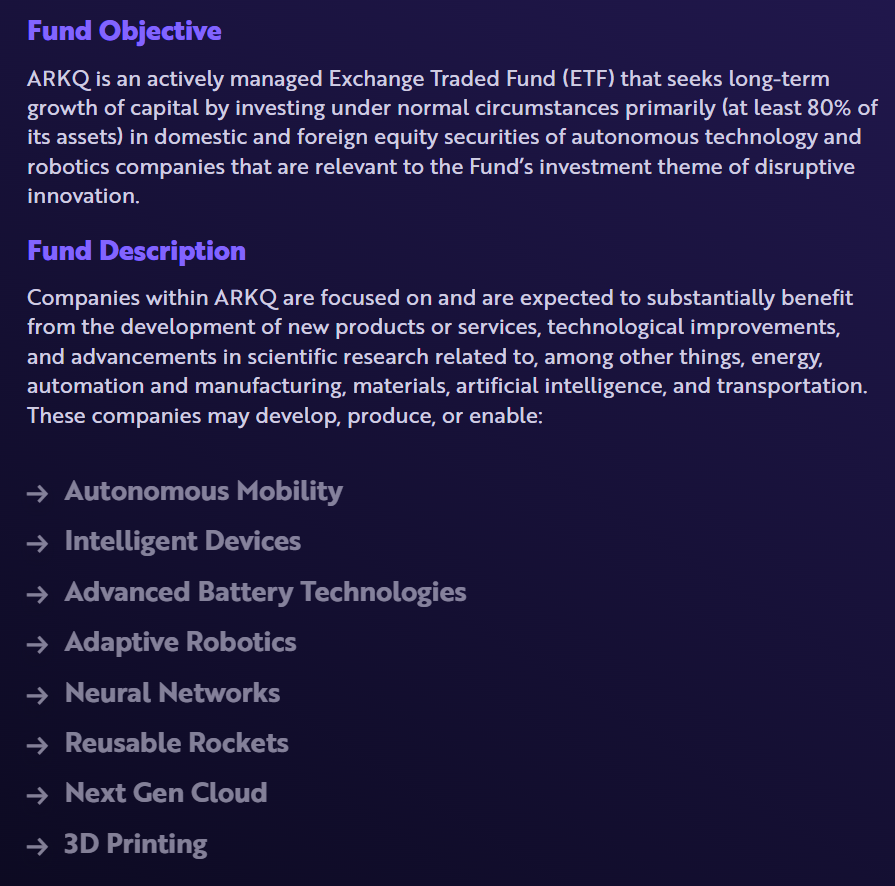
To target the broad sector, the ARK Autonomous Technology & Robotics ETF (ARKQ) is a great way to profit.
This fund focuses on innovation.
It invests mainly in forward-thinking sectors like robotics, autonomous vehicles, energy storage, 3D printing and space exploration.
It’s run by ARK Investment Management, the same firm led by renowned investor Cathie Wood.
After studying economics at the University of Southern California, Wood spent decades on Wall Street at firms like Capital Group and AllianceBernstein before starting her own firm.
As for ARKQ, this fund gives us exposure to multiple robotics firms. The ETF has 38 stocks in its portfolio.
It also gives us exposure to fields like robotics, energy storage and automation.
And it’s an actively managed fund, meaning experts choose and adjust the companies in the fund based on research and trends.
Let’s take a closer look inside this fund …
Inside the Fund
As mentioned, ARKQ has about three dozen holdings, including multiple large-cap stocks.
Notable names include:
- Tesla (TSLA) — makes electric cars that have advanced self-driving and automation features. It’s the largest holding in ARKQ and fits because of its role in autonomous vehicles and future robotics systems.
- Teradyne (TER) — makes automated test equipment and owns robot-focused businesses like Universal Robots. These robots help factories automate work, making it a big robotics player in the fund.
- Kratos Defense & Security Solutions (KTOS) — builds drone systems, autonomous vehicles for defense and other advanced tech that support robotics and autonomous missions.
- AeroVironment (AVAV) — specializes in small drones and robotic systems used in military and commercial markets. Its tech supports automation in vehicles and remote sensing.
- Deere (DE) — is a leader in precision agriculture that includes sensors, software and autonomous features to improve efficiency in farming
Triple the Stock Market
As you can see, the robotics field is robust.
It covers everything from mining and farming to logistics and driving to healthcare and space travel.
In other words, the global robotics industry features bots with a wide range of functions. And of course, of all sizes — even ones smaller than a grain of sand.
ARKQ covers the broad sector with a single market-crushing investment.
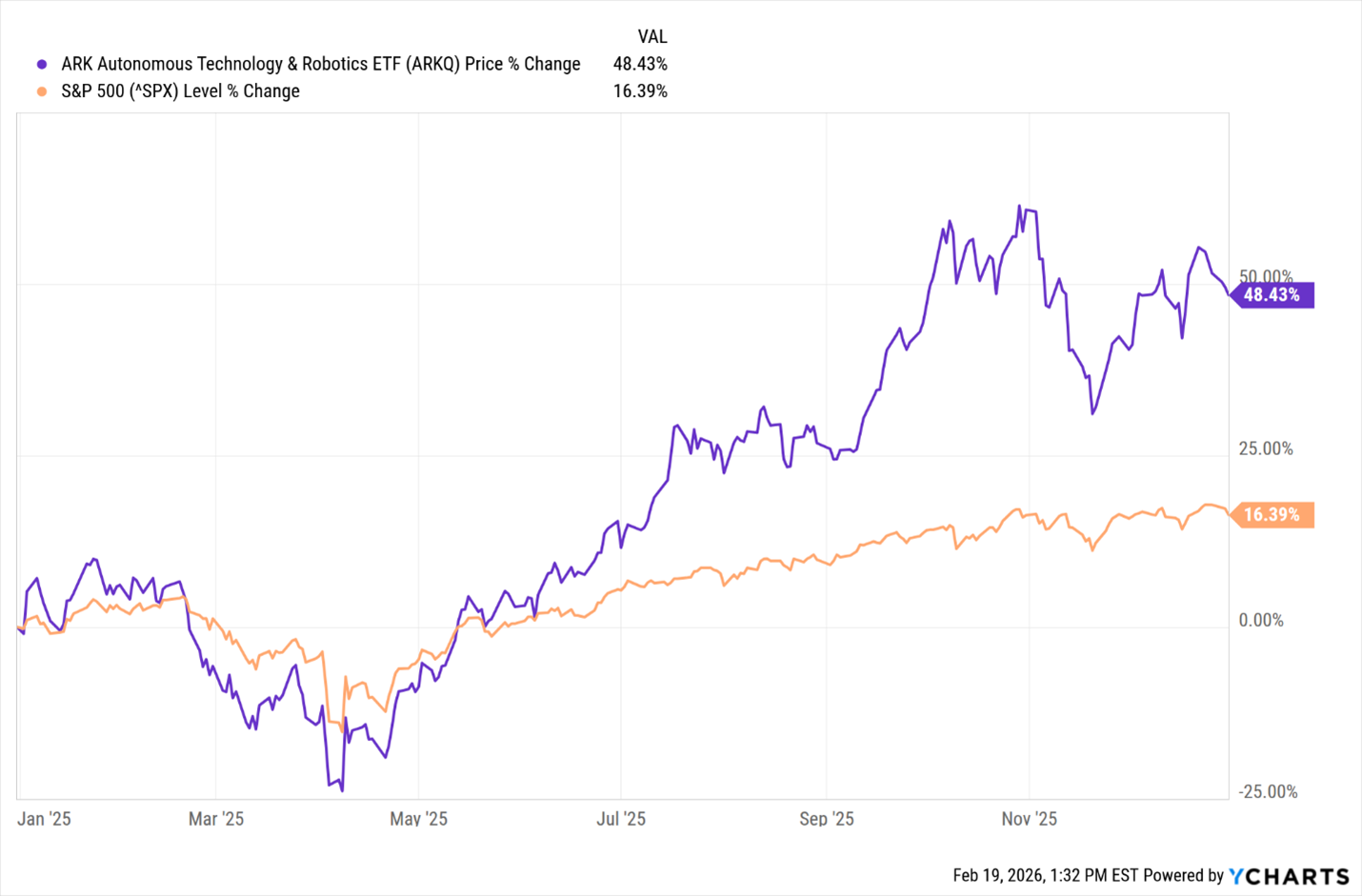
Last year, for example, the fund closed up more than 48%.
That’s about triple the S&P 500’s 16% gains from 2025.
There’s no reason this should stop with the growth potential across the whole industry.
That makes this fund a great way to cash in on the high-growth robotics sector for years to come.
Best,
Michael A. Robinson
P.S. As I said, the highest growth portion of this sector is AI robotics. For that, we need AI leaders like Nvidia.
But we also need Nvidia’s partners — both official … and “unauthorized.”



Tidak ada komentar:
Posting Komentar