Dear Reader,
This is Dylan Jovine with Behind the Markets.
Happy Thursday.
Today is Thursday, February 19th — and yes, today is webinar day at 1:00 p.m. I hope you'll join us.
If you haven't reserved your spot yet, you have just hours left. Click here to sign up now.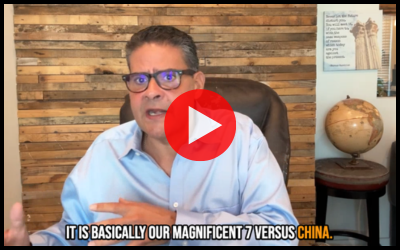
It's important you join.
Because what we're going to talk about today couldn't be more timely.
There was a new note out from TS Lombard's Asia analyst, Rory Green — a very sharp observer, very plugged into what's happening on the ground in China. He just got back and his message was clear:
China is coming for the AI crown.
Now, this isn't hype. It isn't bluster. It's structural.
He laid out a few advantages China has right now — and one of them in particular, is enormous.
First, there's state-backed cost efficiency.
This is the uncomfortable reality: in the short term, a centralized system can move very fast. If Beijing decides something is a national priority, capital gets directed immediately. Infrastructure gets built. Permits get approved. Resources get allocated.
We've seen this before in history. Five-year plans can look incredibly efficient in short bursts. Long term? They misallocate capital. But in short, concentrated pushes — like AI — they can be formidable.
Second, China is scaling its domestic tech stack rapidly. Hardware, software, models — they are climbing the value chain faster than many expected. Even leaders at Google DeepMind have acknowledged Chinese models may only be months behind U.S. systems at this point.
But here's the real issue.
Power.
China already generates roughly twice as much electricity as the United States annually. They are adding new generation capacity at a pace that dwarfs most developed countries. They have surplus capacity. They have super grids that move electricity across regions efficiently. Industrial hubs receive subsidized power at lower per-kilowatt-hour costs than comparable U.S. facilities.
That matters.
Because AI isn't limited by chips alone.
It's limited by energy.
Even if their chips were slightly inferior… even if their models lagged a bit… if they have abundant, cheap, scalable power — they can iterate faster.
Meanwhile here in the U.S., we've built beautiful data centers that can't get plugged in.
There's a brand-new facility in Santa Clara — right in NVIDIA's backyard — sitting idle because it can't secure enough grid capacity. Years of wait time just to connect.
So what you're watching unfold right now is a race with two different systems.
China: centralized, directive, infrastructure-heavy.
The U.S.: market-driven, innovation-led, but historically slowed by regulation and grid fragmentation.
That's changing.
What's happening now — and what we'll preview in detail today — is the unleashing of private buildout.
Instead of waiting 10–12 years to connect to legacy grids, companies are being allowed to build their own power infrastructure. Their own generation. Their own solutions.
And the scale is staggering.
The Magnificent 7 alone are planning roughly $700 billion in capital expenditures. That's comparable to the annual government budgets of major nations.
This isn't incremental.
This is industrial-scale mobilization.
In a way, it's America's version of a five-year plan — except instead of bureaucrats allocating capital, you have companies competing for profit, dominance, and survival.
Our advantage isn't central control.
It's incentives.
Capitalism allocates capital better over time because performance matters. Profit matters. Failure matters.
But we need the regulatory handcuffs removed to let that system work at full speed.
That's what's happening right now.
There's a major announcement expected on February 26th that could significantly accelerate this process. We'll discuss what it means, how it shifts the balance, and — most importantly — where the opportunity lies.
Because this is not just geopolitical theory.
This is investable.
The first time in American history that energy infrastructure, AI, national security, deregulation, and hyperscaler spending are converging at this scale.
Charles and I will break it all down today at 1:00 p.m.
If you care about AI.
If you care about energy.
If you care about where the next major capital wave is going.
You won't want to miss this. I promise you'll learn something.
Sign up here today.
See you at 1:00.




Tidak ada komentar:
Posting Komentar