Dear Reader,
This is Dylan Jovine with Behind the Markets.
Happy Wednesday. Today is Wednesday, March 25th.
Everybody has been talking about the price of oil. Everybody is focused on where Brent Crude or West Texas WTI is trading, and everybody thinks that whenever oil crosses $110 or $115 a barrel, the stock market sells off.
Look, amateurs study the market that way.
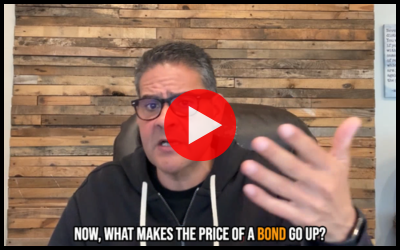
Professionals are watching something else entirely — the price of the 10-year bond.
And that is the real biggest threat to the stock market and the economy right now.
We've talked about this many times on this channel, but it bears repeating. The 10-year bond is a benchmark, meaning that a yield above 4.5% raises borrowing costs for basically everything in America — consumers, businesses, and the US government itself on all its debt.
That 4.5% is the magic number.
And here's the most important thing to remember about how this works.
Stocks and interest rates have an inverse relationship — a seesaw. When rates go up, stock prices go down, and all asset prices go down with them. When rates come down, asset prices go up. So when you see that 10-year yield creeping toward 4.5%, that is gravity pulling the stock market down. When it drops below 4.5%, the market starts to lift. This is where the real action is. And if you don't believe me, consider that the bond market is many times larger than the stock market. It is everybody's boss.
The 10-year yield is now up 45 basis points since the war began on February 28th. That is very similar to what we saw around Liberation Day in April 2025, and it's worth remembering what happened then. President Trump came out guns blazing with tariffs, but as the 10-year yield surged above 4.5%, he started floating a potential pause.
James Carville once said when Clinton was president that he wanted to come back after he died as the bond market, because it tells everybody what to do. He was right. Once the yield broke above 4.6%, Trump officially announced his 90-day pause on reciprocal tariffs on April 9th, 2025 — and the stock market rallied hard.
Now, oil is one of the inputs that pushes yields higher. When producers pay more for fuel — airlines, trucking companies, manufacturers — those costs filter through to inflation, which pushes up bond yields. So the rise in oil prices we've been watching isn't just a standalone story. It is feeding directly into the 10-year yield, which is the thing that actually matters.
With the 10-year yield now at 4.4%, we are approaching that 4.5% to 4.6% range that appears to be Trump's line in the sand again. And the US economy simply cannot handle a sustained 5% yield. House buying freezes. Borrowing costs for everything spike. And here is the part that should really concern you given everything we've been saying about the debt situation.
The bipartisan policy center estimates that a sustained 20 basis point rise in the 10-year yield — just one fifth of one percent — adds $702 billion to net interest payments over 10 years. That's $70 billion a year from a barely perceptible move in rates. We've already gone from 3.9% to 4.4%, a 50 basis point move, which translates to roughly $1.4 trillion in additional interest over the decade — $140 billion a year in new red ink for the government alone, before you even count the impact on citizens trying to buy homes or businesses trying to borrow.
And this is why the debt spiral we keep warning about is so dangerous. We are refinancing $7 to $10 trillion in existing debt every single year. The higher rates go, the more expensive it gets to roll that debt over. At some point, if we're borrowing at rates that keep climbing, the interest payments alone start to consume everything. It's like carrying a balance on a credit card that keeps raising its rate. At 30%, 40%, 50% — it's game over.
And frankly, this is exactly the kind of thing I've been warning about for a while now. It's actually the entire premise behind a book I wrote called Midnight in America.
In it, I lay out the five biggest cracks forming underneath the American economy right now — the debt addiction, the affordability crisis, the dollar devaluation — and the exact steps you can take to protect yourself before it gets worse.
Make sure you pick up your copy of Midnight in America today.
And keep your eye on the 10-year yield. More than oil, more than earnings, more than anything else right now — that number is going to tell you where this market is headed.
That's all I have for you today. Have a wonderful day. I'll see you tomorrow.



Tidak ada komentar:
Posting Komentar