Have $500? Invest in Elon's AI Masterplan (From Brownstone Research)
Key Points
- Super Micro Computer is outperforming competitors in current hardware delivery volume by prioritizing immediate execution over future promises in the data center market.
- Management has strategically built up significant inventory to ensure faster delivery times than peers amid global component scarcity.
- Super Micro is transitioning its business model to capture higher long-term profits by selling essential liquid-cooling infrastructure.
- Special Report: [Watch] FREE STOCK PICK for Elon Musk's Starlink SuperIPO (From Paradigm Press)
For weeks, Wall Street whispered about a potential bubble in the artificial intelligence (AI) sector. Anxiety regarding a potential slowdown in capital spending gripped the market, causing significant volatility in major semiconductor stocks. However, late February 2026 provided a definitive answer to these concerns. The Super Week of earnings, highlighted by industry titan NVIDIA (NASDAQ: NVDA), proved that the global infrastructure boom is not only alive but accelerating.
While chipmakers rallied on this news, their primary hardware partner, Super Micro Computer (NASDAQ: SMCI), has seen its stock consolidate. Shares closed the end of February, successfully holding the critical $30 support level during a volatile trading period. This divergence between the company’s operational execution, delivering record volume, and its stagnant share price has created a notable valuation gap.
The market appears to be misinterpreting Super Micro’s strategic reinvestment as a sign of weakness. While competitors focus on backlog, Super Micro is focusing on immediate deployment. For investors seeking exposure to the next phase of the AI cycle, this consolidation phase offers an opportunity to analyze a triple-digit-growth company trading at a discount.
While headlines focus on Tesla's car sales, tech analyst Jeff Brown says the real story is Tesla's role in a $25 trillion AI revolution — one that Nvidia's CEO himself has called a "multi-trillion-dollar future industry" — and he's uncovered a little-known stock 168 times smaller than Nvidia that could be positioned to ride this breakthrough.
Click here now to see the full report
The Engine And The Car: Understanding The Ecosystem
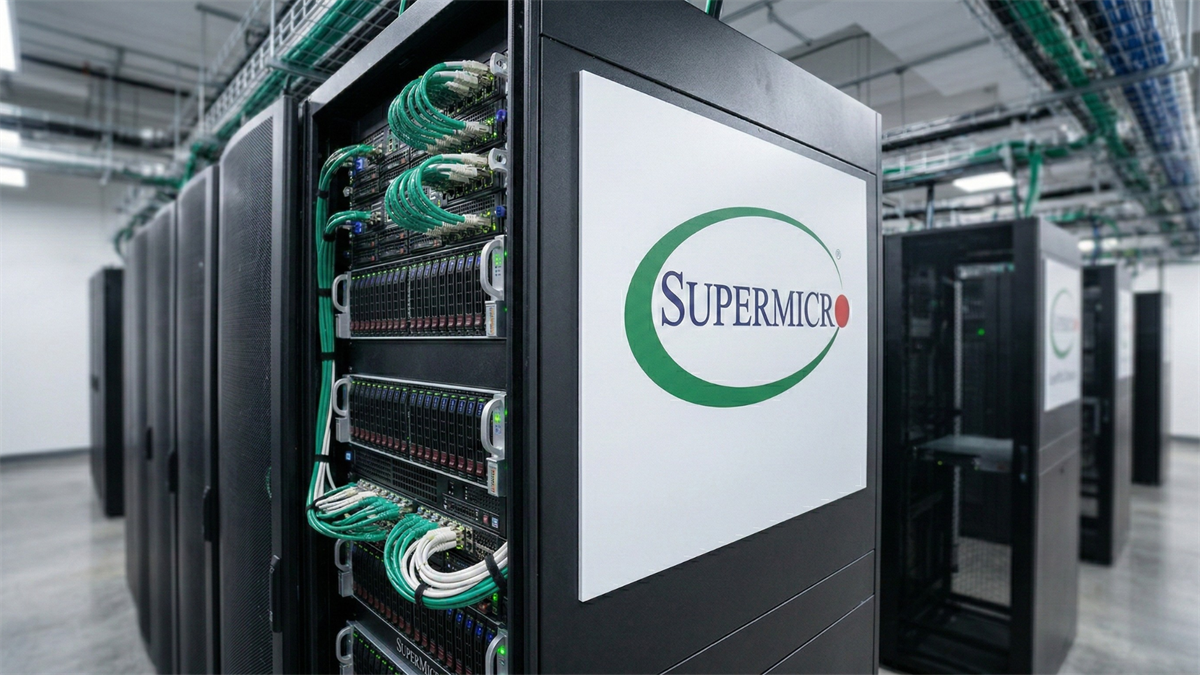
The investment thesis for Super Micro Computer has always been simple: NVIDIA sells the engine (the chips), but Super Micro builds the car (the servers).
In the current market, you cannot have one without the other. High-performance AI chips, such as the Blackwell and upcoming Vera Rubin series, cannot simply be plugged into a wall outlet.
They require complex, high-density server racks to function. As long as NVIDIA forecasts exponential demand, Super Micro’s order book is mathematically underpinned by the industry leader.
The financial data supports this correlation. In late February, NVIDIA reported record revenue of $68.1 billion, a 73% increase year-over-year.
CEO Jensen Huang confirmed that demand for their latest platforms is off the charts. Super Micro is capturing this volume directly. The company reported fiscal Q2 2026 revenue of $12.68 billion, a 123% increase from the same period last year.
Critics often argue that Super Micro is too dependent on its partner. However, in a market where one company holds a near-monopoly on the most desirable technology, being their preferred deployment partner is a competitive moat, not a weakness. The data confirms that as the chip supply grows, Super Micro’s revenue grows in lockstep.
Trading Margin For Dominance
The primary reason Super Micro's stock price has not rallied alongside its revenue is profitability. In the most recent quarter, gross margins dropped to 6.4% on a non-GAAP basis. This is significantly lower than historical norms and has understandably spooked some investors. However, looking at the competitive landscape suggests this is likely a deliberate land-grab strategy rather than a business failure.
Super Micro is engaged in a fierce battle with Dell Technologies (NYSE: DELL) to win contracts with the world’s largest data center operators. On Feb. 26, Dell reported an impressive $43 billion AI backlog. While this number is massive, it highlights a crucial difference in strategy between the two firms:
- Backlog vs. Deployment: Dell’s backlog represents future promises. Super Micro’s revenue represents current execution.
- The Volume Gap: In the most recent quarter, Super Micro shipped $12.7 billion in product, outpacing Dell’s $9.5 billion in AI server shipments.
Super Micro is using aggressive pricing to win the install base now. This strategy consumes cash and compresses margins in the short term, but it prevents competitors from gaining a foothold in the world's most important data centers. Once a data center is designed around Super Micro’s architecture, the switching costs become prohibitively high, securing a long-term customer relationship.
Silver: 20% + 68%
Tim Plaehn just found a Silver ETF that delivers monthly income (up to 20% in annual distributions) plus share appreciation (68% in 5 months). The precious metal has become one of the best investments for growth AND income right now.
Click here and start to collect in the next 30 days.
The $10 Billion Stockpile: Preparing For The Future
To support this high-volume strategy, Super Micro has made a controversial decision to balloon its inventory to $10.6 billion. In a traditional retail business, unsold inventory is a liability that eventually leads to write-downs. However, in the current AI hardware market, the rules are different. The sector is defined by scarcity.
Global shortages of advanced components mean that lead times, the time it takes to build and deliver a server, are the most critical factor for buyers. Companies building AI models are in an arms race; they cannot afford to wait six months for hardware. By stockpiling components, Super Micro ensures it can deliver servers faster than peers who are stuck waiting for parts.
- Strategic Positioning: This inventory is not gathering dust; it is a war chest.
- Future Proofing: It positions the company to immediately fulfill orders for the upcoming NVIDIA Vera Rubin and AMD (NASDAQ: AMD) Helios platforms later in 2026.
This liquidity usage explains the negative free cash flow in the recent quarter, but it is a feature of the company's growth strategy, not a bug in its operations.
The Razor and Blade Pivot
If the land-grab explains why margins are down today, the company’s product roadmap explains how they will go back up tomorrow. Super Micro is transitioning to a classic razor-and-blade business model. The low-margin servers currently being installed are the razor; the high-margin liquid cooling infrastructure is the blade.
The company is moving beyond simple box-building to sell Data Center Building Block Solutions (DCBBS). This includes the entire ecosystem required to keep AI factories running:
- Coolant Distribution Units (CDUs)
- Power distribution shelves
- Manifolds and management software
Management has confirmed that these DCBBS products carry gross margins estimated above 20%. This transition is driven by physics, not just finance. The next generation of AI processors creates immense amounts of heat that traditional air cooling (fans) cannot handle. Liquid cooling is mandatory for the upcoming NVIDIA Vera Rubin platforms.
By securing the server footprint now through aggressive pricing, Super Micro is effectively positioning itself to upsell high-margin liquid-cooling infrastructure to these same customers later. The company plans to double the profit contribution from this segment by the end of 2026, providing a clear mechanism for margin recovery.
Why The Risk Is Worth The Reward
The divergence between Super Micro’s stock price and its operational performance has created a compelling valuation scenario. The stock is currently trading at a price-to-earnings ratio (P/E) of approximately 24x. For a company growing revenue at a triple-digit pace (123%), this is remarkably cheap compared to the broader technology sector, where slower-growing software companies often trade at 30x or 40x earnings.
The margin compression appears to be temporary and strategic, designed to lock out competitors during a critical phase of industry growth. The shadow of NVIDIA remains a profitable place to be. As the AI infrastructure build-out enters its next phase, Super Micro’s massive installed base and inventory advantage position it to outperform expectations. Investors looking for growth at a reasonable price might consider adding Super Micro Computer to their watchlist as it consolidates above $30.
Read this article online ›
Stay Ahead of the Market
The best investment opportunities don't wait. Get our research and stock ideas delivered straight to your smartphone—so you never miss a market-moving opportunity. Our text alerts ensure you see timely stock ideas and professional research reports instantly, whether you're in a meeting, commuting, or away from your desk.
Get Text Alerts from American Market News (free)



Tidak ada komentar:
Posting Komentar