|
5 Drone Stocks Investors Are Watching Right Now |
|
|
|
Let's be honest, when you hear "U.S.-Iran conflict," most people think of geopolitics, not portfolios. |
But what's unfolding in the Middle East right now isn't just a military story. It's a financial story too. And if you're an investor who pays attention to where government money flows, this is worth a close read. |
When the U.S. and Israel launched Operation Epic Fury, a coordinated military strike targeting Iranian military assets, Iran hit back fast, deploying more than 2,000 drones across the region in a matter of days. |
Some slipped through U.S. air defenses. A Dubai skyscraper was struck. Airports took hits. Six U.S. soldiers were killed in Kuwait from a single drone strike at a command center. |
This wasn't a proxy war with distant echoes. It was a live demonstration that cheap, mass-produced drones have become the defining weapon of modern conflict. |
And that changes things: for military strategy, for national security, and yes, for investors. |
|
The "Poor Man's Cruise Missile" Problem |
Here's a simple way to think about what happened: Iran's main drone, the Shahed-136, costs somewhere between $10,000 and $50,000 to build. Each one is essentially a flying bomb, it buzzes low and slow, under the radar, then smashes into its target. |
Now compare that to what it costs to stop it. A Patriot missile interceptor, one of the U.S.'s go-to defense tools, runs $3 million to $4 million per shot. Iran fires a $20,000 drone. The U.S. fires a $4 million interceptor to knock it down. |
Do that math a few hundred times, and suddenly the adversary with "an economy smaller than Vermont" (Bloomberg's words, not ours) is imposing exponential costs on the world's most powerful military. |
| ❝ | | | "Even a hundred of these drones in the hands of a decentralized unit can cause terror in a neighboring state like never before imagined." | | | | Cameron Chell, Draganfly CEO |
|
|
That's not a problem that goes away when the shooting stops. It's a structural shift in how wars are fought and how governments spend money to prepare for them. |
|
What the U.S. Is Doing About It |
|
The Pentagon isn't standing still. Here's what's already happening: |
DoW committed $1.1 billion to buy drone systems over the next 18 months, including 30,000 small, one-way attack drones to be delivered to military units within five months. |
During Operation Epic Fury, U.S. Central Command deployed LUCAS, the Low-Cost Unmanned Combat Attack System, for the first time in combat. These are American-made kamikaze drones, modeled on Iran's own Shahed design, reverse-engineered and fast-tracked through the Pentagon's acquisition pipeline in just 18 months. |
The U.S. is also deploying Merops, an AI-powered counter-drone system originally developed for use in Ukraine. It fits in the back of a pickup truck, flies drones against drones, and uses AI to navigate when communications are jammed. |
| ❝ | | | "Now we have low-cost interceptors effectively combating Iranian drones." | | | | President Donald Trump |
|
|
The message is clear: the U.S. is investing heavily in both offensive drone capability and counter-drone defense. And that spending has to go somewhere, specifically, to the companies that build this technology. |
5 Drone Stocks to Watch Closely |
|
Let's look at the companies that analysts and retail traders are paying attention to right now. Keep in mind: these aren't tips or recommendations. They're companies in the spotlight, with context to help you evaluate them yourself. Always do your own due diligence. |
|
AeroVironment (NASDAQ: AVAV) |
Current Price: ~$207–$227
Market Cap: ~$11.0 billion
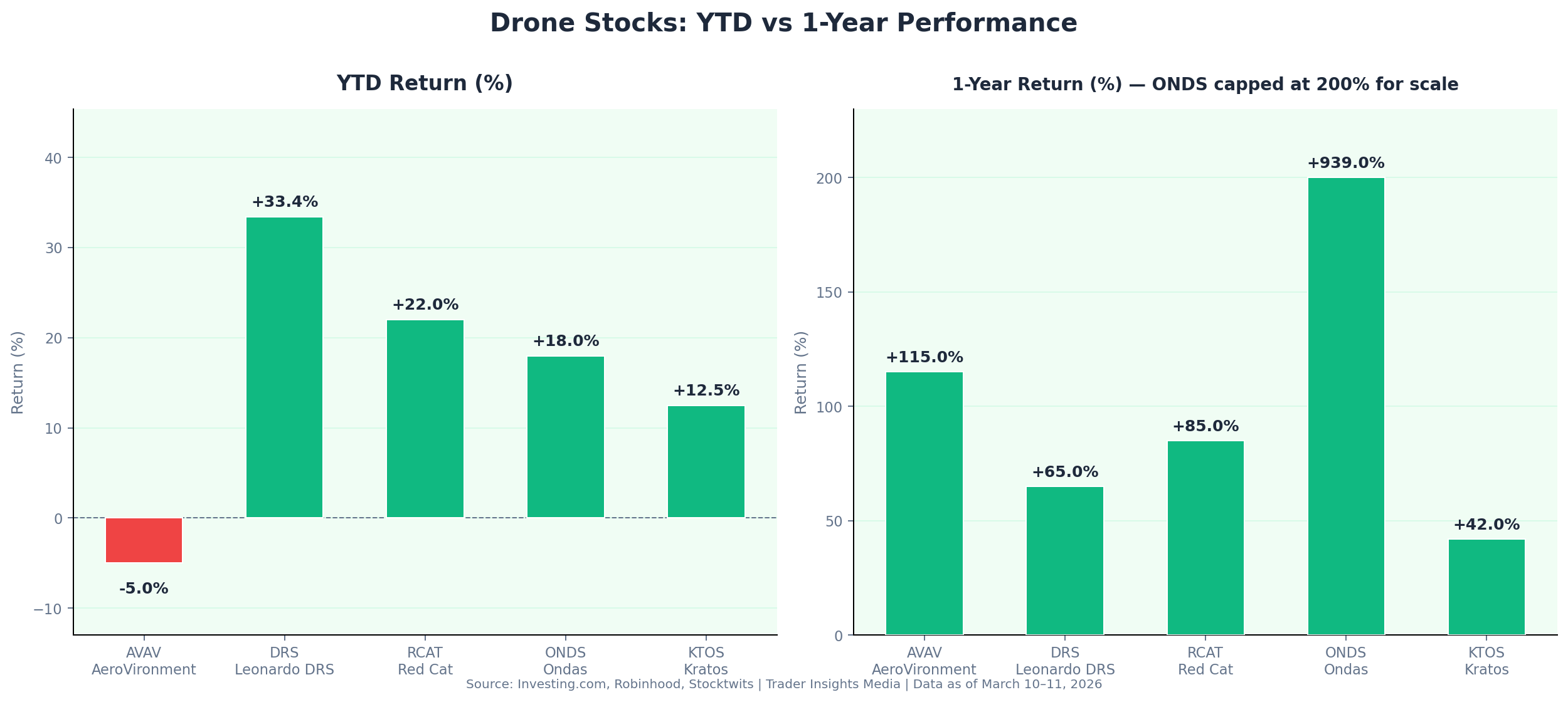
YTD Return: -5.0% |
1-Year Return: +115%
P/E Ratio: 151.3x |
AeroVironment is probably the most talked-about name in this space. The company makes small military drones and loitering munitions, the kind of systems at the center of modern conflicts. In late 2025, the U.S. Army selected AeroVironment's Freedom Eagle-1 as a counter-drone interceptor. |
Of 17 analysts covering the stock, the consensus is Strong Buy, with a median price target of $330–$350, suggesting roughly 45–55% upside from current levels. |
William Blair analyst Louie DiPalma reiterated his outperform rating, calling AeroVironment "a leading drone provider." Defense analyst Rob Madrid sees a "several hundred million, if not several billion dollar opportunity" emerging from C-UAS systems alone. |
The recent dip? It came after AVAV lost exclusivity in a U.S. Space Force contract, a separate program that analysts say has little impact on the company's core drone business. $AVAV dropped 17.4% in a single day on that news, then clawed back nearly 10% the next day. |
That kind of volatility is real and worth factoring into any decision. |
| | The Pre-IPO AI Company Tech Giants Tried to Acquire | #1 work app on the Meta Quest Store.
Samsung headset's launch partner.
Intel's former CEO invested. | 1.5M users have already adopted Immersed's spatial computing platform. The company is now building Visor for the computing shift expected to follow the smartphone, and you can invest before a potential public listing. | Current Pre-IPO price: $0.66/share. | Invest Before the Pre-IPO Round Closes | Disclaimer: Immersed is offering securities through the use of an Offering Statement that has been qualified by the Securities and Exchange Commission under Tier II of Regulation A. The valuation is set by the Company and there is currently no public market for the Company's Common Stock. Please read the offering circular and related risks at invest.immersed.com. Nasdaq ticker "IMRS" has been reserved by Immersed and any potential listing is subject to future regulatory approval and market conditions. |
| | |
|
|
Leonardo DRS (NASDAQ: DRS) |
Current Price: ~$46.51
Market Cap: ~$12.4 billion
YTD Return: +33.4%
1-Year Return: +65%
P/E Ratio: 39.5x |
Leonardo DRS doesn't get the same social media attention as some smaller drone names, but analysts are paying close attention. The company is a key supplier to the U.S. Army's Directed Energy Maneuver-Short Range Air Defense (DE M-SHORAD) system, a platform specifically designed to shoot down drones using directed energy (lasers and high-powered microwaves). |
Truist raised its price target to $59 in late February. Analyst Rob Madrid described DRS as an "undervalued name in counter-drone technology," noting the stock has already rallied more than 33% this year. With a P/E of 39.5x (far lower than AVAV's premium), it may appeal to value-conscious defense investors. |
Last quarter, DRS beat earnings estimates by 13.3%, delivering $0.42 EPS vs. the $0.37 expected. Revenue came in at $1.06 billion, also above forecasts. |
|
3. Red Cat Holdings (NASDAQ: RCAT) |
Current Price: ~$8.20–$9.50
Market Cap: ~$680 million
YTD Return: +22.0%
1-Year Return: +85%
P/E Ratio: N/M |
Red Cat is a small-cap defense drone company that surged more than 10% in overnight trading when news of the U.S.-Iran conflict broke. Retail sentiment on the stock went "extremely bullish" according to Stocktwits, with message volumes jumping 50% in seven days. |
Here's the honest part: Red Cat makes short-range, squad-level drones. Some analysts note these likely weren't deployed in the Iran strikes directly. But the company is in the right sector at the right time, with exposure to the growing demand for small, cheap tactical drones. High upside potential, high volatility, high risk. Not for the faint-hearted. |
|
4. Ondas Holdings (NASDAQ: ONDS) |
Current Price: ~$3.10–$3.40
Market Cap: ~$165 million
YTD Return: +18.0%
1-Year Return: +939%
P/E Ratio: N/M |
Yes, you read that right, 939% in 12 months. $ONDS jumped nearly 5% overnight after the Iran strikes. Retail traders on Stocktwits saw message volumes soar more than 145% in seven days, and some bulls were predicting the stock could double again in weeks. |
But a word of caution: Ondas is a micro-cap, pre-profit company. Moves like 939% in a year are spectacular and they come with equally dramatic downside risk.
Any position sizing here should reflect that reality. |
|
5. Kratos Defense (NASDAQ: KTOS) |
Current Price: ~$31.50
Market Cap: ~$5.6 billion
YTD Return: +12.5%
1-Year Return: +42%
P/E Ratio: 88.1x |
Kratos rounds out the list as a more established, mid-cap defense player.
The company specializes in jet-powered target drones and autonomous combat aircraft, including the Valkyrie, a low-cost, high-speed unmanned fighter jet.
Oppenheimer recently predicted the global drone market will be worth $400 billion within a decade, a rising tide that names like Kratos are positioned to benefit from. |
|
The Bigger Picture |
Here's what all of this adds up to. |
Iran deploying thousands of $20,000 drones that can overwhelm $4 million interceptors is not just a tactical problem. It's a market signal. Governments around the world, not just the U.S., are now watching and asking: "Are we ready?" Most of them aren't. |
Russia produces up to 1,000 Shahed-equivalent drones per day. Ukraine has developed cheap interceptors to fight them. The U.S. is fast-tracking its own versions. Every major military power is rethinking its drone strategy in real time. |
And Oppenheimer's forecast of a $400 billion global drone market in the next decade suddenly doesn't look like an outlier. It looks like a floor. |
The Council on Foreign Relations described this as "the era of precise mass — the high-volume use of low-cost, increasingly autonomous systems." Ukraine proved the concept. Iran is proving it at a larger scale. And the U.S. military is now actively deploying it. |
If you believe that trend continues and the evidence suggests it will then the companies building this technology are worth understanding. |
|
What Should You Do With This Information? |
|
Slow down. Seriously. |
$RCAT ( ▼ 1.86% ) and $ONDS ( ▼ 1.65% ) are up sharply on retail speculation. That kind of momentum is exciting, but it's also where people make rushed decisions. The discipline is in not chasing. |
Here's a more grounded approach: |
If you want lower risk: Look at the established players: AeroVironment $AVAV and Leonardo DRS $DRS with actual contracts, revenue, and analyst coverage. Neither is cheap, but they have real businesses behind them. |
If you want growth exposure: Understand that $RCAT and $ONDS are speculative plays. Position sizing matters. Small allocations to high-volatility stocks are fine. Betting big on them is a different conversation. |
If you want broader exposure without picking individual stocks: Look at defense ETFs like ITA (iShares U.S. Aerospace & Defense ETF) or DFEN for leveraged exposure. Less exciting, more diversified. |
And above all: don't let headlines drive your decisions. The Iran conflict has brought real attention to a real trend. But the best investment decisions are made with clear heads, not fear of missing out. |
|
Bottom Line |
The U.S.-Iran conflict has accelerated something that was already happening: drones are the future of warfare, and the companies building them, both attack systems and defenses, are sitting at the center of a massive, long-term government spending wave. |
The Pentagon has already committed $1.1 billion in 18 months. The global drone market is forecast to hit $400 billion in a decade. And right now, the companies building that future are publicly traded and accessible to any investor with a brokerage account. |
That doesn't mean you should rush in tomorrow. It means you should start paying attention: carefully, thoughtfully, and with realistic expectations about both the upside and the risk. |
Because this is not a short-term news story. It's a structural shift that's just getting started. |
|
| | | | Quick ratingHow was this one? | |
| |
| | |
|
Disclaimer: This analysis is for educational purposes only and should not be considered investment advice. Always do your own research before making investment decisions. |
Items marked with an asterisk (*) are promotional and help support this newsletter at no cost to readers. |






Tidak ada komentar:
Posting Komentar