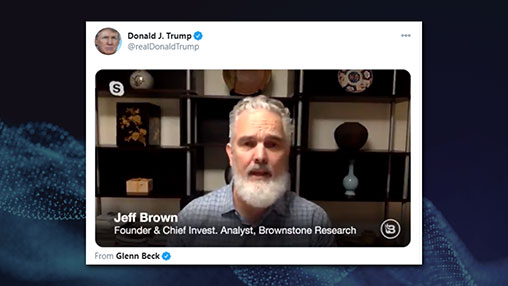
| By Tom Dyson, Editor, Postcards From the Fringe In 1998, Wall Street bailed out a hedge fund. In 2008-2009, the government bailed out Wall Street. In 2020-2021, who bails out the government? This is the easiest way to understand what’s happening… In 1998, a big hedge fund called LTCM blew up. It had borrowed such extraordinary amounts of money from various banks, its collapse threatened to bring down the whole banking system. So a cabal of Wall Street banks clubbed together and bailed out LTCM. They averted the crisis. In 2008, Wall Street blew up. Bear Stearns, Lehman Brothers, and a bunch of other big banks collapsed when their bets on subprime loans went wrong. It threatened to bring down the whole banking system. So the government stepped in. Acting in concert with the Federal Reserve, it bailed out the whole of Wall Street. This averted the crisis. | Recommended Link | | Trump Tweets About Tech Expert Jeff Brown
After he was banned from Twitter, Donald Trump’s retweet of Jeff Brown’s appearance on the Glenn Beck Show disappeared forever. But Jeff Brown’s new presentation explaining his thoughts on the “Great Reset,” and what it means for ordinary Americans, can still be seen for now. | | | -- | In early 2020, the government was $23 trillion in debt and was running a trillion-dollar budget deficit. Plus, it had a $100 trillion pile of bills (off-balance-sheet entitlements) to pay, stretching into the future. A recession arrived (fueled by the COVID-19 pandemic), impairing the government’s tax revenues, while also triggering a series of fresh trillion-dollar bailouts… The Treasury is now in the most stretched financial position of any entity in history… And it’s entering the exponential stage of the bankruptcy process, where it can only service its existing debt by adding more and more new debt. So who bails out the Treasury? [Featured: Where America Goes From Here (It's a Nightmare)] The Only Way Out There is only one way to rescue the government. That’s devaluation of the dollar. Devaluation is a way to reduce the real value of the government’s debt (and everyone else’s, too). It’s the only remaining way to bail out the system. Devalue or die. I know currency devaluations only happen in undeveloped countries, and no one believes it could happen here. I know U.S. government borrowing costs are still near their lowest levels in history, and no one seriously entertains the idea that the U.S. government could be broke. I know everyone’s focused on lockdowns, small business failures, and the deteriorating unemployment situation. So I know this sounds crazy. But I’m certain about this… | Recommended Link | | Jeff Clark has done the impossible He's found a way to take a seemingly boring stock… and use it to potentially generate thousands – or even tens of thousands of dollars – EVERY MONTH… Without doing anything crazy or complicated. Check out the details right here – including the name and ticker of this stock. | | | -- | Devaluation is the ONLY path left to bail out the government from bankruptcy. And they’ve already decided to pursue this path… You can see this in the price of the U.S. dollar over the last nine months. And you can see the first signs of this in the stock market, commodities markets, real estate markets, and cryptocurrency markets, as prices start to “pop” like popcorn. [Featured: Hidden Time Bomb in Your Brokerage Account?] Protect Your Wealth Against Devaluation This is just the beginning. When the market fully absorbs what’s happening, I predict a thunderous stampede of capital will leave the currency and bond markets and charge into the stock markets and other real assets. The next indicator to flash will be rising consumer prices. It’s not flashing yet, but it will soon… We’ll see stagflation because the currency devaluation won’t produce real economic growth. It will only devalue the dollar, other currencies, and things that are claims on currencies (loans) relative to anything backed by real assets. What to do about all this? U.S. dollars and bonds are the worst things you can hold. They’re effectively guaranteed to lose purchasing power. Stocks are harder to predict. Some stocks should do okay, as they’re claims on real, hard assets. I prefer industrial or commodity businesses, and I like international stocks. That’s because they’re much cheaper than U.S. stocks and pay better dividends. I’m staying away from U.S. stocks… especially the most popular ones. Finally, I like gold and silver for maintaining the purchasing power of our savings during the devaluation… Regards, Tom Dyson, Editor, Postcards From the Fringe P.S. No one is saying the U.S. government is bankrupt. But it is. If the Federal Reserve hadn’t monetized its debt last year (and continued this year), the government would have defaulted on its obligations. It’s in a position where the only way it survives is through bailouts. That’s a blow-up. I saw something like this coming back in 2018. So I moved to the sidelines in gold and silver – to protect and grow my family’s nest egg over the next decade. And it’s not too late yet for anyone who wants to do the same. I’ve put together a model portfolio, including percentage allocations for the ideal precious metals portfolio… as well as the 11 gold stocks I recommend today. Learn more here.
Like what you’re reading? Send your thoughts to feedback@rogueeconomics.com.
Get Instant Access Click to read these free reports and automatically sign up for daily research. | 





Tidak ada komentar:
Posting Komentar