Sabtu, 20 Februari 2021

3 Ways to Go Broke in the Stock Market

 View this email in your browser
Welcome to StockUp, the investing newsletter that’s wearing, like, three sweaters and two pairs of socks right now. This week, three really excellent ways you might lose a lot of money in the stock market, and one far more sensible alternative. Plus, a surprising and unexpected stock that could benefit from COVID-19 vaccines; why Elon Musk’s big promises for satellite internet run headlong into obstacles like “science” and “math;” and a video interview with Tom Gardner about where The Motley Fool's co-founder thinks the market's headed in the next 10 years.
— Nathan Alderman, StockUp Editor
MONEY MASOCHISM

3 Ways You Might Go Broke in the Stock Market


What’s the next best thing to making money in the stock market? Not losing it. Unfortunately, bad investing decisions are far easier to make than good ones. Fool Katie Brockman has corralled three colossal, catastrophic strategies that can hasten your path toward investing ignominy. 

  1. Investing all your money in a single stock. In hindsight, it’s easy to look at massive winners and wish you’d shoved all your eggs into that particular basket. But we advise diversification for a reason. Stock market successes only seem obvious in hindsight, and plenty of companies that promise bright futures go on to flame out spectacularly. Hedging your bets across different companies and industries can keep one bad guess from torpedoing your entire financial future. 
  2. Trying to get rich quick. Say it out loud. Write it on a convenient Post-it note. Hang it in a giant frame on your wall. Tattoo it backwards on your forehead. THERE ARE NO SHORTCUTS. Throw money at risky, volatile companies in hopes of a rapid gain, and you’re likely to end up empty-handed. 
  3. Listening only to your gut. In the stock market, research beats instincts almost every time. We don’t generally like things because we’ve carefully considered their various facets and weighed their pros and cons. We like things because we like them. This approach might work well in helping you figure out where to eat lunch, but in investing, it could blind you to flaws that might leave you ruing your decision to dole out dollars. 

So if these three are no-nos, what should you do instead? We’ll share a simple, slow-and-steady strategy that still makes sense when you read the rest


Already subscribed to a premium service? Click here to view your subscriptions. Not a member yet? Click here to sign up!


JARGON DECODER

Money Laundering

They don’t call it “Wall Street” for nothing; the big banks there build bigger barriers of baffling terminology to keep regular Fools like you intimidated, underconfident, and ready to fork over your cash to a broker. Each week, Jargon Decoder translates one of those worrisome words or phrases into plain English, helping you get a leg up on the Wall Street Wise. 

This week’s term: The wash-sale rule. Uncle Sam prevents people from scoring dishonest tax breaks by making it illegal to sell a stock at a loss, use that loss to offset taxes on other gains, and then buy back the same stock within 30 days. 

As tax season approaches, you’re probably looking for every legal loophole to lower what you owe the government. You probably already know that if you lose money when you sell a stock, you can use the amount you lost on that transaction to cancel out equal gains from buying low and selling high. 

A quick example: You buy 10 shares of Stock A at $35, and later sell them at $10. You’ve lost $25 per share, or $250 total. In the same year, you buy 10 shares of Stock B at $25, and later sell at $85, netting a $60-per-share profit, or $600 total. The IRS allows you to offset your $600 gain with your $250 loss, so that you only owe taxes on a total of $350. 

Ah, but what if you try to game the system? What if a stock you like and plan to hold for a long time just happens to be down at the moment? Why, you could sell it for a loss, wipe out at least a chunk of your gains, then buy back those shares right away, at essentially the same price. Your holdings wouldn’t have changed, but you’d have weaseled your way into a cunning on-paper tax break. The whole thing, as they say, would be a wash. (Hence the name.)

Except, of course, you can’t do this. Uncle Sam is wise to your tax shenanigans, and like the current president, he maintains a strict “no malarkey” policy. You can’t buy AND sell the same stock, in the same amounts, within 30 days, and count any losses off your tax bills. And if you sell a stock at a profit, then buy the shares right back, you’ll still pay taxes on the entire profit, too. 

To avoid having the IRS take you to the cleaners, learn more about the wash-sale rule


BROWN CAN DO A LOT, APPARENTLY

1 Surprising COVID Vaccine Stock The Market Might Be Missing

We’ve all understandably been so focused on the development of vaccines to fend off COVID-19 that we probably haven’t thought as much about how to get those elixirs into people’s arms. But as Fool Daniel Foelber notes, United Parcel Service (NYSE: UPS) has. It’s been going all Auguste Rodin on that very dilemma, and the careful planning and preparation it’s put into the problem could be poised to pay off prodigiously. 

UPS isn’t the only company to have profited from the pandemic-spawned push for plentiful parcels. But its 15 years of experience in specifically distributing medicine and vaccines left it particularly well-placed to help with COVID-19 vaccines. It’s landed deals to ship the Pfizer (NYSE: PFE) and Moderna (NASDAQ: MRNA) vaccines, but its efforts don’t end there. 

For example: Shippers need dry ice to keep vaccines cold and effective -- in some cases, really cold. UPS knew that vaccines would drive up dry ice demand and shrink its supply. So the company fortified its ability to make its own dry ice, and forged a partnership with a manufacturer to stockpile portable, super-cold freezers. And its shipping network’s already set up to monitor temperatures of the products it ships and ensure they reach their destinations on time.

To see how UPS’s efforts compare to rival FedEx (NYSE: FDX), and discover what to watch for to see how UPS fares going forward, read the rest


ALEXA, WE'RE GETTING HOW MUCH SNOW?
Smart Speaker

Not sure what to ask your smart speaker? Keep up with what's happening in the market by asking your Amazon Alexa or Google Home to "Play Motley Fool podcasts."


OH, VIDEO, WE MISSED YOU SO MUCH

Tom Gardner on How to Beat the Market in the Next 10 Years

Screenshot of a Youtube video with Dave Lee on the left and Tom Gardner on the right. Overlayed is a play button.

Dave Lee on Investing interviews Motley Fool co-founder Tom Gardner about his investing philosophy, how The Motley Fool has been able to beat the market, and what strategies will work over the next decade.


ELON-GATING THE TRUTH

Elon Musk Predicted Starlink Would Generate $30 Billion in Revenue. We're Not So Sure.

Wait, wait, wait. You’re telling us that Elon Musk -- shy, modest Elon Musk, the humble and publicity-averse founder of Tesla (NASDAQ: TSLA) and SpaceX -- made a public pronouncement that might have been wildly exaggerated? No way

But seriously, Fool Rich Smith notes that Starlink, Musk’s ambitious plan to blanket the earth in satellite-provided internet access (as opposed to his ambitious plans to reinvent the auto industry, or solar power, or rocketry, or public transit, or…) may fall far short of the financial goal that Musk set for it in 2017. According to internal documents from the time obtained by The Wall Street Journal, Musk aimed to have Starlink bringing in a whopping $30 billion-plus in annual revenue for SpaceX by 2025. 

Starlink’s made incredible progress in the six years since Musk first announced it. Last October, it surpassed 800 satellites in orbit -- enough to start offering some kind of service to some parts of the world. It’s kept adding to that figure since, one rocket launch and 60 new satellites at a time. By the end of the year, Starlink will be able to provide internet service to essentially the entire planet. 

So what’s the problem? Bandwidth. Each satellite can only transmit so much information at one time. And by 2025, Starlink will still only be halfway to its target goal for satellite coverage. Rich did the math, and he’s discovered that even at the company’s relatively modest initial data speeds, and even if you give the company every conceivable benefit of the doubt, maxing out its network and customer count would still only yield roughly $10 billion in revenue. 

But wait, the outlook gets even worse! Starlink’s a tremendous accomplishment, yes, but not as tremendous as Musk might want us to believe. Watch Elon’s dreams crumble one simple calculation at a time when you read the rest


DISNEY, DAVID, DIGITAL DATING

FEATURED PODCAST

Motley Fool Money

Disney's New High, Bumble's IPO, and Motley Fool Co-founder David Gardner

Disney (NYSE: DIS) hits an all-time high as Disney+ reports 95 million subscribers. (This is the way.) Dating app Bumble (NASDAQ: BMBL) surges 70% in its Wall Street debut. (This is the heyyyyyyyy.) Motley Fool analysts Emily Flippen and Jason Moser discuss those and other stories, and Motley Fool co-founder David Gardner shares his thoughts on Amazon’s next CEO, Jeff Bezos’ second act, and how today’s stock market compares to the one 20 years ago.

Subscribe on iTunes

THE FIRST $50 MILLION IS FREE

Quick Reads


CRYPTO 'GRAM

Social Media Post of the Week

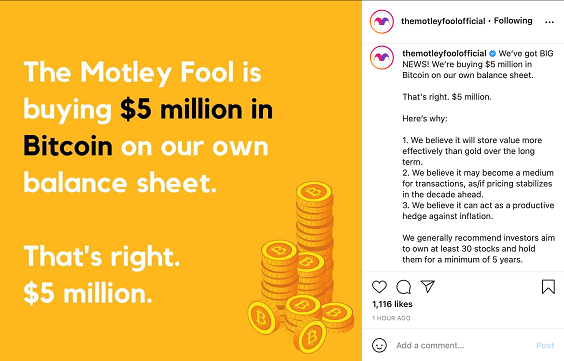
Image: The Motley Fool is buying $5 million in Bitcoin on our own balance sheet. That's right. $5 million. Caption: We've got BIG NEWS! We're buying $5 million in Bitcoin on our own blanace sheet. That's right. $5 million. Here's why: 1. We believe it will store value more effectively than gold over the long term. 2. We believe it may become a medium for transactions, as/if pricing stabilizes in the decade ahead. 3. We believe it can act as a productive hedge against inflation. We generally recommend investors aim to own at least 30 stocks and hold them for a minimum of 5 years.
See all our Instagram posts!
Join the 1,300,000+ people who follow us!
Facebook
Twitter
Instagram
YouTube
LinkedIn
 
We work fervently, fastidiously, and Foolishly to make sure all the facts and figures we publish in our emails are 100% accurate and up to date. Returns as of February 17, 2021.

Have a question or topic you'd like to see covered in a future edition of Stock Up? Email us at stockup@fool.com.
For questions about your Motley Fool account, subscriptions, or anything else related to The Motley Fool, please email membersupport@fool.com

Our mailing address is:
The Motley Fool | 2000 Duke St. | Alexandria, VA 22314

Want to change how you receive these emails?
You can update your preferences or unsubscribe from this list.

This is a promotional message from The Motley Fool
Copyright © 1995-2021 The Motley Fool. All rights reserved. Legal Information.

Tidak ada komentar:

Posting Komentar