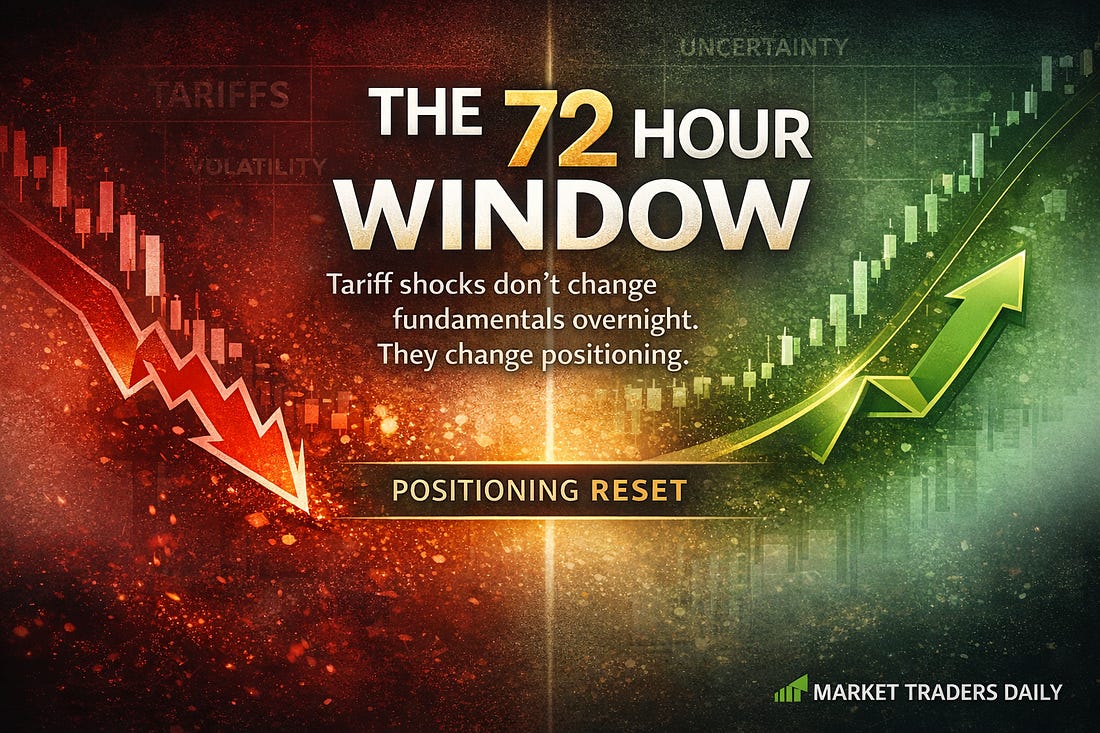
The 72 Hour WindowTariff shocks do not change fundamentals overnight, but they do change positioning
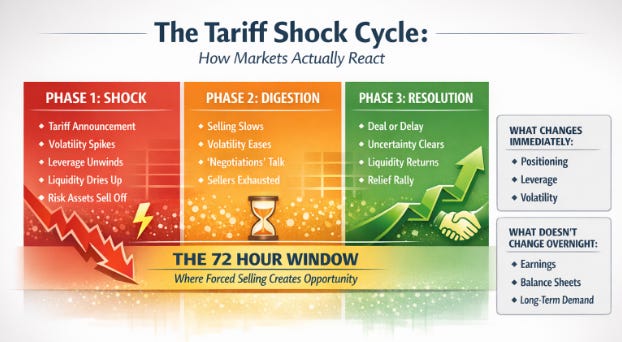
There is a familiar moment in every tariff scare. A headline hits. Futures gap lower. Crypto starts bleeding before the opening bell. Social feeds fill with confident explanations about what this “means for the economy.” By the time markets open, fear has already been priced in. And almost every time, investors are told the same story: tariffs change everything. They do not. At least not overnight. What tariff shocks do change immediately is positioning. And in modern markets, positioning matters long before anyone updates a discounted cash flow model. That is the difference most investors miss. And it is where a repeatable opportunity often appears. Tariffs Do Not Break Earnings Models in a WeekendTariffs are not instantaneous economic events. They are policy tools that unfold over time. Negotiations happen. Exemptions appear. Deadlines get extended. Enforcement dates shift. Supply chains adjust slowly, not in a single trading session. Corporate earnings do not collapse in 72 hours. Yet markets frequently react to tariff headlines as if the entire economic outlook has been rewritten before Monday morning. The reason is not valuation. It is risk management. Modern markets are dominated by capital that responds to volatility first and explanation second. When uncertainty spikes, those systems do not pause to debate policy outcomes. They reduce exposure. That is why tariff shocks tend to feel sudden, violent, and emotional. They collide directly with leverage. Why Timing Feels So Important (And Why It Is Not the Point)Many tariff headlines land late on Fridays or over the weekend. When markets are closed, anxiety builds without price discovery. By the time futures reopen, everyone reacts at once. That can exaggerate the move. But midweek announcements can be just as disruptive. In some cases, more so. When uncertainty hits during active trading hours, it runs straight into live risk limits, intraday volatility controls, and margin requirements. The calendar is not the driver. The uncertainty is. The common factor is simple. Tariffs introduce unknowns around size, timing, retaliation, and enforcement. Markets price those unknowns immediately, long before they price actual economic impact. Phase One: The Mechanical FlushThe first leg of a tariff shock rarely reflects thoughtful analysis. It reflects forced behavior. As volatility rises, a chain reaction begins: Volatility targeting strategies reduce exposure. This is not panic in the emotional sense. It is protocol. When enough capital is governed by the same rules, selling becomes fast and indiscriminate. Strong companies fall alongside weak ones. Large caps fall with small caps. Liquid assets sell first because they can. The market looks irrational because it is not thinking yet. Why the First Selloff Is Often OverdoneHere is the disconnect. Tariffs do not hit GDP immediately. They do not instantly destroy profit margins. They do not rewrite balance sheets in real time. But uncertainty does force repositioning in real time. That creates a gap between price movement and fundamental reality. Prices fall not because earnings have changed, but because capital structures are being reset. This is not always a buying opportunity. Sometimes tariffs escalate and lead to genuine economic repricing. But in the early stages, especially in the first 48 to 72 hours, markets are often pricing uncertainty rather than outcomes. That distinction matters. Phase Two: When the Narrative ShiftsAfter the initial flush, something subtle changes. Headlines stop sounding apocalyptic and start sounding procedural. Words like “negotiations,” “framework,” “constructive talks,” and “implementation timelines” begin to appear. Officials emphasize process. Deadlines feel less absolute. Volatility often peaks before prices do. Selling slows, not because everyone is suddenly bullish, but because forced sellers have finished reducing exposure. Liquidity begins to return. Markets start to breathe again. This is where most investors are still frozen, waiting for clarity. Phase Three: Resolution and ReliefResolution does not always mean a full deal. Sometimes it is a delay. Sometimes exemptions. Sometimes a phased rollout. Sometimes a partial agreement framed as progress. What matters is not perfection. What matters is that uncertainty collapses. When unknowns become known, markets reprice quickly. Not because tariffs disappeared, but because investors can finally assess risk again. Relief rallies are not celebrations. They are recalibrations. The 72 Hour Window Is Already Open
This is not a theory. It is not a warning about something that might happen. It is already happening. Over the weekend, tariff threats reentered the market narrative. Futures sold off. Risk assets repriced lower. Crypto absorbed the pressure first, as it always does when global uncertainty spikes. Nothing material changed about earnings power between Friday’s close and Sunday night’s open. What changed was positioning. Capital that had grown comfortable with low volatility was forced to react. Exposure was reduced. Liquidity thinned. Leverage was cut back. This was Phase One. What the Market Just Told UsThe selloff we just saw was not a judgment on long-term economic damage. It was a reset. Markets moved lower because uncertainty was injected suddenly, not because fundamentals deteriorated suddenly. That distinction matters because it tells you how to respond. When positioning resets, price overshoots reality. Not forever. Not always dramatically. But often enough to matter. The market has already done the hard part. It flushed leverage. What comes next is not about fear. It is about digestion. Where We Are in the Cycle Right NowWe are no longer at the headline. We are in the window immediately after it. This is the period where:
That is the moment professionals pay attention. Not because they suddenly feel bullish. But because uncertainty has already been priced faster than outcomes can unfold. How to Apply This in Real TimeThe goal right now is not prediction. It is preparation. Here is how disciplined investors think about the current environment. Step One: Recognize the Event for What It IsThis was not an earnings-driven selloff. It was a headline-driven uncertainty shock. Those events tend to resolve faster than they appear in the moment. Step Two: Accumulate, Don’t ChaseThis is not the time to rush in all at once. It is also not the time to wait for certainty. Certainty arrives after positioning resets. By then, prices have already moved. The approach is controlled accumulation. Start with small exposure into weakness. Leave room to add. Expect volatility to remain elevated for a few sessions. This is not about picking a bottom. It is about building exposure while others are still reacting emotionally or mechanically. Step Three: Watch the Right SignalsThe next move will not be dictated by headlines alone. Watch for:
These are signs that Phase One is ending. Step Four: Let the Market ConfirmThe final add does not come from a tweet or a quote. It comes when price reclaims levels that were lost during the panic. That is the market signaling that forced selling is done and risk can be reintroduced. What This Is NotThis is not a call that tariffs will disappear tomorrow. It is a recognition that markets consistently overreact to uncertainty shocks before information has time to settle. That creates opportunity for those who understand structure instead of narratives. The Mistake to Avoid Right NowThe worst response is paralysis. Waiting for “clarity” feels prudent, but clarity comes after the market has already repriced. The second worst response is aggression without discipline. Going all-in during peak volatility turns a structural edge into a gamble. The advantage lives in between. Tariffs did not change the economy over the weekend. They changed positioning. That adjustment is already underway. The investors who benefit will not be the ones arguing about politics or predicting deals. They will be the ones quietly accumulating exposure while uncertainty is being priced faster than reality. The 72 hour window is not coming. It is open now. How We’re Positioning Inside the 72 Hour WindowThis section is for premium members only. The market has already reacted to the tariff headline. What we are seeing now is not a debate about fundamentals. It is a reset in positioning. As of the open, broad market exposure was already down materially from recent highs. That move was driven by uncertainty and forced de-risking, not by a sudden deterioration in earnings power. That creates an opportunity, but only if it is approached with structure. At this point, the discussion shifts to how we’re actively positioning around it. Scroll down to continue. Get the Playbook. Follow the Signals. Stay Positioned. When you become a premium Insider Alerts member, you don’t just read about market dislocations. You get the step-by-step playbook for how we’re navigating them in real time. That includes:
This is not about reacting to headlines. It’s about following disciplined signals while others are still guessing. Continue reading this post for free in the Substack app
|
Rabu, 21 Januari 2026
The 72 Hour Window





Langganan:
Posting Komentar (Atom)
Tidak ada komentar:
Posting Komentar