The Elevator vs. the Stairs |
Every investing cycle teaches the same lesson — just with new names. |
When Amazon went public, it felt early. In hindsight, it wasn't. Most of the exponential value had already been created before public markets ever had access. |
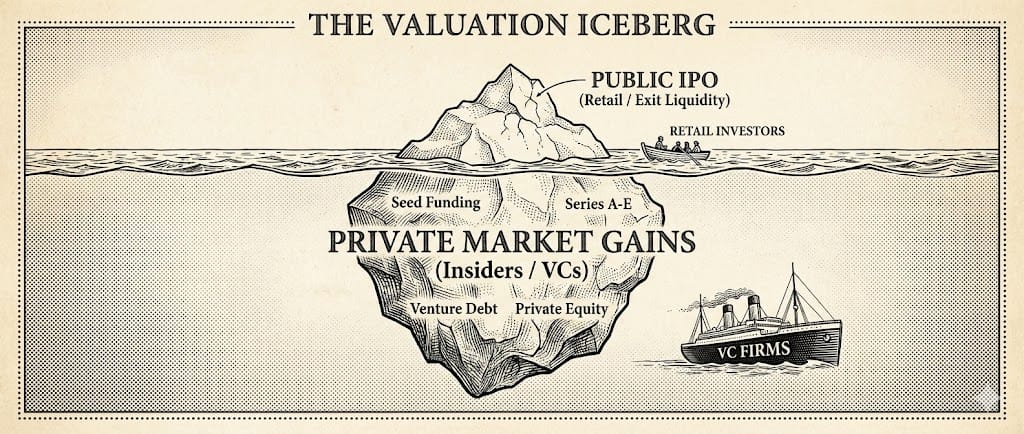
With Uber, the pattern became impossible to ignore. Venture capital absorbed years of risk and upside privately. Public investors arrived when the curve flattened. |
That wasn't bad timing.
That was structure. |
Why 2026 Makes This Impossible to Ignore |
This week, Reuters and the Financial Times reported that SpaceX is actively weighing an IPO as early as June 2026 — at a valuation discussed as high as $1.5 trillion. |
If it happens, it would be the largest IPO in history.
But the most important detail isn't the size. |
It's that the value isn't about to be created.
It's already been captured. |
SpaceX has spent years compounding privately while risk was highest and growth steepest. An IPO, if and when it comes, will be designed to distribute ownership — not manufacture early-stage upside. |
That's the quiet shift most investors still underestimate. |
How Modern Capital Really Works |
Over the past two decades, companies have stayed private longer, raised more money off-market, and delayed public listings. |
Public markets now serve a different role: |
|
Not discovery. |
Private capital absorbs uncertainty. Public capital absorbs maturity. Once you see that clearly, frustration gives way to strategy. |
Where Public Investors Still Have Leverage |
Here's the part that gets missed. |
You don't need access to private shares to benefit from private growth — if you understand dependencies. |
Large private companies don't build alone. They rely on suppliers, contractors, and infrastructure partners whose economics are contractually tied to expansion itself. |
Those relationships exist before any IPO prospectus appears. |
That's why, even before SpaceX files anything publicly, shares of companies tied to satellite infrastructure and telecom backbones have already begun reacting to the news, according to Barron's. |
This isn't speculation.
It's structural exposure. |
The Mental Shift That Changes Outcomes |
Retail investors are trained to think in tickers and headlines. |
Institutions think in: |
contracts guaranteed demand locked-in relationships
|
That difference explains why the same event produces wildly different results depending on where you stand in the capital stack. |
The system isn't "rigged" in an emotional sense.
It's engineered. |
Once you understand the engineering, the map changes. |
|
|
|
A Calm Conclusion |
The biggest investing mistake isn't missing an IPO. It's assuming opportunity disappears when access is restricted. |
In reality, it just moves one layer deeper — into supply chains, contracts, and incentives most people never look at. |
The elevator still exists. You just won't find it on the front page. |



Tidak ada komentar:
Posting Komentar