Washington promised this wouldn't happen until 2030.
They were wrong.
The $37 trillion debt bomb has already exploded — years ahead of schedule.
Every tick higher means higher interest rates, more inflation, and deeper cuts to Social Security and Medicare. It means the dollar in your pocket buys less and less… while your taxes quietly rise.
History shows what happens when nations drown in debt: savings may be eroded, currencies pressured, and ordinary citizens bear the burden.
And yet, the media barely talks about it.
In my new briefing, I expose the so-called "safe havens" that are turning into traps — and reveal the hidden plays built to withstand the Age of Chaos. 👉 Click here now to see the urgent briefing — before the $37 trillion debt bomb ignites the full Age of Chaos | | | | Today`s special bonus sponsored by InvestorPlace Media |
|
|
|
| Hey there! You're reading The Budget Analyst — a calm space in the noise of markets.
Here we collect signals, patterns, and quiet insights that help you see the bigger picture.
No rush, no hype — just clarity for your financial journey. | | | | In partnership with Brownstone Research. |
|
|
|
| | | | | Walk into a Tier 1 hyperscale facility in Northern Virginia today, and the first thing you notice isn't the noise. It is the heat. | It is a thick, physical presence—the thermodynamic exhaust of a trillion dollars in capital expenditure burning to process the world's data. For the last three years, the market has been obsessed with the engine of this heat: the GPU. The "Brain." | We have watched the headlines scream about processing power, floating point operations, and the sheer speed of calculation. But if you look past the racks of blinking lights and peer into the floorboards, you see a different story emerging. | The bottleneck has shifted. | We are no longer limited by how fast the chips can think. We are limited by how fast they can talk to each other. | This is not a tech story. It is a structural shift in the physics of computing. | From 2023 to late 2024, the race was about individual intelligence—building a faster Einstein. But as we close out 2025, the game has quietly pivoted to collective intelligence—building a faster telepathy. | The capital allocators who understand this shift are no longer just looking at the processor. They are looking at the plumbing. |
| |
| | |
| | | | | The Thermodynamics of Friction | For a long time, the math was simple. You bought a faster chip, you got a faster result. | That linear relationship is breaking down. | When you chain 10,000 GPUs together to train a model like GPT-6, the individual speed of a single chip becomes irrelevant if it spends 40% of its time waiting for data to arrive. This is the "interconnect barrier." | Think of it like building a Ferrari engine and placing it in downtown Manhattan traffic. The engine is capable of 200 mph. The infrastructure allows for 12 mph. | The utility is lost to friction. | This is why the recent moves around NVLink 6 and the Blackwell architecture are not just product updates. They are attempts to rewrite the laws of digital logistics. | We are seeing a move from "compute-centric" to "network-centric" design. The value is migrating from the core to the edge—to the switches, the optical cables, and the proprietary interconnects that bind these silicon brains together. | It is a quiet crisis. | Engineers call it "latency." Investors should call it "inefficiency." | If you cannot solve the plumbing, the $40,000 chip is just an expensive space heater. The companies that are solving this—removing the friction between the nodes—are effectively printing efficiency. | And efficiency, in a high-rate environment, is the only metric that matters. | Jensen Huang's Shocking Announcement | | NVIDIA's revolutionary new invention just solved the #1 chokepoint that's been strangling big AI companies. | And Tech legend Jeff Brown — the Silicon Valley insider who called NVIDIA before it skyrocketed more than 30,000%... | ... says a shocking announcement by NVIDIA CEO Jensen Huang could make a lot of early investors rich. | | The New Utility Layer | We need to reframe how we view these systems. | Stop thinking of them as "computers." Start thinking of them as "utilities." | In the 1880s, the money wasn't just in the lightbulb; it was in the copper wire that brought the current to the socket. Today, the "current" is data, and the "wire" is the complex mesh of optical and ethernet fabrics holding the data center together. | This is the invisible grid. | The introduction of platforms like Spectrum-X signals a regime change. It suggests that standard Ethernet—the generic plumbing of the internet for thirty years—is no longer sufficient for the violent demands of AI workloads. | We are witnessing a bifurcation. | On one side, you have the public internet: slow, robust, general-purpose. | On the other, you have the "AI Fabric": private, hyperspeed, specialized. | This second layer is where the capital is flowing. It is a closed loop of high-fidelity data transfer. It is a toll road where the only currency is speed. | When institutions look at Blackwell, they don't just see a chip. They see a unified platform that forces a total rewrite of the data center's nervous system. | This implies a massive, silent capex cycle that has nothing to do with buying more GPUs. It has everything to do with ripping out the old wiring and installing the new nervous system. | It is unglamorous. It is invisible. And it is absolutely critical. |
| |
| | |
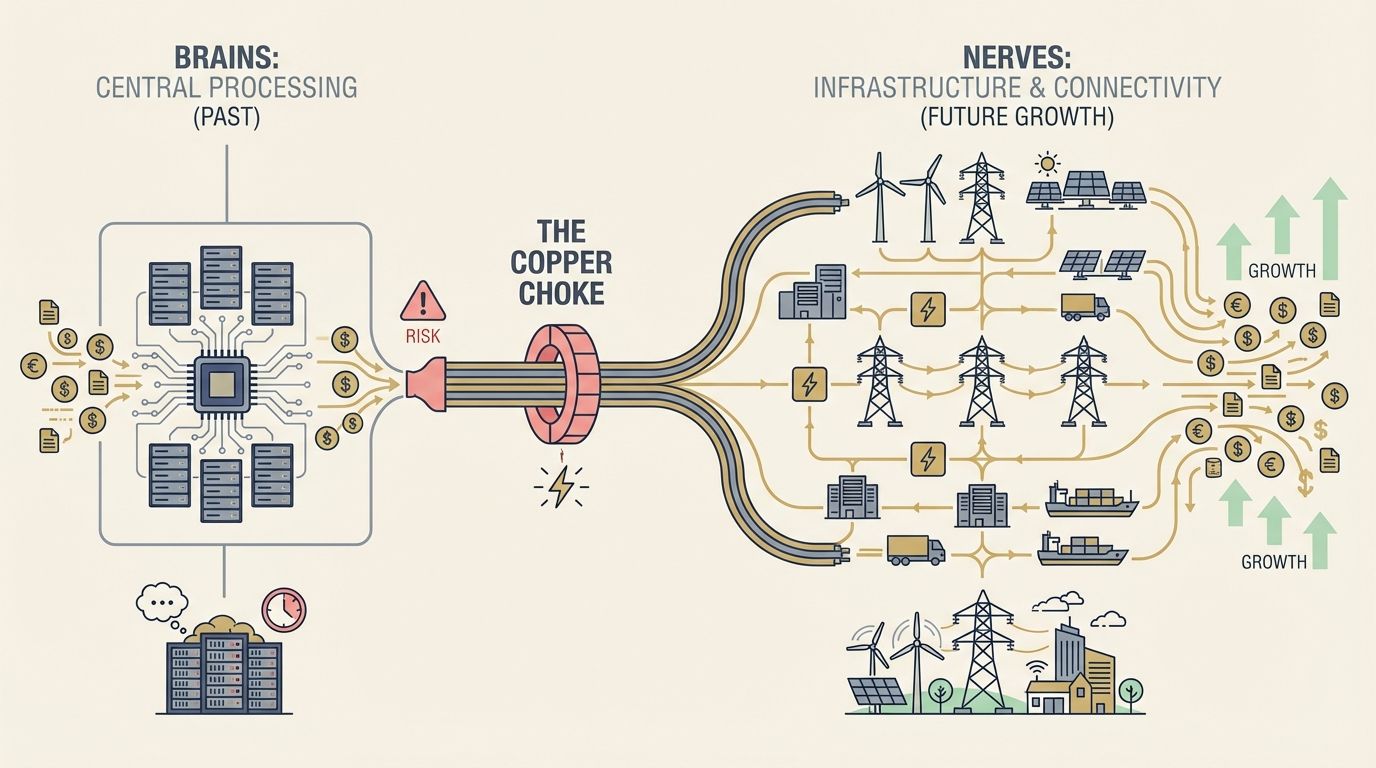
| | | | | The Capital Rotation | Let's look at the numbers. | The projection for data center infrastructure spending through 2030 is currently hovering around $1.8 trillion. | The retail market assumes this money goes to the chipmakers. But a significant percentage—perhaps as high as 30%—is earmarked for "connectivity and thermal management." | That is a massive, underreported pool of capital. | While the headlines focus on the "Brain" (the logic processors), the smart money is quietly accumulating the "Nerves" (the interconnects). | Why? Because the "Brain" is subject to fierce competition. Everyone is designing a chip. Amazon, Google, Meta—they all have their own silicon now. | But the "Nerves"? The physics of moving photons and electrons across a server rack without losing signal? That is a much harder moat to cross. | We are seeing a convergence of networking and computing. | In the past, these were separate departments. The server guys didn't talk to the network guys. Now, with architectures like Triton Inference Server streamlining deployment, the hardware and the network are becoming a single, fused organism. | You cannot buy one without the other. | This creates a "lock-in" effect that is incredibly powerful for the incumbents. If you use the chip, you must use the cable. If you use the cable, you must use the switch. | It is the ultimate utility model. | | The Signal for 2026 | o, where does this leave us as we look toward 2026? | We are entering a period of "infrastructure digestion." The initial frenzy of chip buying is settling into a more calculated phase of system building. | The winners of the next cycle won't just be the ones with the fastest raw math. They will be the ones who can move data through the system with the least amount of friction. | Friction is the enemy of scale. | Watch the "boring" companies. Watch the firms making the optical transceivers, the advanced ethernet switches, and the proprietary link cables. | They are the ones laying the rails for the next leg of the journey. | The market is noisy. It screams about AI sentience and robot butlers. But if you sit quietly and watch the flow of capital, you see the truth. | The money is moving into the plumbing. | It is moving into the invisible architecture that makes the magic possible. | That is where the signal is. |
| |
| | |
|  | | | Brownstone Research | |
|
|
|
|
|
| | The AI bottleneck has shifted. Where do you think the real constraint is now? | | (Thank you for reading, thinking, and staying curious through all of it.) | — Claire |
|
| The framework thousands of teams use daily | | Organizations worldwide are adopting Smart Brevity to move faster with clearer comms. This free 60-minute session shows you how the methodology works and how to start applying it immediately. | Join the next one | |
|
| |
|



Tidak ada komentar:
Posting Komentar