May 8, 2026
The Hidden Way to Play The $2T SpaceX IPO
Dear Subscriber,
 |
| By Michael A. Robinson |
At first glance, the state of Maine and rocket-pioneer SpaceX would seem to have little in common.
Maine, on the one hand, wants to grab its share of the New Space Race. But its space industry is still pretty nascent.
SpaceX, on the other hand, is the juggernaut of the space industry. It accounts for 60% of all global launches, including 95% of those from the U.S.
Surprisingly, though, Maine and SpaceX are two sides of the same AI coin.
You see, Maine just became the first state to enact a de facto ban on the building of new AI data centers.
The state took the measure because officials and residents were alarmed by the prospect of having energy-hungry data centers drive up their electricity rates.
Maine’s governor, Janet Mills, vetoed the legislation. But it’s probably not the last we’ll see of these kinds of bans.
Wouldn’t you know, these energy concerns are a big reason why Elon Musk is taking SpaceX public.
This IPO is projected to be worth $1.75 trillion, the largest IPO in history. And investors all over the world want to be part of it.
That’s why I want to focus on this pending IPO today.
I’ve discovered a hidden way to play Musk’s upcoming move.
That is, with a firm that’s integral to his success.
A Classic Bottleneck
Maine’s call to ban data centers was indicative of growing sentiment throughout the U.S.
The primary concern? That America’s digital boom is running headfirst into a physical limit.
That limit is energy.
You see, AI, cloud computing and modern tech all rely on massive data centers — warehouse-sized facilities packed with high-powered chips running 24/7.
These centers are multiplying fast.
And they’re all competing for the same finite electricity supply.
At the same time, the U.S. power grid — much of it built decades ago — simply can’t keep up.
The result? A classic bottleneck.
Electricity demand is surging. But supply isn’t scaling nearly as fast.
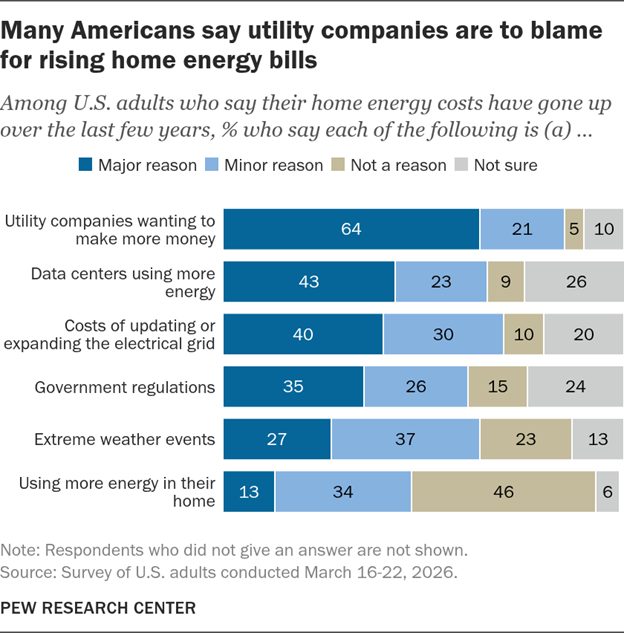
In fact, Americans have already seen electric bills jump more than 30% since 2021.
They attribute these bigger bills to utility companies, data centers and the aging electrical grid.
Utilities in major hubs like Northern Virginia — viewed as the data center capital of the world — are warning they can’t meet future demand without major upgrades.
More than 2,000 gigawatts of new energy projects are still waiting in line to connect to the grid. Many could take years to come online.
All of this was happening before the war in Iran created a global energy supply shock.
Now there’s even more pressure on the global markets.
I call this predicament as the “energy wall.”
What we’ve got is a mismatch: Demand is surging, while supply is lagging.
That’s the energy wall.
And it’s not a temporary issue.
It’s a structural bottleneck.
Unless it gets solved, it could slow the entire AI revolution.
What’s the Solution?
Some companies are restarting old nuclear power plants.
Some are trying to build new ones.
Others are seeking to lock in long-term energy deals.
But all these approaches run into the same problem:
They take years to scale.
AI doesn’t have years — it needs power today.
That’s why Elon Musk is asking a different question.
What if you didn’t need a grid at all?
That’s where outer space comes in.
Instead of building more data centers here on Earth, the idea is to move them into orbit.
Up there, satellites can tap into near-constant solar energy.
No fuel. No grid. No bottlenecks.
And unlike on Earth, where cooling systems cost billions, the vacuum of space naturally keeps equipment from overheating.
Simply put, space offers two things the AI industry desperately needs: unlimited energy and efficient cooling.
It may sound like science fiction. But it directly targets the biggest constraint holding AI back today.
If it works, it doesn’t just ease the pressure. It could completely knock down this energy wall.
The thing is, for Musk’s idea to become a reality, he needs the help of a company you might not be familiar with yet.
It’s a company that plays a key role in SpaceX already.
That’s because it’s been supplying it with chips for a decade.
And as Musk gears up to take SpaceX to the next level with a constellation of orbital AI satellites, this quiet leader is poised as the top company to play it.
I’ve prepared a special video presentation on this exact topic.
Watch to the end to see what other plays you should own for this upcoming IPO.
Best,
Michael A. Robinson






Tidak ada komentar:
Posting Komentar